Working More, Earning Less — The Algorithm Change Most Drivers Never Noticed That Is Costing Them Hundreds Per Month
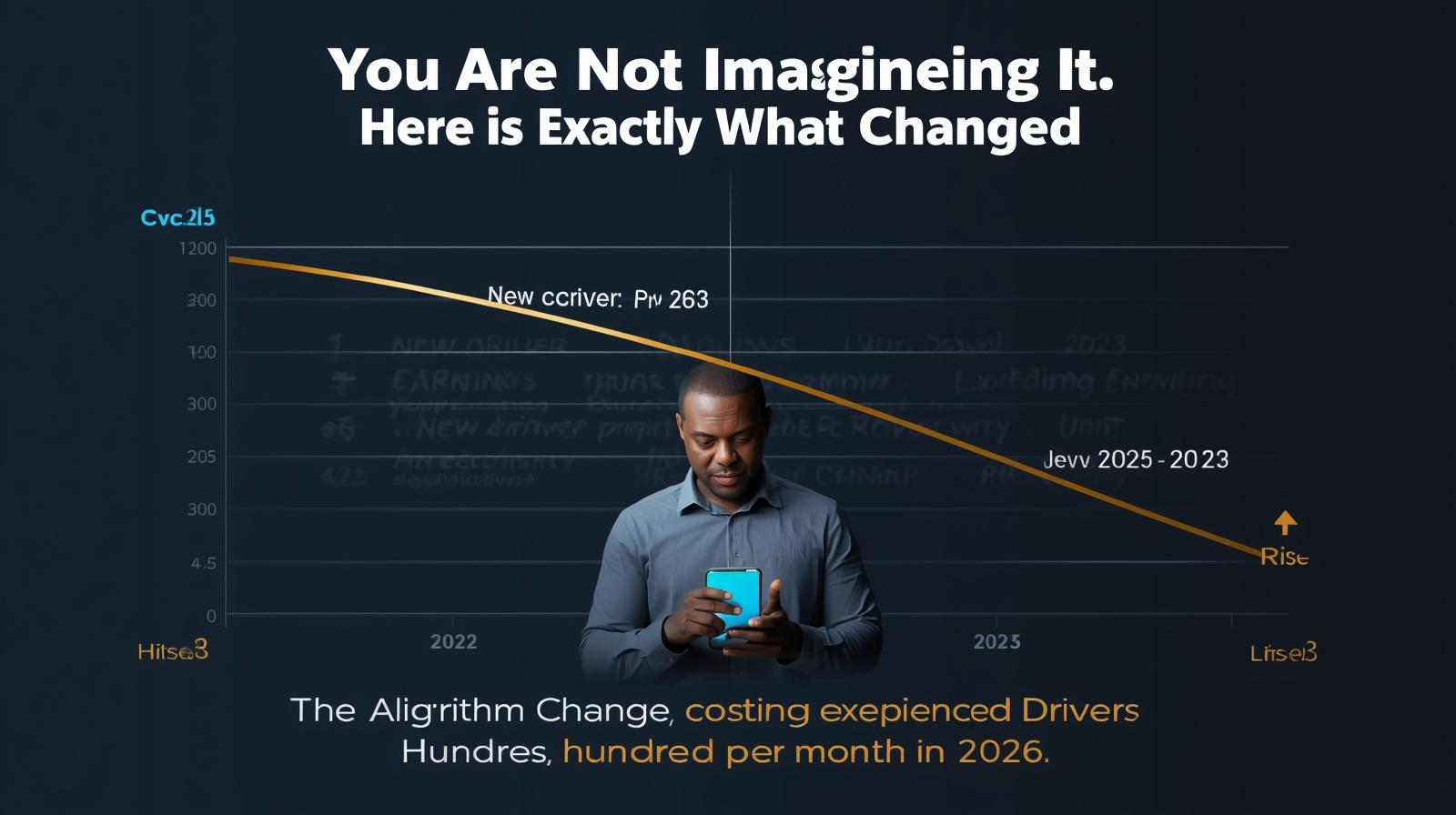
You Are Not Imagining It. Here Is Exactly What Changed and Why.
Something shifted. You felt it before you could name it.
Not dramatically. Not overnight. Gradually — the way water temperature changes in a pot you have been sitting in long enough that you stopped noticing the increments.
The waits between rides got longer. The surge windows that used to find you reliably started finding you less. The Monday morning that used to produce ten rides in five hours now produces seven. The Thursday evening shift that felt reliably productive started feeling like work to produce the same outcome it used to deliver without effort.
You drove more hours to compensate. The hours produced the rides. But the net result — the actual dollars deposited after fuel and time and platform fees — did not grow proportionally with the hours. Sometimes it did not grow at all.
You checked everything you could check. Your rating is strong. Your acceptance rate is within normal range. Your vehicle is maintained. You are in the right zones at roughly the right times. Nothing visible explains the gap between the effort you are putting in and the outcome you are getting back.
Here is what you could not see.
In 2026 rideshare algorithms prioritize coverage not tenure. Veteran drivers do not receive better pay or protection for experience. In some cases newer drivers are temporarily favored to keep them engaged. This creates a paradox where experienced drivers work more hours to maintain earnings while platforms continuously cycle in new supply. Loyalty is no longer rewarded the way many drivers expect. The Rideshare Guy
This is not speculation. This is documented platform behavior — the specific algorithmic logic that explains the gap you have been feeling without being able to name.
The algorithm that assigns your rides is not neutral. It is optimized for the platform's specific objectives. And in 2026 those objectives include something that directly conflicts with your interest as an experienced driver.
This article names it completely. Explains the specific mechanism. Quantifies the financial cost. And provides the specific strategic response that experienced drivers who understand what is happening use to stop losing the money the algorithm is taking from them.
The Algorithm's Actual Objective — What It Is Optimized For
To understand what the algorithm is doing to experienced drivers you first need to understand what the algorithm is actually optimized for — because it is not optimized for what most drivers assume.
Most drivers assume the platform's ride assignment algorithm is optimized to provide the best passenger experience — fastest pickup, highest-rated driver, most efficient route. This assumption is partially true and significantly incomplete.
The algorithm is optimized for platform marketplace health — a set of metrics that includes passenger experience but also includes driver supply retention, market coverage density, new driver engagement, and a dozen other variables that the platform manages simultaneously and that are sometimes in direct tension with each other.
Driver supply retention is where the veteran driver's problem begins.
A platform needs a continuous flow of new drivers entering the market to replace the drivers who exit — through burnout, through better opportunities, through the natural attrition of a gig workforce. If new drivers do not receive enough rides during their first weeks on the platform to feel that the income opportunity is real they exit before they become reliable supply contributors.
The platform's solution to this new driver retention problem is algorithmic — temporarily prioritizing new driver ride assignment to keep new entrants engaged during the critical early period when the income experience needs to feel positive enough to retain them.
In some cases newer drivers are temporarily favored to keep them engaged. The Rideshare Guy
The ride that a new driver receives in their first month — the ride that keeps them in the marketplace and contributing to coverage density — is a ride that a veteran driver did not receive. The veteran driver waited. The veteran driver drove to another zone. The veteran driver experienced the ride density reduction that the new driver's algorithmic preference produced.
Multiplied across every veteran driver in every market over every shift the aggregate effect is the income compression you have been experiencing without understanding why.
The Coverage Priority Shift — Why Your Market Knowledge Stopped Mattering
Beyond the new driver preference there is a second algorithmic shift that specifically disadvantages experienced drivers — the shift from demand-matching optimization to coverage-density optimization.
In the platform's earlier algorithmic approach ride assignment favored drivers who were well-positioned for demand — drivers whose market knowledge, shift timing, and zone selection put them in the right place at the right time. The experienced driver who knew that the business district produced reliable 7:30am rides and positioned accordingly was rewarded with consistently faster ride assignment.
In 2026 rideshare algorithms prioritize coverage not tenure. The Rideshare Guy
Coverage-priority algorithms assign rides with the objective of maintaining driver presence across all zones rather than concentrating assignments among the best-positioned drivers in the highest-demand zones. A driver in an underserved zone receives algorithmic priority over a more experienced driver in a well-served zone — not because the underserved zone driver will provide better service but because the platform needs coverage across the market to maintain response time metrics that affect passenger satisfaction scores.
This means that the market positioning intelligence you have spent months or years developing — the specific knowledge of which zones produce which ride types at which times — produces less algorithmic reward than it used to. The algorithm is partially redistributing ride assignments away from positioning accuracy and toward coverage uniformity.
The experienced driver's competitive advantage from superior market knowledge is being algorithmically compressed — not because the knowledge is less accurate but because the algorithm is optimizing for a metric that your knowledge does not directly serve.
The Financial Quantification — What This Is Actually Costing You
Understanding the mechanism is important. Knowing what it costs is urgent.
More hours behind the wheel do not automatically mean more money. In fact in many markets working more actually reduces hourly net earnings due to fatigue inefficiency and declining trip quality. The Rideshare Guy
The specific financial cost of the algorithm shift has two components — the direct income reduction from reduced ride assignment and the indirect cost of the additional hours driven to compensate for it.
The Direct Income Reduction
Consider a veteran driver who previously completed an average of 3.8 rides per active hour during their optimal shift windows. The algorithmic shifts described above — new driver preference and coverage redistribution — have reduced their ride assignment rate to 3.1 rides per active hour during the same windows.
The difference is 0.7 rides per active hour. At an average net fare of $11 per ride after platform fees the hourly income reduction is $7.70 per active hour.
Over a 35-hour active driving week the weekly income reduction is $269.50. Over a month it is $1,078. Over a year it is $12,936.
Not from working less. Not from declining ratings. Not from market deterioration. From the algorithmic shift that redistributed ride assignment away from experienced drivers and toward coverage uniformity and new driver engagement.
The Compensation Cost
David Crane a Chicago-area rideshare driver said he now earns about half of what he made when he started driving in 2018 despite spending far more time on the road. "I can be out there 12 to 16 hours a day. The money keeps going down but the work keeps going up." Block Club Chicago
The driver who responds to reduced ride density by adding hours is making a specific financial error — one that the algorithm's design effectively produces intentionally. More hours in a lower-density assignment environment means more fuel consumed, more vehicle depreciation incurred, and more cognitive depletion accumulated without proportional income recovery.
Working more actually reduces hourly net earnings due to fatigue inefficiency and declining trip quality. The Rideshare Guy
The veteran driver who extends their shift from eight hours to twelve hours to compensate for reduced ride density is not earning 50 percent more. They are earning perhaps 20 to 25 percent more in gross fares while consuming significantly more fuel, wearing their vehicle faster, and making lower-quality decisions in the final hours of an extended shift — decisions that affect acceptance rate optimization, positioning choices, and passenger interaction quality in ways that compound the income compression over time.
The Specific Algorithmic Behaviors Experienced Drivers Report
The research and driver community documentation of algorithmic behavior in 2026 identifies several specific patterns that experienced drivers report consistently across multiple markets.
The New Driver Ride Surge
New drivers in their first thirty to sixty days on the platform report higher ride density than they experience after the initial engagement period ends. Experienced drivers in the same markets during the same periods report lower ride density than they experienced before the market's driver supply grew to current levels.
The correlation is not coincidental. The algorithmic mechanism that produces both effects is the same new driver engagement priority that creates the paradox described above.
The Acceptance Rate Sensitivity Shift
The algorithm's sensitivity to acceptance rate has changed in ways that specifically affect experienced drivers who learned their acceptance rate optimization in an earlier algorithmic environment.
Veteran drivers do not receive better pay or protection for experience. The Rideshare Guy
The veteran driver who maintained a 75 percent acceptance rate through years of platform driving and experienced consistent ride assignment at that threshold is finding that the same 75 percent acceptance rate now produces a different algorithmic response — more frequent low-value ride assignments and less frequent high-value assignments than the same acceptance rate produced previously.
The algorithm is using acceptance rate data differently than it did when the veteran driver calibrated their acceptance rate strategy. The optimal acceptance rate threshold has shifted and the experienced driver's calibration has not kept pace.
The Quest and Streak Bonus Targeting
Mark Balentine said he finished the required trips for a quest bonus and his app confirmed it. But when the payout never arrived Uber told him the missing money was likely the result of a system glitch and that there was nothing the company could do. Block Club Chicago
The bonus structure targeting that the platform uses to direct driver behavior — Quest bonuses, streak bonuses, guaranteed earnings — is calibrated differently for new drivers and experienced drivers in ways that create specific income traps for veterans who attempt to optimize their earnings through bonus structure participation.
New drivers receive bonus structures calibrated to their lower ride density — achievable targets that reinforce engagement. Experienced drivers receive bonus structures that appear similarly achievable but that the algorithmic ride density changes have made more difficult to hit than the nominal targets suggest.
Crane described being locked out of the Uber app just four rides short of earning a $300 weekend bonus after he logged off for safety reasons due to exhaustion. Block Club Chicago
The bonus that requires exhausting driving to complete is a bonus designed to extract maximum platform supply during high-demand periods — not to fairly compensate experienced drivers for their contribution. Understanding this design logic allows experienced drivers to evaluate bonus participation decisions with clearer eyes rather than optimizing toward targets that the platform can adjust at any point.
The Seven Strategic Responses That Work
Response One — Stop Optimizing for the Algorithm That Is Working Against You
The most important strategic shift available to any experienced driver who understands the algorithm changes described above is to stop treating platform ride assignment optimization as the primary income lever.
You cannot out-optimize an algorithm that has been specifically designed to reduce your assignment rate relative to new drivers and to prioritize coverage over your positioning expertise. Attempting to compensate for algorithmic income compression by driving more hours in the same platform environment is the response the algorithm's design produces — and it serves the platform's coverage density objectives while gradually depleting your income, your vehicle, and your professional energy.
The strategic redirect is identical to what this guide has described throughout — building income streams that do not compete in the algorithmically managed platform environment. Direct booking clients, corporate accounts, medical transport, specialty transportation — these are the income streams where your experience is an asset rather than an algorithmic liability.
Response Two — Recalibrate Your Acceptance Rate for the New Algorithm
The acceptance rate threshold that optimized your ride assignment rate in the old algorithmic environment is not necessarily the threshold that optimizes it in the current environment.
Research current driver community intelligence for your specific market about acceptance rate thresholds and their effects on assignment quality in the current algorithm. The specific threshold that produces the best quality ride assignment — highest average fares, shortest deadheads, most favorable route characteristics — changes as the algorithm changes and requires periodic recalibration rather than a set-and-forget approach.
The key insight is to optimize acceptance rate for assignment quality rather than assignment volume. In the current algorithmic environment accepting every ride to maintain high acceptance rates produces more low-value rides that the platform assigns to fill coverage gaps. Selective acceptance at the right threshold — which requires current market-specific data rather than historical calibration — produces better net income from lower ride volume than high-acceptance-rate strategies.
Response Three — The Shift Timing Adjustment
One of the most damaging trends is confusing being busy with being profitable. The Rideshare Guy
The shift timing optimization that produced the best income in the old algorithmic environment may not produce the best income in the current one. Specifically — the coverage-priority algorithm creates windows during off-peak periods when experienced driver ride assignment rates are relatively more competitive because coverage demand is lower and the algorithmic advantage given to new drivers is less pronounced.
Experiment with shift timing that your current data does not support as optimal — specifically, the transitional windows between peak and off-peak periods where coverage demand creates assignment opportunities that the veteran driver positioning advantage can still capture effectively.
Response Four — The Platform Diversification Response
The algorithmic disadvantage that veteran drivers experience on a single platform is partially mitigated by operating across multiple platforms. Each platform's algorithm independently manages its engagement metrics — which means the new driver preference that compresses your assignment rate on Uber is not compounding with the same effect on Lyft simultaneously.
A veteran driver who distributes their active hours across two platforms is experiencing the new driver engagement priority on each platform at a reduced effective rate compared to single-platform operation in the same total hours.
The practical implementation is shift-window specific — use the platform whose current algorithmic state favors your market positioning during each specific shift window rather than defaulting to single-platform operation throughout.
Response Five — The Bonus Structure Audit
Review your participation in platform bonus structures — Quest bonuses, streak bonuses, guaranteed earnings, referral bonuses — with the specific analytical framework of calculating the effective hourly rate produced by bonus participation versus non-participation.
Confusing being busy with being profitable The Rideshare Guy is the specific error that bonus structure participation most commonly produces. A Quest bonus that requires 40 rides in a weekend to unlock $150 requires completing those rides at whatever fare level the algorithm assigns during the bonus period — including the low-value coverage-filling rides that the algorithm is specifically incentivized to assign during high-participation bonus periods.
Calculate the net effective hourly rate of bonus participation including all rides — the low-value ones the algorithm assigns to fill coverage gaps and the higher-value ones — against the non-participation baseline. In many cases selective non-participation in bonus structures during periods when the ride quality deteriorates produces better net income than the bonus payment compensates for.
Response Six — The Earnings Documentation System
The algorithmic changes described in this article are documented through driver experience but are not officially acknowledged by platforms. Building a specific earnings documentation system — tracking ride assignment rate, average fare, deadhead miles, and net hourly rate by shift window and market zone — creates the data that reveals the algorithmic pattern in your specific market rather than relying on general descriptions.
Your specific earnings data is the most accurate intelligence available about how the current algorithm is affecting your specific driving patterns in your specific market. Three months of systematically tracked earnings data will show you specifically which shift windows, which zones, and which acceptance rate thresholds are producing income above and below your break-even threshold in the current algorithmic environment.
This data is the foundation of every other strategic adjustment — you cannot optimize what you have not measured.
Response Seven — The Income Architecture Transition
The strategic response that addresses the root cause rather than the symptoms is the income architecture transition that has been building throughout this entire guide.
While the structural issues are real drivers are not powerless. Others are diversifying into delivery local services freelancing or building exit paths altogether. Rideshare driving in 2026 is not broken but it is fundamentally different from what it was even a few years ago. The Rideshare Guy
The algorithm will continue to evolve in directions that serve the platform's marketplace management objectives. Those objectives are not aligned with experienced driver income optimization and the alignment will not improve as autonomous vehicle supply enters the market from the second direction described in the flooded market article.
The income architecture that protects against algorithmic income compression — direct booking clients at direct rates, corporate accounts at negotiated rates, medical transport at contracted rates, specialty income from categories the algorithm does not touch — is the architecture that makes the platform's algorithmic choices decreasingly relevant to your monthly financial outcome.
Every percentage point of your income that moves from platform-assigned rides to direct and specialty income is a percentage point that the algorithm cannot reach. Building toward the 60-40 income split — 60 percent from direct and specialty sources, 40 percent from platform rides — is the specific target that produces financial resilience against the algorithmic income compression that experienced drivers are experiencing right now.
The Validation You Were Looking For — And What to Do With It
You have been feeling something real. The algorithm shifted in ways that specifically disadvantage the drivers who built their income on the expertise and loyalty that the platform no longer rewards.
Experienced drivers work more hours to maintain earnings while platforms continuously cycle in new supply. Loyalty is no longer rewarded the way many drivers expect. The Rideshare Guy
That is the validation. The thing you felt before you could name it has a name now and a mechanism and a documented financial cost.
What matters more than the validation is what you do with it.
The response that produces results is not the one that waits for the platform to restore the algorithmic balance that served experienced drivers in 2021 and 2022. That balance reflected the platform's marketplace management objectives at that specific moment. The current algorithmic balance reflects the platform's current objectives. And the current objectives — coverage density, new driver engagement, autonomous vehicle integration — are not going to naturally realign with experienced driver income optimization.
The response that produces results is the one that moves your income outside the reach of the algorithm that is working against you.
Build the direct booking clients. Build the corporate accounts. Build the medical transport relationships. Build the specialty income. Build the income architecture that the algorithm cannot touch.
Your experience is not a liability in those markets. It is the most valuable asset you have.
The algorithm does not know that.
Your clients do.
Name the problem. Understand the mechanism. Build the income the algorithm cannot reach. 🚗📊💡
Comments
Sign in to join the conversation
Sign In