The Human Driver Advantage : Why Waymo's Own Safety Data Actually Helps Your Direct Booking Pitch
The Data Everyone Is Reading Wrong
When Waymo published its latest safety report every rideshare driver in America read the headline and felt the same thing.
Dread.
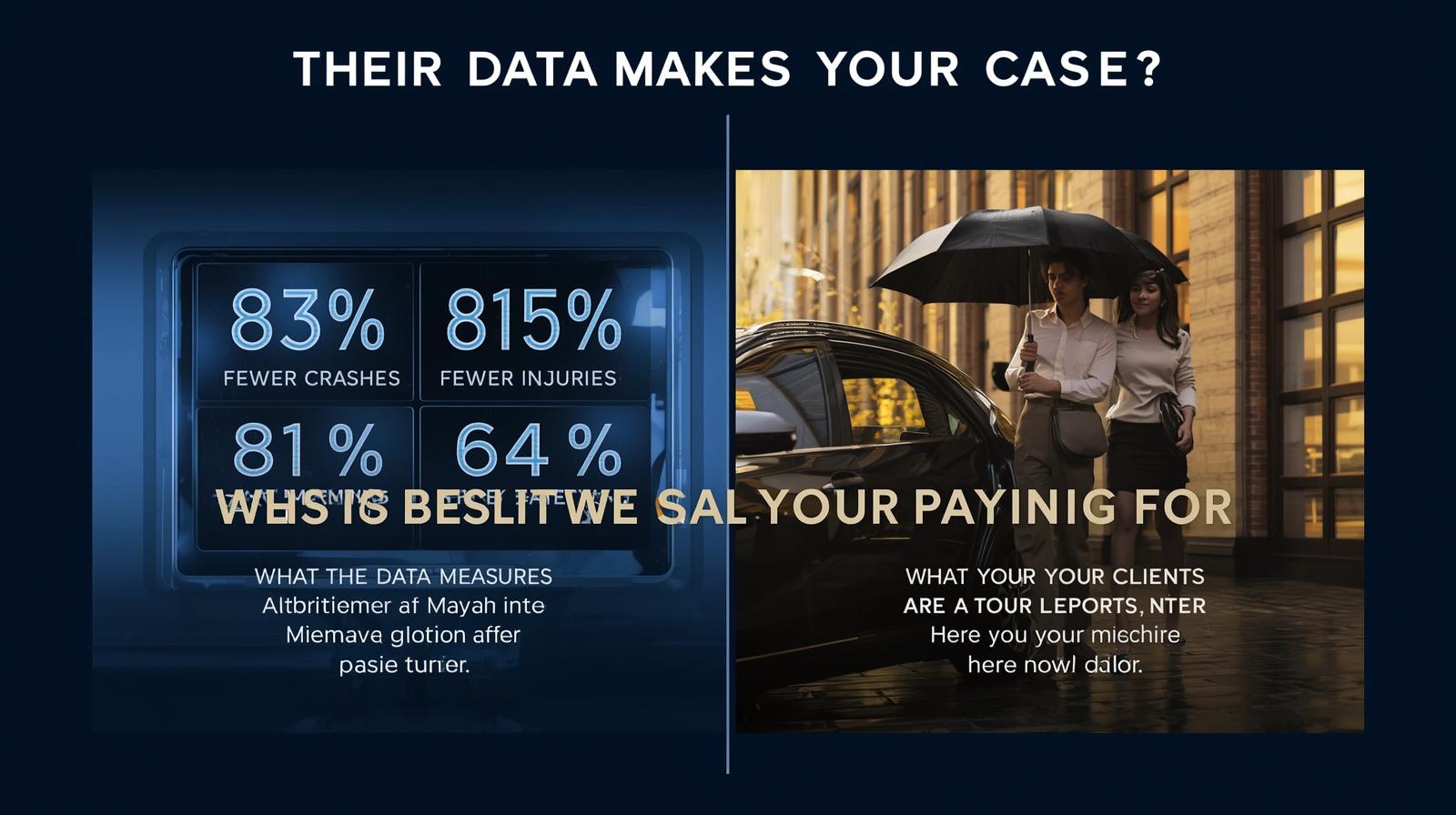
After clocking over 50 million miles Waymo reported 83 percent fewer airbag deployment crashes 81 percent fewer injury-causing crashes and 64 percent fewer police-reported crashes compared to human drivers in Phoenix and San Francisco. Thedriverlessdigest
The instinct is to read those numbers as a verdict. As the data that proves the human driver's days are numbered. As confirmation of the anxiety that has been building since the first Waymo appeared in San Francisco and the first Tesla rolled unsupervised through Austin.
That instinct is wrong.
Not because the data is wrong — it is accurate and the safety improvement is real and meaningful. But because every driver who reads those numbers as a threat is missing the marketing opportunity buried inside them.
Waymo just told every high-value transportation client in America exactly what they are getting when they book an autonomous vehicle.
They are getting safety statistics. They are getting consistency. They are getting a vehicle that follows traffic laws with machine precision and never has a bad day.
What they are not getting — what the safety report cannot quantify because it does not exist in the autonomous vehicle experience — is everything that your best direct booking clients are actually paying for.
What the Safety Data Cannot Measure
Waymo's safety report measures crashes. It measures airbag deployments and injury incidents and police-reported collisions. These are the things that sensors record and algorithms optimize for.
The safety report does not measure the water bottle that was there before the executive asked. It does not measure the driver who recognized a passenger's distress and adjusted the entire service register without being asked. It does not measure the corporate client whose sensitive pre-meeting conversation was protected by a driver whose discretion was not algorithmic but personal — a professional who understood what they heard and chose what they would never say.
It does not measure the medical patient who needed a hand from their front door to the vehicle and received it without having to ask. The teenager whose family specifically books the same driver every week because they trust that specific person with their child. The wedding couple whose once-in-a-lifetime transportation was managed with the judgment and flexibility that no geofenced autonomous system provides.
These are not sentimental additions to the transportation service. They are the specific value proposition of professional human transportation — and they are completely invisible to the metrics that Waymo's safety report was designed to capture.
The Counterintuitive Marketing Insight
Here is the insight that turns the Waymo safety data from a threat into a tool.
The clients who are most likely to switch from human drivers to autonomous vehicles are the clients who were only ever buying point-to-point transportation — the commodity ride from location A to location B at the lowest available price.
Those clients were never your best direct booking clients. They were your platform rides — anonymous, transactional, interchangeable.
The clients who are your best direct booking prospects — the corporate executive, the medical patient, the family with specific trust requirements, the high-value individual whose transportation needs involve discretion and judgment — are the clients for whom the Waymo safety statistics are the beginning of the conversation rather than the end of it.
Because those clients are not asking whether the vehicle is safe. They are asking something the safety report cannot answer.
Can I trust this driver with what happens in my vehicle?
Using the Data in Your Direct Booking Pitch
The Waymo safety data gives you a specific and powerful framing for the conversation that converts a prospective client into a standing direct booking relationship.
You acknowledge the autonomous vehicle's genuine strengths — safety statistics that are real and impressive — and then you articulate precisely what those statistics do not and cannot provide.
The conversation sounds like this.
"Autonomous vehicles are genuinely impressive on safety metrics. What they cannot provide is what my best clients tell me matters most to them — a driver who remembers their preferences, exercises genuine professional discretion, handles the unexpected with judgment rather than an algorithm, and is personally accountable for every ride. That is what a direct booking relationship with a verified professional driver provides that no platform assignment or autonomous vehicle can."
This framing does three things simultaneously. It demonstrates that you are informed and honest about the competitive landscape rather than dismissive of it — which builds credibility. It pivots immediately from the autonomous vehicle's strength to its structural limitation — which is the inability to provide personal professional relationship. And it positions your specific value — verified professional identity, personal accountability, demonstrated discretion — as the answer to the limitation that the prospective client's most important transportation needs expose.
The Four Advantages That the Safety Report Cannot Quantify
Personal Accountability
What makes this especially frustrating is the lack of transparency. Tesla redacts everything. Tesla wants us to trust its safety record while making it impossible to verify. Electrek
An autonomous vehicle has no personal accountability. When something goes wrong the accountability chain leads to a corporation — to legal teams and insurance adjusters and algorithmic incident reports. A human professional driver is personally accountable in a way that no autonomous system can replicate. They can be named in a vendor contract. They can be held to a specific professional standard by a corporate travel manager who has a direct relationship with them. They can be trusted in a way that depends on specific personal history rather than statistical safety performance.
Professional Discretion
The executive whose merger negotiation was discussed in the back of a vehicle. The medical professional whose patient case was reviewed during transit. The family whose personal situation was visible during a difficult ride.
An autonomous vehicle records everything — Uber announced a new initiative to collect and analyze data from vehicle cameras and sensors for its robotaxi partners. CBS News A trusted human professional driver exercises discretion that is not algorithmic but ethical — a personal professional commitment to what they will never repeat.
This distinction is not lost on the corporate and professional clients whose transportation involves information that matters.
Judgment in Novel Situations
There were instances of Tesla vehicles driving on the wrong side of the road phantom braking dropping passengers off in intersections and committing traffic violations. Wikipedia
The novel situation — the construction zone not in any map, the passenger who needs specific accommodation, the pickup environment that requires human assessment — is where human professional judgment produces outcomes that current autonomous systems cannot reliably match.
The specialty transportation clients whose needs regularly involve novel situations are the ones whose direct booking relationships are most structurally protected from autonomous vehicle competition.
Physical Presence and Human Care
No autonomous vehicle opens a door. No autonomous vehicle carries luggage to the entrance. No autonomous vehicle waits at the building until the elderly passenger is safely inside. No autonomous vehicle notices that a passenger is unwell and responds with the professional calm that a trained human driver provides.
Physical presence and human care are not premium additions to professional transportation. For specific client categories they are the core service requirement that defines whether the transportation was adequate or excellent.
Building Your Human Advantage Into Your Professional Identity
Your RSG profile at rideshareguides.com is where the human advantage becomes a specific, searchable, verifiable professional identity that the clients who value it can find.
The profile language that converts the autonomous vehicle era into a direct booking opportunity is specific rather than generic. Not "professional reliable driver" — every platform listing says that. But "verified professional transportation with demonstrated discretion executive service standard and personal accountability that autonomous alternatives cannot provide."
The clients who are specifically looking for what autonomous vehicles cannot offer are looking right now. The autonomous vehicle expansion has made them aware of what they are choosing between. Your verified professional identity is the mechanism that makes you findable when they decide they want the human professional rather than the algorithm.
The Pitch in One Sentence
When a prospective direct booking client asks you directly why they should book a human driver when autonomous vehicles have better safety statistics your answer is simple and honest.
"Because safety statistics measure what the vehicle does on the road. What you are also paying for is what happens in the vehicle — the discretion judgment personal relationship and physical presence that no safety report has ever been designed to measure."
That answer wins the client that autonomous vehicles cannot serve.
Those clients exist in every market. In every city on Waymo's expansion list and Tesla's announced rollout. In every corporate travel program and medical facility and family with specific trust requirements.
They are looking for you.
The data that every driver read as a threat is the data that tells them exactly what they are missing.
Use it.
Know the data. Articulate the advantage. Win the clients that algorithms cannot serve. 🚗🤝⭐
Comments
Sign in to join the conversation
Sign In