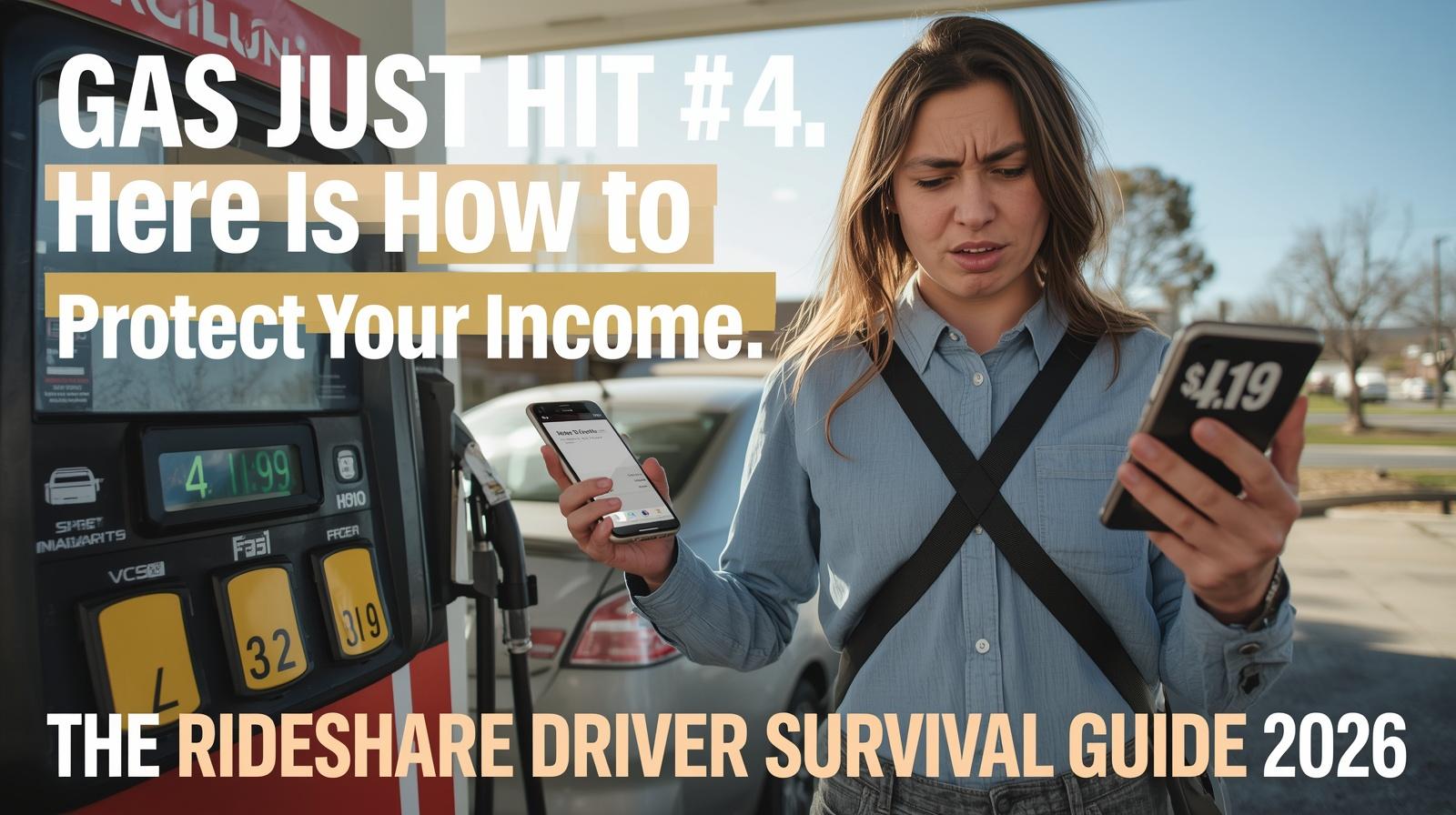
The Gas Price Crisis — How Rideshare Drivers Are Surviving $4 Per Gallon and What to Do Right Now
The Gas Price Crisis — How Rideshare Drivers Are Surviving $4 Per Gallon and What to Do Right Now
The Math Just Changed. Here Is How to Change With It.
It happened fast.
Three weeks ago the national average for regular gas was $2.94 per gallon. Manageable. Factored into your cost calculation. Part of the weekly expense rhythm that your income absorbed without crisis.
Then the conflict escalated. The Strait of Hormuz tightened. Crude crossed $100 per barrel for the first time since 2022. And the pump price that was $2.94 on a Tuesday was $3.47 the following Monday and $4.03 the Monday after that.
The national average for a gallon of regular gas crossed $4 for the first time since 2022, up more than a dollar in the past month. Americans have spent north of $8 billion more in the last month to fill up their tanks. CNN
For the average consumer that is an inconvenience. A grumble at the pump. A mild adjustment to the weekly budget.
For a full-time rideshare driver covering 50,000 miles per year that is a financial emergency.
Not a metaphorical emergency. A specific, calculable, month-by-month reduction in net income that at $4 per gallon represents the difference between a profitable driving business and one that is genuinely breaking even or below.
Tamira Moncur, a teacher who works part-time as a Lyft driver, said she is not sure how long she can keep up the side gig if the price of gas keeps climbing. "I'm working now for rideshare, but I don't know what that's going to look like next week. Because if gas is $4 a gallon, I'm done." CNN
She is not alone. Drivers are logging off across every market. Some permanently. The platforms' response has been inadequate — Uber offered drivers $1 off per gallon through the cash back platform Upside and an additional 5% if they use the Uber Pro card to buy gas. Lyft offered up to 2% cash back through its own Lyft Direct debit card. KTVZ CNN spoke to more than a half-dozen Uber and Lyft drivers and only one had heard about the companies' offerings. CNN
The platforms are not going to solve this for you. The solutions that protect your income exist — but they require you to find them, implement them, and act on them now rather than waiting for conditions to improve.
This is that guide.
The Honest Math — What $4 Gas Actually Costs You
Before strategies the numbers need to be clear. Not estimated. Not rounded. The specific financial impact of $4 gas on a rideshare driving business so you know exactly what you are solving for.
The Full-Time Driver Calculation
A full-time rideshare driver covering 50,000 miles per year in a vehicle averaging 28 miles per gallon consumes approximately 1,786 gallons of gas annually.
At $2.94 per gallon — the price one month ago — annual fuel cost: $5,251. Monthly fuel cost: $438.
At $4.03 per gallon — today's national average — annual fuel cost: $7,198. Monthly fuel cost: $600.
Monthly fuel cost increase: $162 per month. Annual fuel cost increase: $1,947 per year.
That $162 per month comes directly from your net income. Not from gross fares. Not from the platform. From the money that was going into your account and is now going into your gas tank.
The Part-Time Driver Calculation
A part-time driver covering 20,000 miles per year in the same vehicle consumes approximately 714 gallons annually.
Monthly fuel cost increase at $4.03 versus $2.94: $65 per month. Annual increase: $777 per year.
Smaller in absolute terms but potentially equally devastating in relative terms if part-time income was already marginal.
The Break-Even Threshold
Every rideshare driver has a break-even threshold — the minimum hourly net income at which driving is financially worth doing. When fuel costs rise without a corresponding increase in fares that threshold moves — rides that previously produced income above break-even now produce income below it.
A driver whose break-even threshold was $18 per net hour at $2.94 gas needs approximately $19.50 per net hour at $4.03 gas to maintain the same financial position. The rides and hours that produced $18 to $19 per net hour before the price spike now produce below break-even outcomes.
Knowing your specific new break-even threshold — calculated with current fuel prices — is the foundation of every strategic decision in this article. Recalculate it today with current fuel prices before making any other decision about your driving schedule or strategy.
What the Platforms Are Offering — And Why It Is Not Enough
Understanding exactly what platform assistance exists allows you to capture every dollar available while being clear-eyed about how much of the gap it actually closes.
Uber's Current Gas Assistance
Uber offered drivers $1 off per gallon through the cash back platform Upside, and an additional 5% if they use the Uber Pro card to buy gas. KTVZ
The Upside app — which provides cash back at participating gas stations — is genuinely useful and completely underutilized by most drivers. Download it today if you have not. The $1 per gallon discount at participating stations is real money — at 1,786 gallons per year for a full-time driver that is $1,786 in annual savings if every fill-up happens at a participating Upside station.
The practical limitation is that Upside's participating station network is not comprehensive — you cannot always fill up at a participating station without a meaningful detour. The optimization here is to plan fill-ups at participating stations when they are on your route rather than making dedicated detour trips that cost time and additional fuel.
The Uber Pro card's 5% gas cash back is available only to drivers who have and use the card. If you have it use it for every fuel purchase. If you do not have it the application process requires maintaining certain platform metrics — check your current eligibility in the app.
Lyft's Current Gas Assistance
Lyft offered up to 2% cash back through its own Lyft Direct debit card. KTVZ
2% cash back on gas at $4 per gallon is $0.08 per gallon — a meaningful but modest offset. For the full-time driver consuming 1,786 gallons annually that is approximately $143 in annual savings. Real money but not close to closing the $1,947 annual cost increase.
The Lyft Direct card also provides direct deposit of earnings — which eliminates the standard bank transfer delay and gives you access to earnings immediately after each ride. For drivers managing cash flow during a fuel cost spike the immediate access to earnings has genuine practical value beyond the cash back percentage.
The Honest Assessment
The platform assistance programs close approximately 10 to 15 percent of the annual fuel cost increase at current prices for drivers who fully utilize every available program. The remaining 85 to 90 percent of the cost increase requires driver-level strategy rather than platform assistance.
Strategy One — Fuel Efficiency Optimization
The fastest and most immediately actionable response to higher fuel costs is reducing fuel consumption per mile — getting more miles from every gallon without changing vehicles or driving patterns dramatically.
Driving Technique Changes That Reduce Fuel Consumption
Eliminate aggressive acceleration. Hard acceleration from stops is the single largest driver-controllable fuel consumption factor. A vehicle accelerating aggressively from every traffic light consumes 15 to 30 percent more fuel than the same vehicle accelerating gradually to the same speed over a longer distance. The gradual acceleration habit — developing the patience to reach cruising speed over 8 to 12 seconds rather than 3 to 4 — produces measurable fuel savings with zero cost beyond the habit change itself.
Maintain consistent highway speed. Fuel consumption increases significantly above 60 mph — approximately 1 to 2 percent per additional mph above that threshold. A driver cruising at 70 mph on the highway consumes approximately 14 percent more fuel than the same driver cruising at 60 mph. For rideshare routes with significant highway segments reducing cruising speed to 62 to 65 mph produces meaningful fuel savings at the cost of marginally longer trip times.
Anticipate traffic and coast more. A driver who anticipates red lights and slowing traffic and removes their foot from the accelerator early — coasting toward the stop rather than maintaining speed until the last moment and then braking — uses regenerative energy in hybrids and EVs and reduces energy waste in conventional vehicles. The habit of reading traffic further ahead and coasting rather than maintaining power to the last moment reduces fuel consumption measurably in stop-and-go urban driving.
Reduce idle time. A vehicle idling consumes fuel at approximately 0.5 to 0.7 gallons per hour depending on engine size and age. A driver who idles for 30 minutes per shift — between rides, at pickup locations, waiting in airport queues — burns approximately 0.25 gallons per idle period. At $4 per gallon that is $1 per shift in completely wasted fuel. Turn off the engine at every stop exceeding 60 seconds.
Maintain proper tire inflation. Under-inflated tires increase rolling resistance and fuel consumption by 0.2 to 0.4 percent per PSI below the recommended pressure. A vehicle running 6 PSI below recommended pressure on all four tires has a fuel consumption increase of approximately 2 to 3 percent — which at $600 per month in fuel is a $12 to $18 monthly cost that a $2 tire gauge and 5 minutes per week eliminates entirely.
Vehicle Maintenance That Improves Fuel Economy
Air filter replacement. A clogged air filter reduces fuel economy by up to 10 percent in older vehicles — less in newer vehicles with electronic fuel injection but still meaningful. At $20 to $40 for a replacement filter the payback period at current fuel prices is measured in days for a full-time driver.
Spark plug replacement. Worn spark plugs reduce combustion efficiency and fuel economy by 2 to 4 percent. At $100 to $200 for a full set replacement the payback period at current prices and full-time mileage is approximately two to three months.
Oxygen sensor function check. A malfunctioning oxygen sensor can reduce fuel economy by up to 40 percent by providing incorrect feedback to the fuel management system. If your check engine light is on and has been ignored get it checked — the probability that it reflects a condition affecting fuel economy at current gas prices makes the diagnostic cost immediately worthwhile.
Strategy Two — Route and Schedule Optimization
Fuel consumption is determined not just by how you drive but by which routes you drive, when you drive them, and how much time you spend in fuel-consuming conditions that do not generate income.
Eliminating Dead Miles
Dead miles — the miles driven between rides without a passenger — are the most expensive miles a rideshare driver drives. They consume fuel at the same rate as passenger miles while generating zero revenue.
A report based on nearly 1 million trips by local Uber drivers found that a majority of miles driven by Uber drivers are now without a passenger. king5.com If the majority of your miles are dead miles at $4 per gallon your fuel cost per revenue-generating mile is approximately double what the headline fuel economy figure suggests.
The strategies for reducing dead miles are covered in the positioning and surge strategy articles. In the current fuel cost environment their financial importance is dramatically amplified. Every dead mile costs twice what it cost eighteen months ago. Every positioning improvement that reduces dead miles produces twice the financial benefit it produced then.
Specifically — airport queue strategy that minimizes positioning time before long-distance rides, event positioning that concentrates rides in geographic clusters, and direct booking relationships that eliminate dead miles entirely by providing confirmed pickups at specific locations.
Shift Timing for Fuel Efficiency
Traffic congestion dramatically reduces fuel efficiency — stop-and-go traffic produces fuel consumption rates 3 to 5 times higher than consistent highway driving. A shift concentrated in high-congestion peak hours may generate higher gross fares but at a fuel cost that reduces net income below what a less congested off-peak shift produces.
In the current fuel price environment the net income calculation for every shift window needs to be updated with current fuel costs. The shift that was most profitable at $2.94 gas may not be the most profitable at $4.03. Specifically — the late morning and early afternoon windows that produce moderate demand with low congestion may now produce better net income than the peak rush hour windows that generate high gross fares at very high fuel consumption rates.
Recalculate your best shift windows using current fuel prices in the net income formula rather than the fuel prices from your historical earnings data.
Route Optimization for Fuel Economy
Highway miles are dramatically more fuel-efficient than urban miles for most vehicles. A 30-mile highway airport transfer consumes approximately 1.07 gallons at 28 mpg. A 30-mile urban trip through downtown traffic may consume 2 to 3 gallons depending on congestion levels.
In the current environment this difference — previously meaningful but not critical — becomes a significant income variable. Prioritizing longer-distance rides that involve substantial highway mileage over shorter urban rides improves your effective fuel economy per revenue-generating mile and reduces the fuel cost as a percentage of fare revenue.
Practically — in markets where ride preview allows partial destination visibility use that information more aggressively than before to identify highway-dominant long-distance rides and position accordingly.
Strategy Three — The Fuel Cost Surcharge Conversation
Here is the strategy that feels uncomfortable to most drivers but that is entirely legitimate, professionally appropriate, and increasingly standard in direct booking markets where fuel costs have spiked.
A fuel cost surcharge — a temporary addition to your direct booking rates that reflects the current higher operating costs — is the professional mechanism for passing a portion of the fuel cost increase to clients rather than absorbing it entirely as a margin reduction.
How to Implement a Fuel Surcharge for Direct Booking Clients
The fuel surcharge conversation with direct booking clients requires specific framing that is professional and transparent rather than apologetic or demanding.
The correct framing acknowledges the market reality, quantifies the specific impact, presents a reasonable and time-limited surcharge, and positions it as a shared response to an external circumstance rather than a unilateral price increase.
A communication that works professionally for established direct booking clients:
"I wanted to reach out about a temporary adjustment to our arrangement. With national gas prices having increased significantly over the past month — from under $3 to over $4 per gallon — my operating costs have increased materially. I am implementing a temporary fuel surcharge of $5 per transfer while prices remain above $3.50 per gallon. I will remove the surcharge when prices normalize. I appreciate your understanding and remain committed to the same service standard you have relied on."
This communication is specific — it references the actual price movement. It is quantified — $5 per transfer is a defined amount. It is conditional — tied to a specific price threshold rather than permanent. And it is professional — treating the client as a business partner who understands cost economics rather than a passenger who is being charged more for no explained reason.
Most established direct booking clients — particularly corporate clients who understand operating cost dynamics — will accept a well-framed fuel surcharge without resistance. The clients who push back unreasonably on a clearly justified and transparently communicated surcharge are the clients whose relationship economics were marginal before the fuel spike and whose departure at this point produces a net financial benefit.
The Platform Ride Response
For platform rides you cannot implement a surcharge — the platform sets the fare. What you can do is be more selective about which platform rides you accept in the current fuel cost environment.
Specifically — short rides in high-congestion areas that produce low fares with high fuel consumption per revenue-generating mile are now below break-even for many drivers at current prices. Accepting these rides because they maintain your acceptance rate while declining longer rides in favor of short ones is a strategy that made marginal sense at $2.94 and makes no financial sense at $4.03.
The acceptance rate consequences of selective rejection need to be weighed against the fuel cost of accepting rides that are now below your revised break-even threshold. In many cases the financial cost of accepting below-break-even rides exceeds the algorithmic cost of the lower acceptance rate.
Strategy Four — The Upside App and Fuel Savings Programs
Beyond the platform-specific programs several fuel savings tools are available to every driver regardless of which platform they operate on.
Upside — The Highest-Value Fuel Savings App
Upside is a cash back app that provides real cash back — deposited to your bank account or PayPal — on fuel purchases at participating stations. The cash back rates at participating Upside stations currently range from $0.25 to $0.40 per gallon for standard users with higher rates for Uber Pro users through the platform partnership.
Download Upside and activate the Uber partnership for the highest available cash back rates. Use the app to identify participating stations along your regular routes and plan fill-ups accordingly. At $0.25 to $0.40 per gallon cash back on 1,786 annual gallons the savings range from $446 to $714 per year — a meaningful offset to the fuel cost increase.
GasBuddy — Route-Based Price Optimization
GasBuddy provides real-time gas price data at stations near your location or along a specified route. The price variation between stations in the same market — sometimes $0.15 to $0.30 per gallon difference between the cheapest and most expensive stations within a two-mile radius — is real money at current consumption rates.
A full-time driver who consistently fills up at the cheapest available station rather than the most convenient one saves approximately $267 to $535 per year at current prices and consumption levels. The few minutes required to identify the cheapest nearby station before filling up has a higher hourly return rate than most rideshare driving at current fuel prices.
The Costco and Sam's Club Membership Math
Warehouse club memberships provide access to significantly discounted fuel — typically $0.15 to $0.30 below the surrounding market price. The Costco membership costs $65 per year. The Sam's Club membership costs $50 per year.
At $0.20 per gallon savings for a full-time driver consuming 1,786 gallons annually the warehouse club fuel savings are $357 per year — more than five times the membership cost. The break-even volume for the membership to pay for itself is approximately 325 gallons — which a full-time driver exceeds in approximately 3 weeks of driving.
If you do not have a warehouse club membership the current fuel price environment makes acquiring one this week among the highest-return financial actions available to any rideshare driver.
Fleet Fuel Cards
Several fleet fuel card programs provide guaranteed per-gallon discounts at specific station networks for drivers who qualify as small business operators.
WEX Fleet Card — provides discounts of $0.05 to $0.10 per gallon at participating stations nationwide. Available to LLC-registered businesses with a business bank account and basic business credit history.
Fuelman — network-based fuel card with per-gallon savings at approximately 50,000 locations nationwide. Monthly fee of $6 per card with savings that typically exceed the fee at full-time driving consumption rates.
Shell Fleet Card and BP Fleet Card — brand-specific fleet cards that provide per-gallon savings at the respective station networks. Most useful for drivers whose regular routes pass frequently through Shell or BP stations.
Fleet card applications require business entity documentation — your LLC registration and EIN — and basic business credit history. The combination of a fleet card and the Upside app at the same station can stack savings in some configurations — verify this with the specific programs before assuming stacking is available.
Strategy Five — Accelerating the Direct Booking Transition
Here is the strategy that addresses the fuel cost crisis and the long-term income structure simultaneously — and the one that produces the largest financial impact of any response available.
Every direct booking ride produces higher net income than the equivalent platform ride at any fuel price. At $4 per gallon the margin difference between a direct booking and a platform ride is even larger than it was at $3 — because the higher fuel cost reduces the margin on platform rides proportionally more than it reduces the margin on higher-rate direct rides.
A $75 direct booking airport transfer at current fuel costs produces substantially better net income than a $45 platform ride covering the same route. The fuel cost is identical. The gross revenue is 67 percent higher. The net income difference — the actual money that goes into your account — is dramatically larger than the gross revenue difference because the fuel cost is a fixed overhead subtracted from both.
At $4 per gallon the financial case for accelerating direct booking client development is stronger than it has ever been. Every direct booking client you build this month reduces your fuel cost as a percentage of revenue for every subsequent month regardless of what fuel prices do.
RSG at rideshareguides.com is where that transition happens — the verified professional profile that makes direct bookings possible, the digital business card that converts platform rides into direct booking relationships, and the community of drivers who have navigated the same transition. In a $4 per gallon environment the income difference between a platform-only driver and a driver with a significant direct booking client base is not a nice-to-have. It is the difference between a viable business and a break-even grind.
Strategy Six — The EV Acceleration Decision
For drivers who have been considering an EV transition the current fuel price spike has materially changed the financial calculation — and in markets where home charging is accessible the transition math now supports immediate action for many drivers who were borderline before.
At $4 per gallon the annual fuel cost for a full-time driver consuming 1,786 gallons is $7,144. The electricity cost for the same driver covering the same miles in a Tesla Model 3 with home Level 2 charging at the national average electricity rate is approximately $2,857 — a difference of $4,287 per year.
That $4,287 annual fuel savings is 21 percent larger than the same calculation at $2.94 per gallon — which produced $3,541 in annual savings. The larger savings figure improves the EV break-even calculation and moves many borderline cases into clear financial justification.
Drivers in markets with reliable home charging, moderate climate, and access to the federal tax credit for qualifying used EVs should recalculate their specific EV break-even with current fuel prices before concluding that the transition does not make financial sense. The numbers that did not work at $2.94 may work clearly at $4.03.
The specific EV analysis from the electric vehicle guide earlier in this series provides the complete framework. Rerun it with current fuel prices.
Strategy Seven — The Immediate Pricing and Hours Adjustment
While the medium-term strategies above produce the largest long-term financial impact the immediate cash flow crisis requires immediate responses that do not take weeks to implement.
The Hours Reduction With Income Maintenance Strategy
Counter-intuitively the correct immediate response to higher fuel costs for many drivers is not to drive more hours to maintain gross income — it is to drive fewer hours more strategically to maintain net income.
At $4 per gallon driving more hours in below-break-even conditions does not restore income — it accelerates the financial loss. The driver who reduces their hours by 20 percent but focuses those hours entirely on high-value surge windows, corporate account rides, and direct bookings may maintain or improve their net income while burning significantly less fuel.
Specifically — identify the two or three highest-value windows in your week using your current earnings data and concentrate all of your driving hours in those windows. Eliminate the low-value fill-in hours that generated marginal income at $2.94 and negative income at $4.03.
The Rate Review for Direct Booking Clients
As described in Strategy Three implement the fuel surcharge conversation with direct booking clients this week — not next month. Every week of delay is a week of absorbing the full fuel cost increase rather than sharing a portion of it with clients who understand cost economics.
The fuel surcharge is a temporary, transparent, professionally framed adjustment. Most established clients will accept it. The clients who would not accept a justified and transparently communicated surcharge are clients whose long-term relationship economics are worth examining regardless of the fuel price situation.
The Longer View — What This Crisis Is Telling You
Here is the perspective that matters most in a crisis that is revealing something important about the financial structure of platform-dependent rideshare income.
The gas price spike did not create a new vulnerability. It revealed an existing one.
A business whose entire margin is absorbed by a single external cost that the business cannot control or pass through to customers is a business with a fundamental structural fragility — one that this crisis has made visible but did not create.
The drivers who are most financially damaged by $4 gas are the ones who are most completely dependent on platform rides at platform rates with no ability to adjust rates, add surcharges, or shift to higher-margin service channels.
The drivers who are managing through this crisis with the least financial damage are the ones who built enough income diversification — direct booking clients at direct rates, corporate accounts at negotiated rates, medical transport at contracted rates — that the platform's pricing constraints apply to only a portion of their total income rather than all of it.
In 2026 rideshare algorithms prioritize coverage not tenure and veteran drivers do not receive better pay or protection for experience. The Rideshare Guy The platform will not protect you from this fuel crisis. It has demonstrated that clearly in its response.
The protection you need is the one you build yourself — through direct client relationships, professional rate structures, and income diversification that reduces the percentage of your total income that is subject to the platform's pricing constraints.
This crisis is the clearest possible argument for that building. Start today.
Your Immediate Action Plan — This Week
Today: Download Upside and GasBuddy. Identify the three cheapest Upside-participating stations within your primary driving area. Plan your next three fill-ups accordingly.
Today: Recalculate your break-even threshold using current fuel prices. Know the specific minimum net hourly rate below which driving is no longer financially viable. Use that number to evaluate every shift and every ride acceptance decision from this point forward.
Today: Check your tire pressure. Under-inflated tires are burning fuel you are paying $4 per gallon for unnecessarily.
This week: Apply for or activate the Uber Pro card and Lyft Direct card if you are eligible. Use every platform assistance program available regardless of how inadequate the total assistance is.
This week: Get a Costco or Sam's Club membership if you do not have one. The membership cost is recovered in fuel savings within three weeks at current prices and consumption.
This week: Send the fuel surcharge communication to your direct booking clients. Frame it professionally, tie it to the specific price threshold, commit to removing it when prices normalize.
This week: Recalculate your most profitable shift windows using current fuel costs. Eliminate the lowest-value windows from your schedule and concentrate hours in the high-value windows where the fuel cost is a smaller percentage of the fare revenue.
This month: Accelerate your direct booking client development. Every new direct booking client you land this month produces better net income at current fuel prices than the equivalent number of platform rides — and the income advantage compounds with every month of the relationship.
The gas price crisis is real. The platforms' response is inadequate. The drivers who quit are making a rational decision if they have not discovered the strategies that protect margin at $4 per gallon.
You have discovered them.
Use them.
Adapt immediately. Build for the long term. Protect what you have earned. 🚗⛽💰
Comments
Sign in to join the conversation
Sign In