The Complete Guide to Rideshare Driving in Bad Weather — Safety, Income, and Strategy
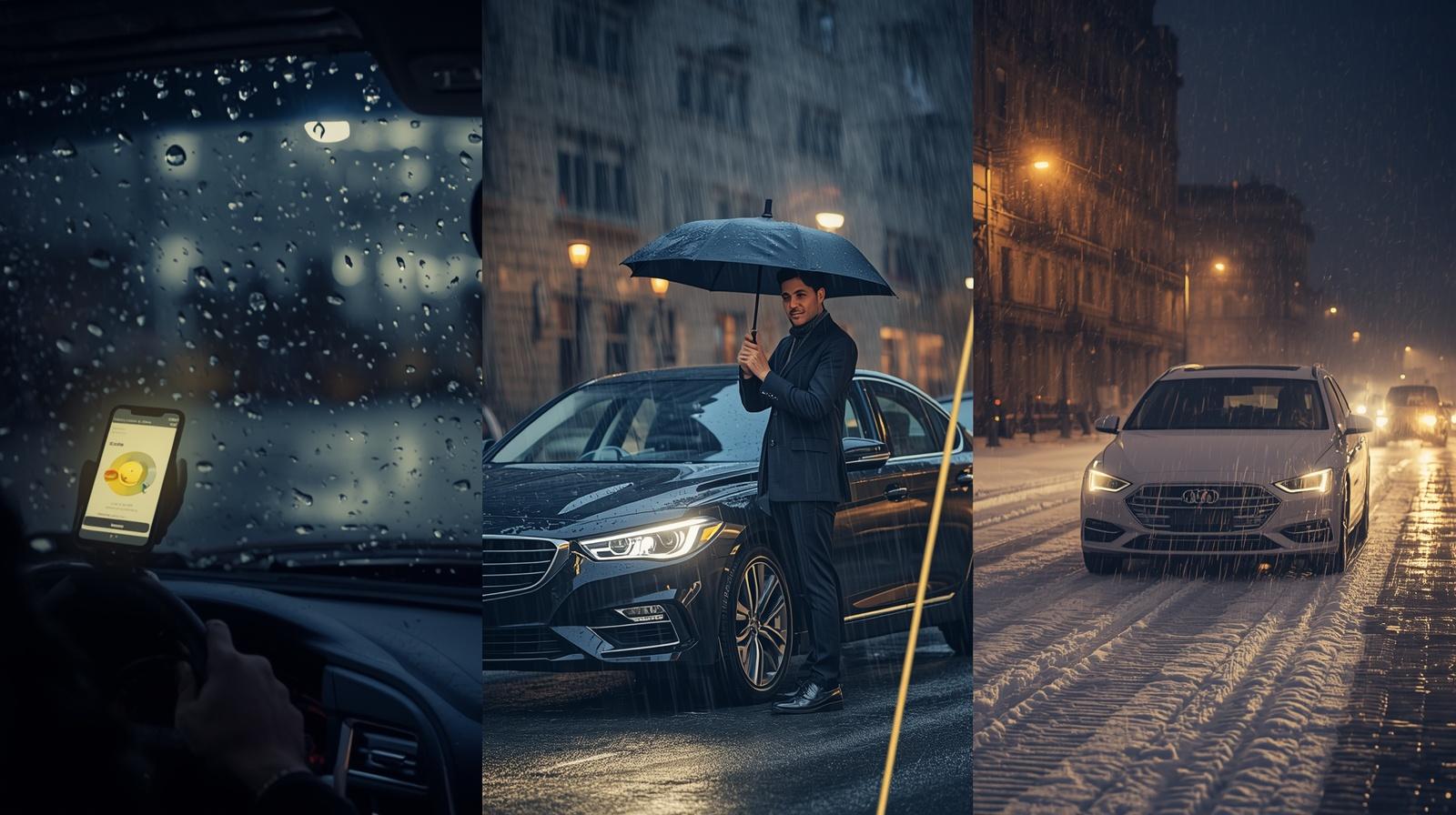
The Drivers Who Master Bad Weather Master Their Market
There is a moment that happens in every rideshare market the instant the first drops of rain hit the pavement.
Half the drivers on the road go home.
They do not want to deal with the traffic. They do not want the wet passengers. They do not want the reduced visibility or the longer trip times or the passengers who are frustrated before they even get in the car because they have been standing in the rain for four minutes.
The drivers who stay — and the drivers who specifically showed up because they knew the rain was coming — inherit the entire market.
Every platform in every city experiences the same dynamic in bad weather. Demand spikes immediately and dramatically as people who would normally walk, bike, or drive themselves suddenly need a ride. Supply drops simultaneously as fair-weather drivers exit. The combination produces some of the highest and most sustained surge conditions available in any market — not the brief post-event surge that lasts fifteen minutes but a weather surge that sustains for the entire duration of the precipitation event.
The math is extraordinary for drivers who are prepared for it.
The danger is equally real for drivers who are not.
This article addresses both completely — the safety protocols that make bad weather driving survivable professionally and financially, the strategic preparation that turns weather events into the highest-earning windows of the week, and the specific techniques that separate drivers who profit from bad weather from drivers who survive it.
Understanding Bad Weather Demand — Why the Surge Is Different
Before getting into safety and strategy it helps to understand exactly why bad weather produces the specific demand patterns it does — because that understanding shapes every positioning and timing decision.
The Demand Spike Mechanism
Bad weather creates rideshare demand from people who were not planning to use rideshare. The office worker who drives themselves every day suddenly cannot find a parking spot because the normally walkable distance from the garage is now a soaking obstacle. The college student who bikes to class cannot bike in a thunderstorm. The family whose normal errand run involves three stops and a loaded trunk does not want to navigate a parking lot in heavy rain.
These are not regular rideshare users whose demand simply intensifies during weather events. They are incremental demand — entirely new rides that would not exist in dry conditions. This incremental demand adds to the normal rideshare baseline rather than replacing it — which is why weather surges can sustain at elevated rates for the entire duration of the event rather than peaking briefly like event-driven surges.
The Supply Drop Mechanism
The supply side of the weather surge equation is as important as the demand side. When rain, snow, or ice arrives drivers exit the market for reasons that are individually rational but collectively create extraordinary earnings opportunities for the drivers who remain.
Fair-weather drivers who drive only when conditions are comfortable exit immediately. Drivers whose vehicles are not equipped for the conditions — summer tires in snow, worn wipers in heavy rain — make the correct safety decision to stop. Drivers who simply prefer not to deal with wet passengers and extended trip times opt out.
The result is a dramatically reduced supply pool competing for dramatically increased demand — which is the precise condition that produces the highest surge rates the platform algorithm generates.
The Duration Advantage of Weather Surges
Unlike event-driven surges that peak sharply and dissipate quickly weather surges sustain for as long as the weather event continues. A thunderstorm that lasts three hours produces elevated surge conditions for those three hours — not just the fifteen minutes of peak demand that a concert ending produces. A snowstorm that lasts all day produces a sustained earning window that no single event can match.
The duration advantage of weather surges is what makes pre-positioning for weather events one of the highest-return strategic decisions available to any rideshare driver. The investment in showing up prepared for a four-hour rain event produces elevated earnings across the entire four hours — not just the peak window.
The Safety Foundation — What You Must Know Before Earning
There is a specific order to bad weather driving strategy that cannot be violated without serious risk. Safety is not a constraint on earning strategy. It is the foundation that makes earning possible.
A driver who earns $300 in a weather surge and then has an accident that damages their vehicle, injures themselves or a passenger, and results in insurance complications has not had a good weather shift. They have had a financially and personally catastrophic one. The earning strategy only matters when the safety foundation is completely in place.
Vehicle Safety Requirements for Bad Weather
Tire condition and traction. This is the single most important mechanical variable in bad weather safety and the one most frequently neglected. Tires with worn tread — below 4/32 inch depth — have dramatically reduced wet-weather traction compared to tires in proper condition. In snow and ice worn tires are not just less effective — they are genuinely dangerous in ways that make even cautious driving a significant risk.
Before every planned bad weather shift check your tire tread depth. A simple tread depth gauge costs $5 at any auto parts store. Tires below 4/32 inch depth on the front axle should not be driven in significant wet conditions. Tires below 2/32 inch — the legal minimum in most states — should not be driven in any condition and represent both a safety risk and a commercial liability.
For drivers in snow markets the tire question is more complex. All-season tires provide adequate traction in light snow but become genuinely inadequate in significant accumulation. Dedicated winter tires — the investment that most drivers in snow markets resist — produce handling differences in snow and ice that are not marginal. They are the difference between a vehicle that responds correctly and one that does not. For a full-time driver in a market with regular winter precipitation the annual investment in winter tires is both a safety investment and a professional continuity investment — the difference between working through winter weather events and sitting them out.
Wiper blades. The cheapest safety investment in this section and the most consistently overlooked. Wiper blades degrade with UV exposure regardless of how much rain they have cleared — a blade that has sat on a windshield through a full summer in a warm climate is degraded whether it rained twenty times or twice. Replace wiper blades annually at minimum and immediately if any streaking, skipping, or incomplete clearing appears. Visibility in heavy rain with degraded wipers is not adequate for professional driving regardless of how slowly and carefully the driver proceeds.
Brake condition. Wet conditions increase stopping distances for every brake condition — a vehicle that stops adequately in dry conditions may require 40 to 50 percent more distance to stop on wet pavement. Brakes with worn pads or rotors that are marginal in dry conditions become genuinely inadequate in wet conditions. Have your brakes inspected before the weather season — before the first significant rain event of the year, before the first snow event — rather than after the first time they feel insufficient.
Defrost and HVAC function. A defrost system that does not clear the windshield quickly and completely is a visibility problem that makes extended bad weather driving professionally impossible. Test your defrost — both front and rear — before every planned bad weather shift. If it takes more than 90 seconds to clear a fogged windshield on a cold morning the system needs attention before driving in conditions that produce constant fogging.
Lights — all of them. Visibility in bad weather is a two-way problem — you need to see clearly and other drivers need to see you clearly. Check that every exterior light is functioning before bad weather shifts — headlights, taillights, brake lights, turn signals. A burned-out taillight that is invisible during a dry day shift becomes a serious collision risk during a heavy rain night shift.
Driving Technique Adjustments for Bad Weather
Reduce speed significantly below posted limits. Posted speed limits are set for dry conditions. In wet conditions safe speed is approximately 20 to 30 percent below posted limits for most vehicles on most roads. In snow and ice the reduction is more severe — 40 to 50 percent below posted limits on standard roads with all-season tires, with further reduction required for unplowed or heavily iced surfaces.
This speed reduction costs time. It extends every trip. It reduces the number of rides completable in a given shift window. These costs are real and they are non-negotiable from a safety perspective. A driver who maintains dry-condition speeds in wet conditions because trip time affects their hourly rate is making a financial calculation with a safety margin that does not belong to them — it belongs to their passengers, to other road users, and to themselves.
Increase following distance dramatically. The two-second following distance rule for dry conditions becomes a four-second rule in rain and a six to eight-second rule in snow and ice. The mental habit of counting following distance — counting seconds from when the vehicle ahead passes a fixed point to when you pass the same point — is simple enough to implement immediately and produces the reaction time buffer that prevents rear-end collisions in conditions where stopping distances are dramatically extended.
Brake earlier and more gradually. Sudden hard braking on wet or icy pavement produces wheel lockup — in vehicles without ABS — or ABS activation — in vehicles with ABS — both of which reduce steering control during the braking event. Begin braking much earlier than normal and apply brake pressure gradually rather than suddenly. The habit of identifying stopping points early enough to brake gradually is a technique that takes conscious effort to develop but becomes automatic with practice.
Accelerate gradually from stops. Wheel spin during acceleration on wet or icy pavement produces loss of directional control — the vehicle moves laterally rather than forward. Gradual acceleration that keeps the driven wheels from spinning eliminates this risk. In vehicles with traction control systems the system manages this automatically — but the system's intervention is not smooth or comfortable for passengers and is better avoided through gradual throttle application than managed after the fact.
Steer smoothly and avoid sudden directional changes. Wet pavement reduces the lateral grip available for cornering. A steering input that is entirely within the vehicle's grip limits on dry pavement can exceed those limits on wet pavement — producing understeer or oversteer that requires specific correction technique. Smooth, deliberate steering inputs — no sudden lane changes, no aggressive cornering — keep the vehicle within its traction limits in wet conditions.
Manage hydroplaning. Hydroplaning — the condition where the tire rides on a film of water rather than maintaining contact with the pavement — occurs on wet roads at speeds above approximately 35 mph and is more likely with worn tires on standing water. If the vehicle begins to hydroplane the correct response is to ease off the accelerator gradually without braking — allowing the vehicle to slow naturally until the tires re-establish pavement contact. Braking during hydroplaning accelerates loss of control.
The Strategic Framework — How to Maximize Bad Weather Earnings
With the safety foundation in place the earning strategy for bad weather conditions is built around three specific principles — preparation before the event, positioning during the event, and recovery after the event.
Preparation Before the Event — The Weather Monitoring System
The drivers who earn most from weather events are not the ones who react when the rain starts. They are the ones who knew the rain was coming and were already in position when it arrived.
The daily weather monitoring habit. Check the weather forecast every morning as part of your shift preparation routine — alongside your event calendar check and your market intelligence review. A five-minute review of the National Weather Service forecast for your market tells you everything you need to plan your week around weather opportunities.
The weather alert system. Both Apple Weather and Weather.com offer precipitation alerts that notify your phone when rain, snow, or severe weather is approaching your location. Set these alerts for your primary driving market and treat every precipitation alert the same way you treat a surge notification — as a signal to evaluate whether the conditions support profitable professional driving.
The forecast-to-positioning calculation. When the forecast shows precipitation for a specific window — say 2pm to 6pm on Tuesday — the pre-event preparation needs to happen before the window opens. Have your vehicle safety checked. Be on the road or in position 15 to 20 minutes before the forecast precipitation start time. The drivers who are already on the road when the rain starts are the drivers who capture the first surge wave — which is consistently the highest surge of the entire weather event.
The shift planning adjustment for weather. Weather events require shorter shift plans than standard conditions. Driving for extended periods in heavy rain or snow produces driver fatigue faster than dry-condition driving — the constant attention demands of reduced-visibility navigation, the mental load of continuous traction management, and the higher frequency of passenger-related complexity all accelerate cognitive depletion. Plan weather shifts of four to six hours maximum rather than the eight to ten-hour shifts that dry conditions support.
Positioning During the Event — Where to Be
Bad weather demand is not evenly distributed across a market. It concentrates in specific zones where normally-independent transportation becomes suddenly insufficient — and positioning in those zones produces higher ride frequency and higher surge rates than waiting in residential areas where demand increases modestly.
Commercial and retail districts. Shoppers who drove to a mall or retail district in dry conditions and emerged to find heavy rain are among the highest-urgency rideshare users during a weather event — their alternative is a long wet walk to a distant parking structure. Commercial districts with large retail concentrations — malls, shopping centers, downtown retail corridors — produce concentrated demand spikes when weather arrives unexpectedly.
Transit connection points. When weather conditions degrade bus and light rail options — wet platforms, crowded shelter areas, reduced schedule reliability — the demand for rideshare connections at transit stations spikes. Positioning near major transit stations during weather events captures passengers who normally use transit but are choosing rideshare for their last-mile connection in poor conditions.
Restaurant and entertainment districts. Weather events during evening dinner and entertainment hours produce specific demand from guests who arrived by car but whose parked vehicle is now inconvenient to reach — a parking structure three blocks away in heavy rain is a rideshare opportunity. Evening weather events in restaurant districts produce sustained demand from both arriving and departing diners throughout the event duration.
Office district end-of-day timing. When weather deteriorates during the late afternoon workday exit window — 4:30pm to 6:30pm — the demand spike in office districts is among the most concentrated and highest-volume in any weather event scenario. Workers who drive normally but face a wet walk to parking, workers whose parking is far from their office, and workers who take transit in dry conditions all simultaneously reach for their rideshare apps. Being positioned in office districts 20 to 30 minutes before a forecast weather event that coincides with the end-of-day window is among the highest-return positioning decisions available in any market.
Snow and Ice Market Strategy — The Specific Adjustments
Drivers in snow markets face a distinct set of strategic considerations that rain-market drivers do not encounter.
The snow event timeline. Snow events typically produce three distinct demand phases. The pre-event phase — as weather advisories go out and drivers decide to leave work early or stay home — produces early afternoon demand spikes that precede the actual snow. The active event phase — during the snowfall itself — produces moderate but sustained demand from essential travel and from passengers who are stranded by the weather. The post-event phase — as plowing restores road access and normal activity resumes — produces a recovery demand spike from passengers who deferred their transportation needs during the peak of the event.
Understanding these three phases allows snow-market drivers to position strategically for each — early positioning for the pre-event spike, continued coverage during the active event for drivers whose vehicles and skills support it, and immediate repositioning for the post-event recovery demand.
The plowed vs unplowed assessment. In snow markets the difference between plowed and unplowed roads is the difference between professional driving and genuinely dangerous operation. Prioritize routes on plowed major roads rather than residential side streets regardless of where the pickup location is. A passenger on an unplowed residential street may need to walk 100 meters to a plowed main road to facilitate safe pickup — this is a reasonable expectation to communicate professionally and most passengers in snow markets understand it.
The vehicle limitation communication. Drivers in snow markets whose vehicles have genuine traction limitations in deep snow should communicate those limitations proactively rather than attempting pickups that the vehicle cannot safely complete. A brief professional message to a passenger — "I am on the main roads which are plowed — I can meet you at [nearest plowed street] for your safety" — is a professionally appropriate communication that most snow-market passengers respect and appreciate.
Passenger Management in Bad Weather — The Specific Challenges
Bad weather passenger management requires adjustments that fair-weather driving never demands — and the drivers who handle these adjustments professionally earn consistently better ratings and tips in weather conditions than the drivers who treat wet-weather passengers the same as dry-weather passengers.
The Wet Passenger Protocol
Every wet passenger who enters your vehicle brings moisture. Managing that moisture professionally — before it becomes a problem rather than after — is the difference between a vehicle that maintains professional interior standards through a weather shift and one that requires extensive cleaning before the next shift.
Maintain a small supply of clean microfiber towels in a door pocket accessible to passengers — a visible, wordless invitation for wet passengers to dry their hands and face. A passenger who arrived soaking wet and was given the means to manage their discomfort will rate that service element specifically.
A waterproof seat cover or towel on the rear seat — placed before a weather shift begins — protects the upholstery from sustained moisture exposure without requiring any interaction with the passenger. The cover is visible, professional, and communicates that the driver anticipated the weather conditions rather than reacting to them.
The Frustrated Weather Passenger
Bad weather produces frustrated passengers before they ever enter the vehicle. They have been waiting longer than normal. They may have had a previous driver cancel. They are wet. They are stressed. They enter your vehicle already in a negative emotional state that has nothing to do with you.
The management principle for frustrated weather passengers is simple — do not add to the frustration. A warm, brief professional greeting that acknowledges the conditions — "tough weather out there — glad you are in now" — validates their experience without dwelling on it. Immediately proceed to the ride without asking questions that extend the boarding process or drawing attention to the conditions that are already the source of their frustration.
The driver who gets wet passengers from frustration to calm within the first sixty seconds of the ride — through warmth, efficiency, and professional quiet — earns the five-star rating that the wet walk to the vehicle threatened.
The Safety Conversation With Impatient Passengers
The most professionally challenging weather scenario is the passenger who wants the driver to move faster than weather conditions support. The executive who is late for a flight. The parent who is worried about getting to the school pickup. The passenger who explicitly asks for speed that the conditions do not safely support.
The response that is simultaneously professional, warm, and firm: "I completely understand the urgency — I want to get you there as quickly as I safely can. These conditions require me to leave a bit more time and space, but I am taking the most direct route and we should be there by [specific time estimate]."
This response acknowledges the urgency, explains the constraint without apologizing for it, provides a specific time estimate that gives the passenger a planning horizon, and communicates professional competence rather than apologetic hesitation. Never compromise safety in response to passenger time pressure — but do manage the passenger's anxiety through specific, confident professional communication rather than vague reassurance.
The Vehicle Recovery Protocol After Weather Shifts
A professional vehicle after a weather shift requires specific attention that dry-condition shifts do not demand. The recovery protocol that restores the vehicle to professional standard between weather shifts is the maintenance investment that makes consecutive weather shift income possible.
Interior moisture management. Remove the seat cover or protective towel placed for the shift. Wipe all hard surfaces — door panels, center console, dashboard — with a dry microfiber cloth. Check floor mats for standing water — remove and dry or replace if necessary. Address any visible moisture on fabric surfaces immediately using Folex spot cleaner to prevent set-in water marks.
Exterior mud and spray management. Vehicle exterior spray from wet roads accumulates rapidly in wet conditions — particularly on the lower body panels and under-body surfaces. A post-weather-shift wash — even a quick drive-through — prevents the embedded road grime that rain spray produces from requiring more extensive cleaning effort before the next shift.
Mechanical inspection for snow and ice markets. After snow and ice shifts check wheel wells for ice and snow accumulation that can affect steering. Check brake rotors for ice accumulation — a brief dry application of brakes after clearing snow helps confirm brake function. Inspect wiper blades for ice damage. These brief checks take three minutes and prevent the mechanical surprises that ice and snow conditions occasionally produce.
Building a Weather-Specific Direct Client Base
Here is the opportunity that most drivers who work weather events never capture — the direct booking relationship specifically built around reliable bad weather transportation.
The passengers who need transportation most urgently during weather events — and who are most frustrated by platform unreliability during those events — are your most compelling direct booking prospects. They have experienced firsthand the consequence of platform-based transportation during a weather event — the driver who cancelled because of the conditions, the surge price that was unavailable at the moment they needed it, the wait time that extended because supply dropped.
A driver who provides reliably professional service during a weather event and makes themselves available for direct booking during future weather events is offering something the platform cannot guarantee — a driver they know will show up regardless of conditions.
The direct booking offer for weather event passengers has a specific framing that other direct booking offers do not require. "If you ever need reliable transportation during bad weather I am happy to accommodate you directly — the platform can be unreliable when conditions are difficult and I make a point of staying available."
This framing is specific to the client's just-experienced pain point and specific to the value the direct booking relationship provides. It converts the weather frustration that the platform created into the motivation for the direct booking relationship that bypasses the platform.
RSG at rideshareguides.com gives you the verified professional profile and direct booking mechanism that makes this offer credible and actionable — and the drivers who build direct booking relationships from weather event conversions report that these clients are among the most loyal because the relationship was built specifically on the reliability that matters most to them.
Your Bad Weather Driving Action Plan
This week: Inspect your tires. Measure tread depth. Replace any tires below 4/32 inch depth before the next significant weather event. This is the single most important safety investment and the one most directly connected to professional continuity in bad weather.
This week: Replace your wiper blades if they were installed more than 12 months ago or show any degradation. A $20 investment that takes 10 minutes and eliminates the visibility problem that compromised wipers create in heavy rain.
This week: Set up precipitation alerts on your phone for your primary driving market. Treat every alert as a strategic signal — an opportunity to evaluate whether the conditions support a profitable professional shift.
Before your next weather shift: Complete the vehicle safety checklist — tires, wipers, brakes, defrost, lights. This five-minute check is the professional standard that separates prepared drivers from reactive ones.
During your next weather event: Position 20 minutes early in a commercial district, office corridor, or transit connection point rather than waiting in a residential area. Let the preparation pay off in the first surge wave rather than in the reactive positioning that follows it.
After every weather shift: Complete the vehicle recovery protocol — interior moisture management, exterior wash, mechanical check for snow markets. The recovery protocol is the investment that makes the next weather shift immediately available rather than requiring maintenance time that delays it.
Ongoing: Make the direct booking offer to every weather event passenger who expresses frustration with platform reliability during weather conditions. Build the direct client base that makes weather events not just profitable surge windows but standing income relationships that sustain across every weather event throughout the year.
The drivers who go home when it rains are leaving the market to you.
Be the driver who prepared for the rain. Be the driver who is already in position when it starts. Be the driver who delivers the professional service that wet, frustrated passengers remember and specifically request the next time the forecast shows precipitation.
The weather will come. The surge will follow.
The only question is whether you are ready for it.
Prepare for the weather. Position before it starts. Earn what the prepared driver earns. 🚗🌧️⭐
Comments
Sign in to join the conversation
Sign In