Tesla Robotaxi Is Coming to Your City : What Austin Drivers Experienced and What It Means for You
The Preview Is Already Running. Here Is the Ground-Level Reality That the Headlines Missed.
Elon Musk made a promise at the World Economic Forum in Davos in January 2026 that every rideshare driver in America should have heard.
Tesla CEO Elon Musk said his company will have a widespread network of driverless robotaxis in the U.S. by the end of 2026. "Tesla's rolled out robotaxi service in a few cities and will be very very widespread by the end of this year within the U.S." he said. Alpha Spread
Widespread. By end of 2026.
Musk has made ambitious promises about autonomous vehicles before — there was the time he swore half of the population of the U.S. would have robotaxi access by the year's end. Or the many times he said that the safety driver would no longer be needed. Or the time Musk said Tesla's robotaxi service would operate in eight to 10 major metro areas by the end of 2025. InsideEVs
None of those specific predictions materialized on schedule. Which means the question every driver needs to answer right now is not whether to believe Musk's timeline promises — the track record on those is clear — but whether to understand what is actually happening on the ground in Austin and what it specifically means for every market that Tesla has named as an expansion target.
Because something real is happening in Austin. Slower than promised. More limited than announced. And more instructive for what is coming than most of the breathless coverage has been able to communicate.
This is the ground-level reality of Tesla's robotaxi program — what Austin drivers actually experienced, what the data shows about the technology's current capabilities, what the expansion timeline actually looks like based on evidence rather than promises, and what every driver in Tesla's announced expansion markets needs to do right now.
The Austin Timeline — What Actually Happened vs What Was Promised
Understanding the gap between Tesla's promises and Tesla's execution in Austin is the most important context for evaluating what the national rollout means for your specific timeline.
The Launch — June 2025
The service is launched with human safety monitors using modified Tesla Model Y vehicles. Tesla initially offered those first rides to influencers and handpicked customers. Wikipedia
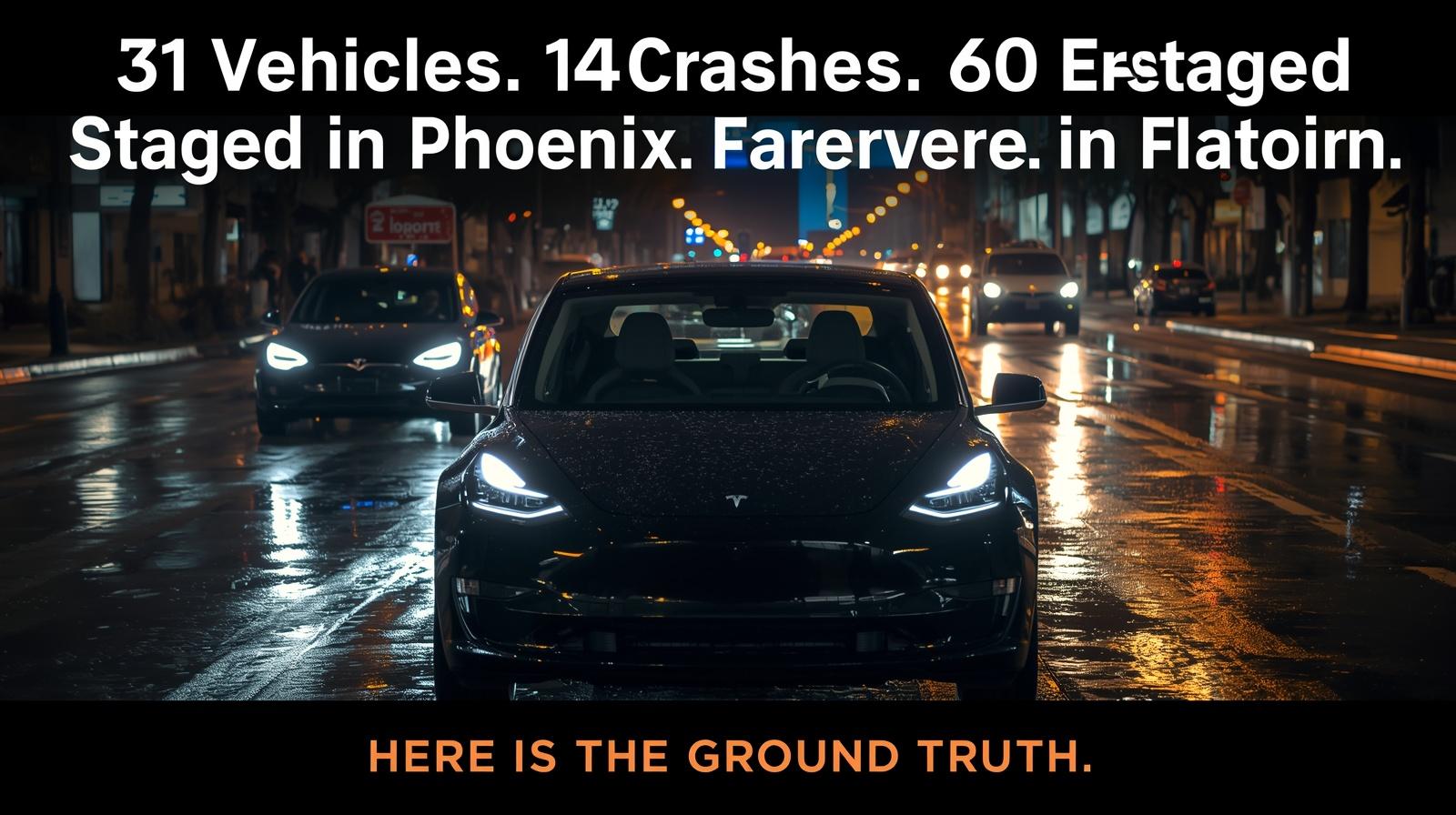
The June 2025 launch was not the public commercial service that most coverage implied. It was an invitation-only program serving a small number of handpicked passengers with human safety monitors aboard. Tesla operates around 31 robotaxis in Austin. Carbon Credits Thirty-one vehicles. In a city of one million people. In a geographically limited service area.
For context — rival Waymo is now clocking 450,000 weekly driverless rides across Austin Phoenix San Francisco Los Angeles and Atlanta. That's an 80 percent increase from 250,000 rides the company disclosed six months ago. InsideEVs
The scale difference between Tesla's Austin operation and Waymo's national operation is not a minor gap. It is the difference between a pilot program and a commercial service.
The Safety Record — What the NHTSA Data Shows
With 14 crashes now on the books Tesla's robotaxi crash rate in Austin continues to deteriorate. Extrapolating from Tesla's mileage data the fleet likely reached around 800,000 miles by mid-January 2026. That works out to one crash every 57,000 miles. Tesla's own Vehicle Safety Report claims the average American driver experiences a minor collision every 229,000 miles. By Tesla's own benchmark its robotaxi fleet is crashing nearly four times more often than what the company says is normal for a regular human driver. Electrek
This is not anti-Tesla advocacy. These are Tesla's own numbers from the NHTSA's mandatory crash reporting database. The specific crashes reported include a collision with a fixed object at 17 mph while the vehicle was driving straight, a crash with a bus while the Tesla was stationary, a collision with a heavy truck at 4 mph, and two separate incidents where the Tesla backed into objects. Electrek
What makes this especially frustrating is the lack of transparency. Every other ADS company in the NHTSA database — Waymo Zoox Aurora Nuro — provides detailed narratives explaining what happened in each crash. Tesla redacts everything. Electrek
The launch of the robotaxi service was met with a polarized reaction. Early riders posted numerous videos to social media praising the experience as smooth. There were also instances of vehicles driving on the wrong side of the road, phantom braking, dropping passengers off in intersections, and committing traffic violations that drew the attention of federal regulators such as the National Highway Traffic Safety Administration to investigate these issues. Wikipedia
The Unsupervised Launch — January 2026
Tesla is offering passengers robotaxi rides in Austin without a human safety driver in the front seat. CEO Elon Musk posted on X: "Just started Tesla Robotaxi drives in Austin with no safety monitor in the car. Congrats to the Tesla AI team!" TechCrunch
This is a genuine technical milestone — one of a small number of companies operating truly driverless public transit alongside Waymo and Zoox. But the context matters.
Not all of Tesla's fleet in Austin will be fully driverless. Per Tesla's AI lead the company will be starting with a few unsupervised vehicles mixed in with the broader robotaxi fleet with safety monitors and the ratio will increase over time. TechCrunch
While Tesla has removed the safety monitor from these vehicles Tesla is still monitoring these vehicles visually. These robotaxis are being followed by multiple Tesla vehicles presumably monitoring them from farther back with controls allowing them to stop the vehicle in its current position or have it pull over. NotateLaApp
So the fully driverless operation is real — but it is a few vehicles within a fleet of thirty-one total vehicles, followed by chase cars that can intervene remotely, operating within a limited geofenced area of Austin.
This is the preview. The national rollout will be a scaled version of this.
What Austin Drivers Actually Experienced — The Ground Truth
The gap between the Tesla robotaxi's media coverage and its on-the-ground market impact for Austin human drivers is significant and instructive.
The Fleet Size Reality
In comparison Tesla operates around 31 robotaxis in Austin. Carbon Credits
Thirty-one vehicles in a city where thousands of human rideshare drivers operate. The market share impact of thirty-one autonomous vehicles on the earnings of thousands of human drivers is — mathematically — negligible.
Austin drivers who have reported significant earnings compression in 2025 and early 2026 are not experiencing that compression because of Tesla's robotaxi fleet. They are experiencing it because of the human driver oversupply documented in the flooded market article — the seven-times-faster driver growth than trip growth that predates and dwarfs Tesla's Austin deployment.
This is the most important Austin lesson for drivers everywhere — in the short term the Tesla robotaxi's market impact on human driver earnings is minimal because the fleet is too small. The impact grows as the fleet grows — and the fleet is growing.
The Geographic Limitation Reality
Tesla FSD v14.3 features a rewritten AI compiler that delivers a 20 percent faster reaction time. Early testers confirm this optimization is incredibly noticeable in the real world. NotateLaApp
The technology is improving — genuinely and measurably. Each FSD update produces documented improvements in specific performance metrics. The direction of travel is clear even if the pace is slower than promised.
But the current geofenced operational area in Austin is deliberately limited to the road conditions and traffic environments that the technology handles most reliably. The complex, unpredictable, variable conditions that produce the edge cases and crashes reported above are the conditions that the current geofenced area is specifically designed to minimize.
As the technology improves the geofence expands. As the geofence expands more of the market becomes accessible to autonomous operation. This is the pattern that produced Waymo's expansion from a small Phoenix service area to 450,000 weekly rides across five cities — and it is the pattern that Tesla's Austin operation is beginning to replicate.
The Pricing Reality
Tesla is charging for the rides according to one rider who posted on X. Some of Tesla's rivals like Zoox and Waymo did not immediately charge for driverless rides upon initial deployment. TechCrunch
Tesla charging from day one — unlike Waymo and Zoox which offered free rides in early deployment — signals a specific commercial priority. The pricing data from Austin rides suggests Tesla is currently pricing at or above standard Uber and Lyft rates for equivalent routes — which means cost competition with human drivers is not the current Austin dynamic.
The future competitive pricing scenario — analysts estimate robotaxi rides could cost more than 60 percent less than trips provided by human drivers once scale is achieved Mexico Business News — is not the current Austin reality. It is the future reality that the scale-up is building toward.
The Expansion — Where Tesla Is Going Next and When
The Announced Cities
Tesla's robotaxi service operates in Austin and San Francisco. Musk has said that the service would expand to Dallas Houston Phoenix Miami and Las Vegas. InsideEVs
Five additional cities. Each representing a different market type — suburban sprawl in Dallas and Houston, extreme heat in Phoenix and Las Vegas, tourism concentration in Miami — that will test different aspects of the technology's capabilities.
Phoenix — The Most Imminent Expansion
Spotting 60 robotaxi Model Ys in one city at one time is not routine testing. Tesla's entire robotaxi fleet in Austin was estimated at roughly 30 to 40 Model Ys as of early March 2026. Phoenix now appears to have a larger concentration than the program's original home base. BASENOR
Tesla received its Arizona ride-hailing permit back in November 2025 and autonomous vehicle testing with safety drivers had already been approved in the state prior to that. The regulatory groundwork is laid. What we're watching now is the operational buildup. Timeline: Q2 2026 — Phoenix launch appears imminent based on fleet size and testing activity. Other H1 cities likely to follow in waves through June 2026. BASENOR
Phoenix is the clearest immediate expansion signal. Sixty pre-staged vehicles before public launch — double the Austin fleet that launched with thirty-one — suggests Tesla has learned from Austin and is deploying with more scale confidence in the second market.
For Phoenix human drivers the Tesla deployment joins Waymo's already-significant Phoenix operation — creating the dual-operator dynamic that Austin is also now experiencing. The combined supply impact of two major autonomous vehicle operators in the same market is meaningfully larger than either alone.
The Cybercab — The Scale Vehicle
The purpose-built Cybercab is expected to begin production in April 2026. The Model Y fleet being staged in Phoenix now likely serves a dual purpose: generating operational data and revenue while Cybercab production ramps. Once Cybercab units are available at scale the Model Y robotaxis may transition to a support or overflow role or be redeployed to new markets. BASENOR
The Cybercab — Tesla's purpose-built autonomous vehicle without a steering wheel or pedals — is the product that changes the scale economics of the Tesla robotaxi program. The Model Y conversions used in Austin and the Phoenix pre-staging are the platform's transitional fleet. The Cybercab is the commercial fleet.
Musk stated the Cybercab would be cheaper to ride in than to take the bus. Tesla revealed a purpose-built robotaxi design for a futuristic two-seater vehicle with no steering wheel or pedals. Wikipedia
A two-seater vehicle with no driver controls positioned at bus-level pricing is explicitly designed to compete with public transportation as much as with rideshare — which means the Cybercab's competitive target is broader than Waymo's current positioning and potentially affects a wider range of transportation use cases.
The Honest Timeline Assessment
Tesla's robotaxi army failed to conquer the world in 2025. The Waymo-like scale that Musk promised will have to arrive in 2026 or later. InsideEVs
Tesla's track record on timeline promises requires honest evaluation. Tesla CEO Elon Musk stated vehicles would be feature-complete on full self-driving by the end of 2019 and would not require driver oversight by the second quarter of 2020. Wikipedia That promise was six years premature.
The national widespread deployment that Musk promised by end of 2026 at Davos is the latest in a series of aggressive autonomous vehicle timeline promises from Tesla leadership. The Austin evidence suggests the technology is progressing — early testers are overwhelmingly calling FSD v14.3 a meaningful step forward in both confidence and refinement with a 20 percent faster reaction time bridging the gap between robotic hesitation and smooth human-like intuition. NotateLaApp
But the gap between thirty-one vehicles in one city and widespread national deployment is substantial — and Tesla's history of overpromising on autonomous vehicle timelines is the most reliable predictor available for how to calibrate the end-of-2026 promise.
The realistic assessment for individual drivers planning around Tesla's expansion — use an 18 to 36 month buffer beyond Tesla's announced timelines for meaningful market impact in any specific city. The direction is clear. The pace is slower than promised.
The Technology Comparison — Tesla vs Waymo and What It Means for the Timeline
Understanding the fundamental technology difference between Tesla and Waymo helps calibrate the competitive timeline that human drivers are planning around.
The Vision-Only Approach vs LiDAR
Tesla uses a vision-only system that relies on eight cameras and artificial intelligence to navigate abandoning the use of LiDAR and radar which are used by Waymo and most other competitors. Critics argue that LiDAR provides a level of redundancy and accuracy that cameras alone cannot match particularly in adverse weather or poor lighting. Wikipedia
This technology choice has specific implications for the markets where Tesla can and cannot operate effectively. Camera-only systems are more susceptible to the weather conditions — heavy rain, snow, direct sun glare, smoke — that produce autonomous vehicle service reduction or cessation. LiDAR-equipped systems like Waymo's are more weather-resilient because radar and LiDAR provide data that is less affected by visual obscuration.
For drivers in weather-variable markets — and most of Tesla's announced expansion cities have significant weather variability including Phoenix's extreme heat that affects camera sensors — the camera-only approach means Tesla's robotaxi service will have more frequent weather-related service gaps than Waymo's.
Those service gaps are human driver income windows — the same weather surge premium described throughout this guide that applies specifically to autonomous vehicle operational limitations.
The Scale Advantage Tesla Has Over Waymo
Tesla's vision-only approach has one significant advantage over Waymo's LiDAR-dependent approach — cost. While Waymo relies on expensive LiDAR arrays and time-consuming pre-mapped HD geofences Tesla achieves the same functionality with only cameras and AI. NotateLaApp
Lower per-vehicle cost means Tesla can potentially deploy far more vehicles per dollar of investment than Waymo can. If the technology proves reliable enough at scale — the critical if — Tesla's cost advantage enables the national deployment scale that Waymo's economics make more difficult.
Morgan Stanley forecasts that Tesla could greatly grow its robotaxi presence in the next 10 years. The bank says Tesla might have 1 million robotaxis on the road by 2035. Carbon Credits
1 million robotaxis. Across a national network. By 2035. That is the scale scenario that produces the trillion-dollar revenue opportunity Uber and Tesla both reference and that would produce material market impact for human drivers across most U.S. markets.
2035 is nine years away. The planning window is real and it is finite — but it is not so short that the strategic response needs to happen in weeks rather than in months to years of deliberate income diversification.
Market-by-Market Impact Assessment — What Austin Means for Each Tesla Expansion City
Phoenix — Imminent
Impact Level: High — This is the transition from Austin experiment to national autonomous ride-hailing network. BASENOR
Phoenix drivers face the most imminent Tesla impact of any announced expansion market. The 60 pre-staged vehicles combined with Waymo's already-significant Phoenix presence create the most complete picture of what dual autonomous vehicle operator markets look like for human drivers.
Phoenix drivers should be treating the Tesla expansion as a present reality to build around rather than a future concern to monitor. The income diversification strategies — direct booking clients, corporate accounts, medical transport, specialty transportation — are urgent in Phoenix in a way they are not yet urgent in most other Tesla expansion markets.
Dallas and Houston — Texas Markets
Texas's regulatory environment — among the most permissive for autonomous vehicle deployment in the country — means the regulatory timeline for Tesla's Texas expansion is shorter than in more regulated markets. Musk has said that the service would expand to Dallas and Houston. InsideEVs
Both cities share Austin's regulatory environment and Tesla's proven Texas operational experience. The timeline for Dallas and Houston deployments is likely faster than for markets in more regulated states.
Texas drivers in both cities should be in the active planning stage — building the income diversification that Phoenix and Austin drivers who acted early demonstrate is protective against the market impact that the expansion will eventually produce.
Miami — The Tourism Market
Miami's tourism-heavy rideshare economy creates a specific Tesla deployment dynamic. Tourist passengers — who are unfamiliar with the city and unlikely to have established driver preferences — are among the most likely passengers to try a novel Tesla robotaxi experience. The novelty factor that drives early adoption is more pronounced among tourists than among regular local commuters.
Miami drivers who are primarily serving tourist transportation demand face faster Tesla market impact than Miami drivers who have built corporate, medical, and direct booking income from the local professional and residential market.
Las Vegas — The Convention and Entertainment Dynamic
Amazon's Zoox announced the start of self-driving ride-hail service in Las Vegas. Smart Cities Dive The Tesla addition to an already-autonomous-vehicle-active Las Vegas market creates the most complex competitive environment of any announced Tesla expansion city.
Las Vegas drivers face the specific challenge of autonomous vehicle competition in the tourist and entertainment transportation segments — the segments that represent the largest portion of Las Vegas rideshare volume. The convention and corporate transportation segments remain less accessible to autonomous vehicles — and are the specific protected income opportunity that Las Vegas human professional drivers should be building toward.
The FSD Update Trajectory — Why the Technology Is Improving Faster Than Most Drivers Realize
The crash data and operational limitations of Tesla's current Austin deployment are real and important. They are also a snapshot of a technology that is improving at a documented and significant pace.
FSD v14.3 features a rewritten AI compiler that delivers a 20 percent faster reaction time. Early testers are overwhelmingly calling FSD v14.3 a meaningful step forward in both confidence and refinement. The day-one consensus is strongly positive with drivers describing the experience as remarkably human-like. NotateLaApp
Each major FSD update has produced measurable capability improvements. The crash rate that was four times worse than human drivers in the first 800,000 Austin miles will not remain at that level as the technology improves — the same way that Waymo's early Phoenix safety data was worse than its current data after millions of miles of fleet learning.
The trajectory of autonomous vehicle technology improvement is more important for long-term driver income planning than the current capability snapshot. A technology that is improving 20 percent in reaction speed per major update is a technology that will look meaningfully different in two years than it does today.
Drivers who are planning their income strategy around the current limitations of Tesla's technology without accounting for the improvement trajectory are underestimating the medium-term competitive threat. Drivers who are planning around the trajectory — building the income streams that remain protected as the technology improves — are the ones whose financial position is actually future-proofed.
The Human Driver's Specific Advantages Over Tesla's Current System
The crash data, the weather limitations, and the operational constraints of Tesla's current system define the specific competitive advantages that human professional drivers maintain — advantages that should be built into income strategy rather than assumed to persist indefinitely.
Weather Operation
The camera-only vision system that gives Tesla its cost advantage also gives human drivers their most durable weather-related competitive window. Testers have noticed that heightened sensitivity occasionally causes the vehicle to apply light braking for blowing leaves. NotateLaApp A system that brakes for blowing leaves is a system that will have significant service limitations in the weather conditions — heavy rain, dense fog, heavy snow — that produce the surge conditions human drivers earn premium rates during.
Edge Case Handling
There were instances of vehicles driving on the wrong side of the road phantom braking dropping passengers off in intersections and committing traffic violations. Wikipedia
These edge cases — the situations that the geofenced operational area cannot fully eliminate — are the scenarios where human judgment produces outcomes that current autonomous systems cannot reliably replicate. Construction zones not in the map data. Unusual traffic control situations. Passengers who need specific assistance entering or exiting the vehicle. Weather conditions that reduce sensor reliability.
As the technology improves these edge cases become less frequent. But they do not disappear — and the specialty transportation services built around human judgment in edge case scenarios maintain their structural advantages as the standard ride market becomes more autonomous.
The Trust Gap in High-Stakes Contexts
What makes this especially frustrating is the lack of transparency. Tesla redacts everything. Tesla wants us to trust its safety record while making it impossible to verify. Electrek
The transparency gap that makes Tesla's safety record difficult to verify independently is also a trust gap that affects high-value client categories whose transportation decisions involve professional judgment about reliability and accountability.
A corporate travel manager who is responsible for their company's executives cannot verify Tesla's robotaxi safety record in the way they can verify a vetted human driver's background check, driving record, and professional references. The accountability that professional transportation clients require is not something a black box autonomous system provides regardless of its actual safety performance.
Your Tesla-Specific Response Plan
If You Are in Austin Right Now
The Tesla fleet is small — thirty-one vehicles — and the market impact on your earnings is currently minimal relative to the human driver oversupply that is the primary income compression factor. The Tesla deployment is important to monitor but it is not currently the primary strategic challenge for Austin drivers.
The primary challenge is the flooded market documented in the previous article. Address that first — income diversification, direct booking development, specialty transportation — and the Tesla expansion becomes a manageable additional pressure rather than a primary crisis.
If You Are in Phoenix
The Tesla pre-staging is real and the deployment timeline is imminent. Phoenix drivers are in the most urgent position of any Tesla-expansion-market driver. The combination of Waymo's established presence and Tesla's imminent launch creates the dual-operator competitive environment that produces the most significant near-term income compression for human drivers.
Accelerate income diversification now. The planning window in Phoenix is shorter than in any other announced Tesla expansion market outside of Austin.
If You Are in Dallas, Houston, Miami, or Las Vegas
You have a planning window of six to eighteen months before Tesla's deployment in your market reaches a scale that produces measurable income impact. Use it.
Every direct booking client you establish in this window is a client whose income is protected from the market impact when it arrives. Every corporate account you develop is an account that autonomous vehicles cannot compete for. Every medical transport relationship you build is income that exists entirely outside the platform market where Tesla will eventually compete.
The six-month week-by-week blueprint in the previous article applies with specific urgency to drivers in these markets. Start it this week.
If You Are in a City Not Currently on Tesla's List
The Tesla expansion is directional — it is moving toward more cities over a multi-year timeline. The strategic response that protects against Tesla's competition is identical to the response that protects against Waymo, the flooded market, and every other income compression force discussed in this series.
Build the income that is not subject to any of these forces. The timeline for when that building becomes urgent varies by market. The direction does not vary.
The Honest Bottom Line
Tesla's robotaxi in Austin is real. It is progressing. It is improving. And it is coming to your city on a timeline that is slower than Musk's promises but faster than the dismissive response that treats this as distant science fiction.
The honest bottom line for every rideshare driver in America is this.
Next year is poised to be even bigger and could decide whether self-driving vehicles are just a very expensive science project or something that could truly scale and drive profits for these companies while also delivering safe and affordable rides for passengers. InsideEVs
2026 is the year that decides. Not just for Tesla. Not just for Waymo. For every human rideshare driver whose income sits in the market that autonomous vehicles are entering from multiple directions simultaneously.
The decision that 2026 requires from you is not whether to believe Musk's timeline promises.
It is whether to use the planning window that exists right now — before the fleet in your city looks like Phoenix's sixty pre-staged vehicles rather than Austin's thirty-one — to build the income that makes the autonomous expansion something you watch from a position of financial strength rather than something you experience as a financial crisis.
Austin showed you the preview.
Phoenix is showing you the next chapter.
Your city is in the story.
Build accordingly.
Know the timeline. Use the window. Build what arrives before the fleet does. 🚗⚡🔮
Comments
Sign in to join the conversation
Sign In