Stop Waiting for Surges. Medical Transport Pays More and Books in Advance. Here Is How to Start.
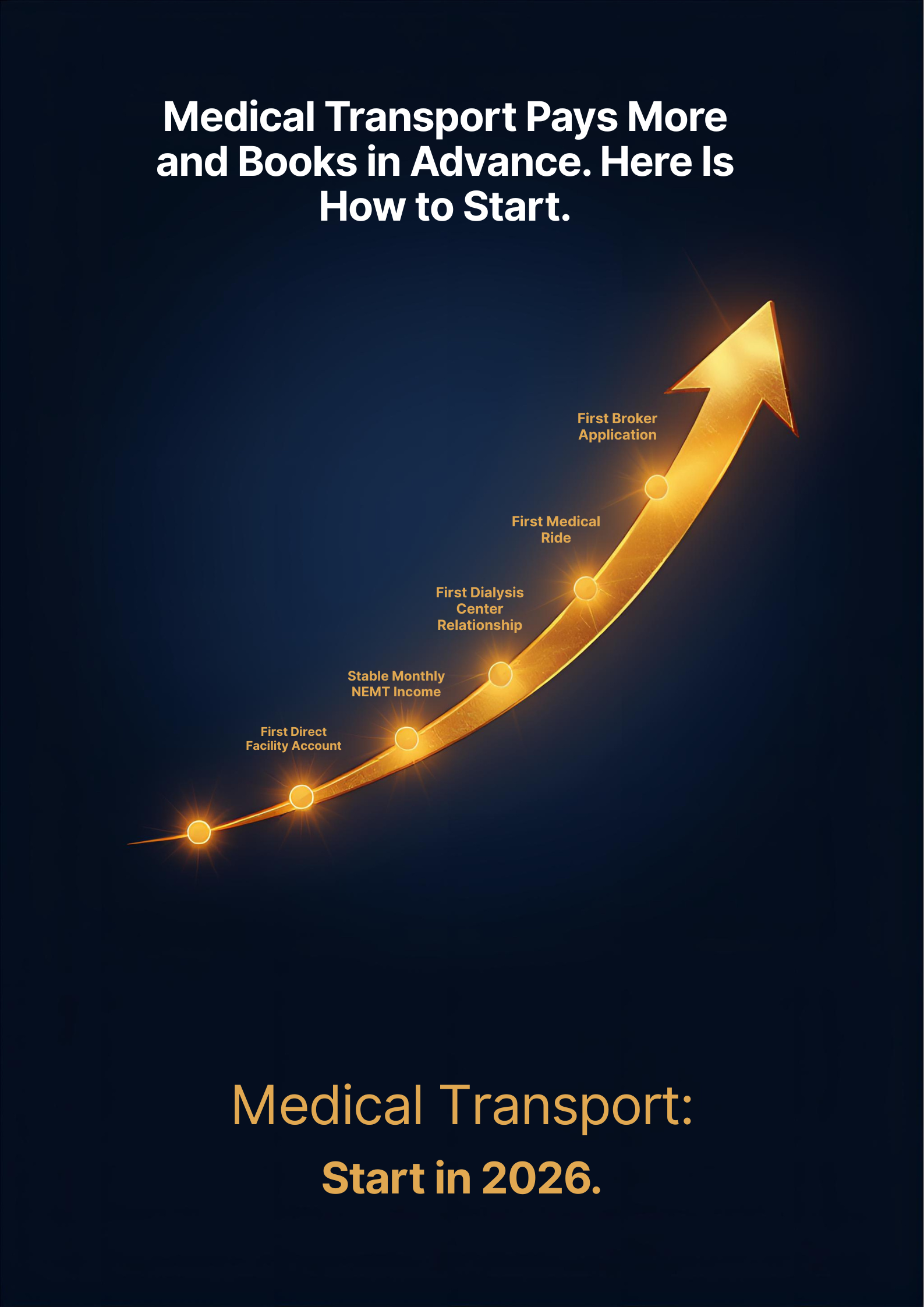
The Steady Income Stream Sitting Right Next to Your Current Routes
You already know the rideshare grind.
The slow Tuesday mornings when the app stays quiet for forty minutes. The surge that evaporates before you reach it. The week where every ride seems short, every tip seems light, and the math at the end of the shift does not add up the way it should.
Now imagine a different kind of Tuesday morning.
Your phone shows three confirmed rides before you leave the house. Same time. Same pickup locations. Same destinations. Patients who need to get to dialysis, physical therapy, and a specialist appointment — and who need that ride every single week without exception. No surge required. No algorithm deciding whether today is your day. Just confirmed bookings, grateful passengers, and steady income that shows up whether the rideshare market is hot or completely dead.
That is medical transport. And for the overwhelming majority of rideshare drivers reading this right now it requires no special license, no medical training, and no vehicle upgrade to get started.
What it requires is knowing where to look, how to position yourself, and what the clients in this space actually need from a driver.
This is everything you need to know.
What Medical Transport Actually Means for Independent Drivers
When most drivers hear medical transport they picture ambulances, paramedics, and specialized equipment. That is emergency medical transport — a completely different category that does require special licensing and training.
What we are talking about here is Non-Emergency Medical Transportation — NEMT for short. It is one of the fastest growing and most consistently funded transportation sectors in the entire country and it is largely served by independent drivers, small transportation companies, and rideshare operators who knew where to look.
NEMT covers the movement of patients who need to get to and from medical appointments but do not require emergency services or ambulance-level care. Dialysis patients who attend treatment three times per week. Elderly patients attending specialist appointments. Cancer patients going to and from chemotherapy. Physical therapy patients completing rehabilitation programs. Individuals with mobility challenges who need regular transportation to ongoing care.
These passengers need rides the way other passengers need air. Their appointments are not optional. Their transportation is not discretionary. And because many of them are Medicaid recipients or covered by insurance programs that include transportation benefits, the funding for these rides is institutional — which means it does not dry up when the economy slows, when surge pricing disappears, or when a competitor enters your market.
Why NEMT Is the Opportunity Most Rideshare Drivers Never Discover
The rideshare platforms do not tell you about NEMT because it moves clients off their platform and into direct relationships with drivers. Medical facilities do not advertise their transportation needs loudly because they are typically working through brokers and coordinators who manage the logistics.
That gap — between the massive need for reliable medical transportation and the drivers who do not know it exists — is exactly where the opportunity lives.
Consider these numbers. The NEMT industry generates over $8 billion in annual revenue in the United States. Medicaid alone funds an estimated 3 million NEMT trips every single day across the country. An aging population with increasing chronic health conditions means that number grows every year without exception.
The drivers who tap into even a small fraction of that demand in their local market are building something that platform rideshare simply cannot replicate — a client base that books regularly, cancels rarely, and generates income that is as predictable as any paycheck.
The License Question: What You Actually Need
Let us address the most common barrier that stops drivers from even researching this opportunity.
In most states, transporting non-emergency medical passengers in a standard personal vehicle does not require any license beyond your standard driver's license and a clean driving record. You do not need a commercial driver's license. You do not need medical training or certification. You do not need specialized equipment unless you are transporting passengers who use wheelchairs or require specific accommodations.
The requirements that do exist vary by state and by the specific type of NEMT service you are providing. Here is a general breakdown of what most states require for standard NEMT drivers operating non-specialized vehicles:
A valid driver's license with a clean record — typically no major violations in the past three to five years depending on the broker or company you work with.
A background check — similar to what rideshare platforms already require and which you have likely already passed.
A defensive driving course — many NEMT brokers require or strongly prefer drivers who have completed a basic defensive driving certification. These courses are widely available online for $25 to $75 and take a few hours to complete.
CPR and first aid certification — not universally required but increasingly preferred by medical facilities and NEMT brokers. A basic certification course through the American Red Cross costs under $100 and takes one day. Having it gives you a meaningful competitive advantage over drivers who do not.
Vehicle requirements — your vehicle must meet basic standards for cleanliness, safety, and reliability. Most brokers require vehicles to be less than ten years old and to pass a basic inspection. If your current rideshare vehicle meets platform standards it almost certainly meets NEMT standards for non-specialized transport.
Wheelchair accessible vehicle certification — this is the one area where additional licensing and vehicle modification comes into play. If you want to transport passengers in powered wheelchairs you need a WAV — Wheelchair Accessible Vehicle — and additional certification. This opens a significantly higher-paying subset of NEMT but it is not where most drivers start and it is not required for standard NEMT work.
The bottom line is that for most rideshare drivers in most states the barrier to entry for standard NEMT is lower than you assumed before reading this sentence.
How NEMT Actually Works: The Broker System
Understanding how medical transportation is organized is what makes it possible to break in efficiently instead of spinning your wheels approaching the wrong people.
Most NEMT in the United States operates through a broker system. Insurance companies, Medicaid programs, and healthcare networks contract with transportation brokers who manage the logistics of getting patients to and from appointments. The brokers then dispatch rides to a network of approved drivers and transportation providers.
As an independent driver your entry point into NEMT is becoming an approved provider in one or more broker networks. Once approved you receive ride assignments — often days in advance — for patients in your area who need transportation to medical appointments.
The major NEMT brokers operating nationally include:
Modivcare — formerly LogistiCare, Modivcare is the largest NEMT broker in the country operating in nearly every state. They manage Medicaid transportation contracts for multiple states and are one of the most accessible entry points for independent drivers breaking into the space.
MTM — Medical Transportation Management — MTM operates in over 30 states and manages transportation benefits for Medicaid, Medicare Advantage, and managed care organizations. Their driver network includes independent operators and small transportation companies.
Veyo — operating primarily in the western United States, Veyo focuses on technology-forward NEMT solutions and works with a network of vetted independent drivers. Their onboarding process is straightforward for drivers who already have rideshare experience.
SafeRide Health — a newer entrant focused on value-based care partnerships, SafeRide connects drivers with health system clients and manages rides through a technology platform that experienced rideshare drivers find intuitive.
MAS — Medical Answering Services — operating primarily in New York and the northeast, MAS manages Medicaid transportation for several states and works with independent transportation providers.
Approaching these brokers directly — applying through their provider portals — is the primary pathway for independent drivers entering the NEMT space. Most have online applications that take 20 to 30 minutes to complete and approval timelines of one to three weeks depending on the broker and your location.
The Direct Relationship Path: Medical Facilities
Alongside the broker system there is a parallel pathway that many experienced drivers prefer for its simplicity and higher margins — building direct relationships with medical facilities in your area.
Medical facilities — dialysis centers, rehabilitation clinics, cancer treatment centers, specialty medical practices — often need reliable transportation for patients who do not have their own arrangements. When a facility has a trusted driver relationship they can call directly they often prefer it over routing through a broker because it is simpler, faster, and more reliable for their patients.
Dialysis centers are the single best direct relationship target for drivers entering NEMT. Here is why.
Dialysis patients attend treatment three times per week — Monday Wednesday Friday or Tuesday Thursday Saturday — every week without exception. Their treatment is life-sustaining. Missing a ride is not an inconvenience — it is a medical emergency. That means dialysis centers take transportation reliability with extraordinary seriousness and pay accordingly for drivers they trust.
A single dialysis center relationship that produces six rides per week — transporting two or three patients round trip — can generate $600 to $1,200 per month in predictable scheduled income. The rides are the same routes, the same times, the same patients, week after week. Once established a dialysis center relationship runs largely on autopilot.
How to approach dialysis centers directly:
Call the center and ask to speak with the social worker or patient care coordinator — not the front desk. Social workers at dialysis centers are the decision-makers for patient transportation arrangements and they are actively looking for reliable driver relationships in most markets.
Introduce yourself as a professional transportation provider with rideshare experience, a clean driving record, and an interest in supporting their patients' transportation needs. Offer a trial run — a week of complimentary or discounted rides for one patient — so the center can evaluate your reliability without commitment.
Show up early. Every time. For the entire trial. Reliability in the first two weeks of a medical facility relationship determines whether it becomes permanent.
What Medical Transport Passengers Need From You
NEMT passengers are different from standard rideshare passengers in ways that matter for how you show up and how you deliver the service.
Patience is the primary skill. Medical passengers often move slowly, need extra time to get in and out of the vehicle, and may be managing physical limitations that make the boarding process longer than a standard rideshare pickup. The drivers who succeed in NEMT understand that patience is not a courtesy — it is the core of the service.
Consistency builds trust faster than anything else. A medical passenger who sees the same driver at the same time every week develops a trust relationship that is qualitatively different from the anonymous platform experience. That trust is the foundation of everything that makes NEMT rewarding — both financially and personally.
Discretion is non-negotiable. Medical passengers discuss sensitive health information during rides. The details of someone's dialysis treatment, their chemotherapy schedule, their rehabilitation progress — these are private. NEMT drivers who understand confidentiality as a professional standard rather than an afterthought build reputations that generate referrals within medical facility networks faster than any marketing effort.
Assistance beyond the seat. NEMT drivers who help passengers from the door of their home to the vehicle, assist with carrying medical bags and equipment, and escort patients to the facility entrance rather than dropping at the curb are the drivers that facilities call first, refer most often, and pay premium rates to keep.
This level of service does not require medical training. It requires attentiveness, patience, and genuine care for the people you are transporting. Most rideshare drivers already have those qualities — they just have not been in a context that rewards them as visibly as NEMT does.
What NEMT Actually Pays
Payment structures in NEMT vary by broker, by state Medicaid rates, and by whether you are operating through a broker or direct facility relationships.
Broker-dispatched rides through networks like Modivcare and MTM typically pay per mile and per loaded mile — meaning you are compensated for the time the patient is in the vehicle plus a portion of the drive to pick them up. Rates vary significantly by state but generally range from $1.50 to $3.50 per loaded mile with additional per-trip fees in some markets.
Direct facility relationships allow you to set your own rates, which in most markets fall between $20 and $45 per one-way trip for standard non-specialized transport. Round trip arrangements produce $40 to $90 per patient per day and dialysis patients require this three times per week.
Medicaid reimbursement rates which underpin most broker payments are publicly available for your state. Searching your state name plus "Medicaid NEMT reimbursement rates" will show you exactly what the system pays for rides in your area — useful intelligence before you decide whether to enter through brokers or direct relationships.
The math at the low end — two dialysis patients round trip three days per week at $50 per round trip — produces $1,500 per month from six hours of weekly driving. At the high end, a driver managing a small network of medical facility relationships and a broker account in a well-reimbursed state can generate $4,000 to $6,000 per month in NEMT income alone.
Building Your NEMT Business Alongside Platform Rideshare
Most drivers who enter NEMT do not abandon platform rideshare immediately. They build NEMT income streams alongside their existing platform work — using the predictable scheduled NEMT rides to create a stable income floor and filling gaps with platform rides during unscheduled hours.
This hybrid approach produces the most financially resilient income structure available to independent drivers. The NEMT rides give you certainty. The platform rides give you flexibility. Together they reduce your dependence on either channel while maximizing the total earning potential of your available hours.
As your NEMT client base grows you can gradually reduce platform hours and replace them with higher-margin direct medical relationships — moving progressively toward the income stability and independence that most platform-only drivers never achieve.
Your Professional Foundation for NEMT
Breaking into medical transport requires a professional presence that medical facilities and NEMT brokers can evaluate with confidence. A driver profile that shows your verified credentials, your clean record, your service offerings, and your professional contact information is not optional in this space — it is expected.
This is where having a verified professional driver profile through RSG at rideshareguides.com becomes directly valuable for NEMT entry. When you approach a dialysis center social worker or submit to a broker network, being able to share a professional verified profile — with your credentials, your experience, and your direct contact information — communicates seriousness and reliability before you have completed a single medical ride.
The drivers who break into NEMT fastest are the ones who look most like professionals from the very first contact. Your professional profile is the first impression that opens the door.
Your NEMT Action Plan Starting This Week
Today: Research your state's specific NEMT licensing requirements. Search your state name plus "NEMT driver requirements" and confirm exactly what applies in your market. In most states you will find the barrier lower than expected.
This week: Apply to at least two national NEMT broker networks. Modivcare and MTM both have online provider applications that take under 30 minutes. Start the approval process now — approval timelines of one to three weeks mean every day you wait is a day of potential income delayed.
This week: Book a CPR and first aid certification if you do not already have one. Check the American Red Cross website for courses in your area. The certification costs under $100 and immediately strengthens every broker application and direct facility approach you make.
Next week: Identify three dialysis centers within your regular driving area. Call each one and ask to speak with the social worker or patient care coordinator. Introduce yourself professionally. Offer a trial arrangement. Let your reliability do the rest of the selling.
This month: Complete a defensive driving course if required by your target brokers. Most are available online for under $75 and take a few hours. Add the certification to your professional driver profile.
This quarter: Build your first two direct medical facility relationships. One dialysis center and one rehabilitation clinic or specialty practice. Track the income they generate monthly and compare it to equivalent platform hours. Let the numbers make the case for expanding further.
The medical transport opportunity has been hiding in plain sight for every rideshare driver who ever wondered whether there was a more stable and rewarding way to earn from the skills and vehicle they already have.
There is. It has been there the whole time.
Drive with purpose. Build with stability. Earn with consistency. 🚗🏥
Comments
Sign in to join the conversation
Sign In