Passenger Psychology — What Every Rideshare Driver Needs to Know to Get Better Tips and Ratings
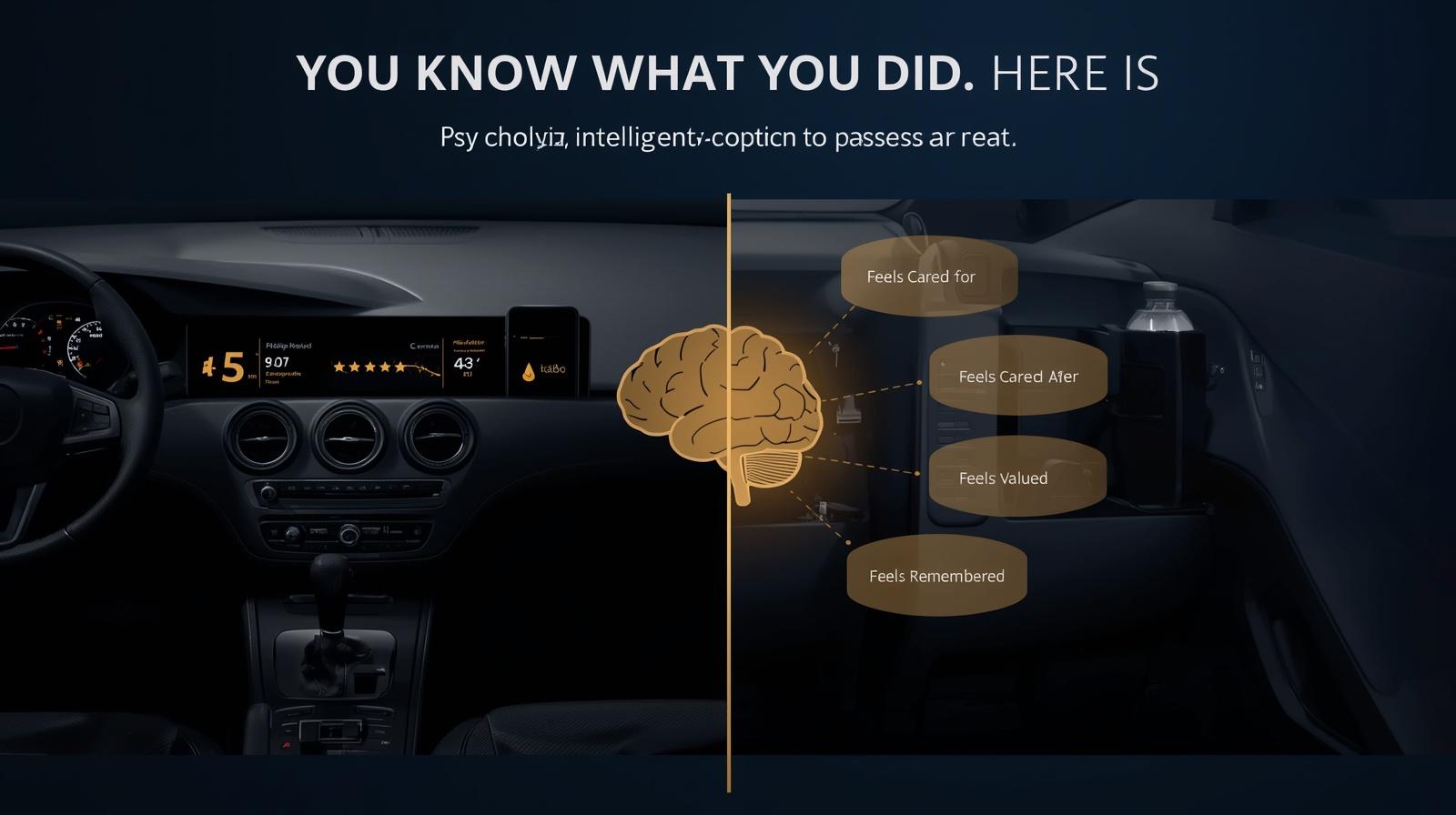
Passenger Psychology — What Every Rideshare Driver Needs to Know to Get Better Tips and Ratings
The Invisible Force That Determines Every Rating and Every Tip
You delivered a perfect ride.
Clean car. Smooth driving. On time. Professional greeting. Correct destination. No unnecessary conversation. Everything by the book.
Four stars.
No tip.
And you have no idea why.
Meanwhile the driver two cars ahead of you in the airport queue — whose vehicle is marginally less clean than yours, whose rating is 4.7 to your 4.9 — just received five stars and a $10 cash tip from a passenger who said "you are the best driver I have ever had."
Same airport. Same route. Similar vehicles. Dramatically different outcomes.
The difference between those two outcomes is not visible in any checklist. It is not captured by any platform metric. It cannot be manufactured through better cleaning products or a more precisely calibrated cabin temperature.
It is psychology.
Specifically — the driver who received the five stars and the $10 tip understood something about what was happening in their passenger's mind that the four-star driver did not. They understood what the passenger was actually experiencing emotionally during the ride. They understood what specific moments produced the feelings that translate into ratings and tips. And they made decisions — small, specific, entirely deliberate decisions — that shaped those feelings in the direction of maximum satisfaction.
This article is the complete psychological framework for understanding what passengers actually experience, what actually drives their rating and tipping behavior, and the specific techniques that use that understanding to produce consistently better outcomes from the same service quality.
The Psychological Reality of the Rideshare Experience — What Passengers Are Actually Feeling
Most drivers think about rideshare service in terms of what they do — the actions they take, the standards they maintain, the protocols they follow. Passenger psychology requires thinking about what passengers feel — the emotional experience that the driver's actions produce and that ultimately determines how the passenger evaluates the ride.
These are not the same thing.
A driver who takes a technically optimal route but does not communicate a brief detour produces a passenger who feels uncertainty — even though the route was better than the alternative. A driver who plays music the passenger did not request produces a passenger who feels the mild imposition of someone else's preference — even if the music is objectively pleasant. A driver who is mechanically professional but emotionally absent produces a passenger who feels processed rather than served — even if every physical standard was met.
Understanding the gap between what drivers do and what passengers feel is the foundation of the psychological framework.
The Passenger's Emotional Baseline at Pickup
Every passenger who enters your vehicle arrives with an emotional state that preceded the ride. That emotional state — their baseline — is not caused by you and cannot be fully controlled by you. But it is the single most important variable in how they experience and evaluate the ride.
Research in service psychology consistently shows that customers evaluate service quality not on absolute standards but on relative standards — specifically on whether the service exceeded, met, or fell below their emotional expectations given their current state. A passenger who arrives stressed and anxious experiences identical service quality more negatively than a passenger who arrives relaxed and unhappy — because the stressed passenger's expectation threshold is higher and their emotional resources for positive interpretation are lower.
The driver who reads and responds to the passenger's emotional baseline — rather than delivering identical scripted service to every passenger regardless of their state — is the driver who consistently produces ratings and tips above what their objective service quality would predict.
The Peak-End Rule — The Psychology Behind What Passengers Actually Remember
One of the most reliably documented findings in the psychology of service experience is the peak-end rule — the cognitive principle that people evaluate an experience primarily based on its most emotionally intense moment — the peak — and its final moment — the end — rather than on a comprehensive average of the entire experience.
For rideshare drivers this principle has specific and profound implications.
The peak moment of a rideshare experience is the moment of highest emotional intensity — either positive or negative. A water bottle offered at the exact moment a passenger realized they were desperately thirsty. A dashcam footage offered immediately when a passenger was worried about a dispute. A driver who recognized and responded to obvious distress. A moment of genuine human connection that surprised the passenger in its warmth.
These peak moments disproportionately determine the passenger's overall evaluation of the ride. A ride that was technically average but contained one genuine peak-positive moment will be evaluated more favorably than a technically excellent ride with no emotional peak.
The end moment — specifically the last 60 to 90 seconds of the ride — carries disproportionate weight because it is the most recently experienced and therefore the most accessible memory when the passenger opens the rating screen. A warm, genuine close that leaves the passenger feeling valued and cared for produces ratings above what the body of the ride would generate. An abrupt, perfunctory close that communicates urgency to move to the next ride degrades the rating below what the body of the ride would otherwise produce.
The practical implication is that a small investment in creating positive peak moments and a consistently professional close produces dramatically better ratings than evenly distributed service quality without these specific psychological anchors.
The Tipping Psychology — What Actually Makes Passengers Open the Screen
Tipping behavior in rideshare is driven by specific psychological mechanisms that most drivers do not understand — which is why most drivers experience tipping as random when it is actually predictable once the underlying psychology is known.
The Reciprocity Principle
The most fundamental driver of tipping behavior is the psychology of reciprocity — the deeply human tendency to respond to gifts and acts of generosity with equivalent generosity in return. When a driver does something for a passenger that the passenger did not expect and did not pay for they experience a psychological obligation to reciprocate — an obligation that in the context of a service relationship most naturally expresses itself as a tip.
The water bottle that costs the driver $0.30 triggers the reciprocity response. The charger cable handed over without being asked triggers it. The brief genuine compliment about their destination that communicates real interest in their experience triggers it. The proactive pull-over during a weather concern triggers it.
Each of these actions is small. Each of them costs almost nothing. And each of them activates the reciprocity psychology that makes tipping feel natural rather than optional to the passenger who experiences them.
The driver who never gives the passenger anything unexpected — who delivers exactly and only what the platform fare purchased — never activates the reciprocity response. Their passengers have no psychological trigger for above-baseline generosity and default to whatever their habitual tipping behavior is — which for many passengers is zero.
The Identifiability Effect
Research in charitable giving and tipping behavior consistently shows that people are more generous when they feel that their generosity specifically benefits an identified individual rather than an anonymous recipient.
In rideshare this effect operates through the personal connection between driver and passenger. A driver who has connected with a passenger — who knows their name, their destination, their purpose for the trip, even one small personal detail — has created identifiability. The passenger is not tipping an anonymous service worker. They are tipping a specific person whose face they have seen and whose story they partially know.
The brief genuine personal exchange — not manufactured small talk but a real moment of human connection — creates the identifiability that makes tipping feel personally meaningful rather than abstractly transactional.
The Social Norm Activation
Tipping behavior is heavily influenced by social norms — what the tipper believes the normal behavior is in their social context. When tipping feels normal and expected most people tip. When it feels optional and unusual most people do not.
Rideshare tipping operates in a norm-ambiguous context — unlike restaurant tipping where the social norm is strongly established, rideshare tipping is genuinely optional in most passengers' mental model. The driver who creates environmental and behavioral signals that normalize tipping — without ever explicitly requesting it — shifts the passenger's mental model toward tipping as the normal response to good service.
The professional close that expresses genuine gratitude for the business — without asking for a tip — activates the social norm that gratitude deserves reciprocation. The overall professional standard that communicates the driver takes their work seriously shifts the passenger's mental categorization from gig worker to professional service provider — a categorization that carries stronger tipping norms in most social contexts.
The Guilt-Free Permission Effect
Some passengers want to tip but do not because they are uncertain whether it is expected, appropriate, or possible. They have the generosity impulse but lack the psychological permission to act on it.
The driver who creates psychological permission — who makes tipping feel easy, natural, and appropriate through the overall professional standard and the specific ease of the tip interface — converts these already-motivated passengers from zero-tippers to consistent tippers without doing anything they were not already going to do for other reasons.
Mentioning the tipping option exists is not appropriate — it is explicitly requesting a gratuity which is tacky and counterproductive. Creating an environment in which tipping feels natural and easy does not require any explicit communication. It requires a professional standard that positions the service as tip-worthy and a close that makes the passenger feel genuinely served.
The Rating Psychology — What Actually Determines the Stars
Understanding why passengers give four stars instead of five — when four stars feels like praise to the passenger and is experienced as a penalty by the driver — is one of the most practically valuable pieces of psychological knowledge available.
The Reference Point Effect
Passengers do not rate rideshare experiences on absolute scales. They rate them relative to a reference point — the service level they expected going in. A passenger whose reference point is low — who has had consistently mediocre rideshare experiences — gives five stars to the same service that a passenger whose reference point is high — who has had consistently excellent experiences — gives four stars.
This means that managing passenger expectations is as important as managing passenger experience. A driver who subtly manages expectations downward — through a brief genuine apology for a minor issue that the passenger would otherwise not have noticed — and then delivers service that exceeds the adjusted expectation produces better ratings than a driver who allows high expectations to remain high and then delivers identical service.
The Negativity Bias in Ratings
Psychological research consistently shows that negative experiences have approximately twice the emotional impact of equivalent positive experiences. A single negative moment in an otherwise positive experience is weighted more heavily than two positive moments of equivalent intensity.
For rideshare drivers this means that the cost of negative moments is disproportionately high relative to their apparent magnitude. The brief impatient comment that the driver did not realize was impatient. The fraction-of-a-second irritated expression that was visible in the rearview mirror. The music that was turned down but not turned off when the passenger looked uncomfortable.
These micro-negatives carry disproportionate rating weight because of negativity bias. The driver who eliminates micro-negatives produces better ratings than the driver who adds more micro-positives while leaving existing micro-negatives unaddressed.
The Effort Heuristic
Research in consumer behavior shows that customers evaluate service quality partly through a heuristic — a mental shortcut — that equates visible effort with quality. When service looks effortful — when the customer can see that the provider cared and tried — they evaluate it more favorably than identical service that looks effortless.
For drivers this means that some visible elements of professional effort — the proactive temperature adjustment, the genuinely attentive close, the specific local knowledge that demonstrates preparation — produce better ratings than equivalent invisible effort because they activate the effort heuristic in the passenger's evaluation.
Personality Type Recognition — Adapting to the Passenger in Front of You
One of the most powerful applications of passenger psychology is the ability to recognize different personality types quickly and adapt service delivery accordingly. Not every passenger wants the same experience — and the driver who delivers identical service to every personality type is averaging across differences that are psychologically significant.
The Business-Mode Passenger
The business-mode passenger is the most common type in airport, corporate, and weekday morning contexts. They are using vehicle time productively — for calls, emails, documents, or mental preparation for the meeting ahead. Their primary need from the rideshare experience is professional quiet that protects their productive time.
The psychological error most drivers make with business-mode passengers is attempting to convert their work focus into social engagement — treating the lack of conversation as awkwardness to be remedied rather than professional preference to be respected.
The correct psychological approach is professional invisibility — being present and competent while making no demands on the passenger's attention. The business-mode passenger who arrives at their destination having completed their mental preparation undisturbed experiences the ride as a genuine professional service and rates accordingly.
The Social Passenger
The social passenger wants genuine human connection. They are not traveling for work and they are not decompressing from stress. They are in a social mood — curious about you, interested in the world, ready for an engaging conversation if the driver is willing to have one.
The psychological error with social passengers is mirroring their social energy with professional distance — treating them like a business-mode passenger when they have made clear that they want engagement. The social passenger who is professionally but warmly deflected experiences mild rejection — which produces a slight ratings drag even when the service was otherwise excellent.
The correct approach is genuine reciprocal engagement — not performed social warmth but real human interest in the person in your car. The social passenger who has a genuinely enjoyable conversation rates more enthusiastically and tips more generously than any other passenger type because the experience exceeded their expectations in a category — human connection — that they specifically valued.
The Anxious Passenger
The anxious passenger is worried about something. Maybe their flight. Maybe a meeting. Maybe something entirely unrelated to the trip. The anxiety expresses itself as urgency, as questioning, as a kind of low-level agitation that some drivers experience as demanding behavior.
The psychological error with anxious passengers is responding to the surface behavior — the questions, the requests for route confirmations, the urgency — with mild impatience that the passenger experiences as indifference to their distress.
The correct approach is anxiety-specific reassurance. Specific, calm, confident information — "we are on track to arrive at 8:47 and your flight does not board until 9:15" — addresses the anxiety directly rather than generically. The anxious passenger whose anxiety is specifically acknowledged and addressed with precise information experiences a significant reduction in distress — and that distress reduction, produced entirely by the driver, generates the emotional gratitude that produces exceptional ratings and generous tips.
The Tired Passenger
The tired passenger wants rest. Late night bar-close passengers. Early morning airport pickups. Business travelers at the end of a three-day trip. Their primary need is recovery — quiet, comfort, and the absence of demands on their depleted attention.
The psychological error with tired passengers is maintaining the same engagement level that works with other types — a greeting that is too energetic, a comfort check that requires a response, music that prevents the decompression they need.
The correct approach for tired passengers is minimum-demand service — a warm but brief greeting, immediate environmental optimization without asking, complete professional quiet from that point forward. The tired passenger who falls asleep in your car and wakes up at their destination is a passenger who experienced exactly what they needed. Their rating reflects that satisfaction even though the entire ride was spent unconscious.
The Distressed Passenger
The distressed passenger is experiencing something difficult. They may be crying quietly. They may be processing bad news. They may be in a situation that is visible in their demeanor even when they do not disclose it.
The psychological error with distressed passengers is either attempting to engage the distress directly — asking what is wrong, offering advice, attempting to cheer them up — or pretending not to notice it in a way that the passenger experiences as coldness.
The correct approach is compassionate professional presence — acknowledging the emotional climate of the ride without intruding on it. A brief, warm statement — "I hope the rest of your day gets better" at the close — communicates that you noticed and cared without demanding that they engage. The distressed passenger who feels seen without feeling interrogated experiences the ride as a moment of genuine care in a difficult day — and that experience produces the kind of specific, enthusiastic rating comment that raises your overall score above where pure service quality would place it.
The Language of Service — What to Say, How to Say It, and What Never to Say
The specific words, phrases, and tones that drivers use in passenger interactions have psychological effects that most drivers never analyze consciously. Understanding the language of service psychology allows drivers to make deliberate rather than habitual communication choices.
The Power of Specific Over Generic
Generic communication — "have a good day," "you are welcome," "thanks for riding" — produces generic emotional responses that do not register as memorable. Specific communication — "safe flight to Chicago," "I hope the meeting goes well," "enjoy the concert" — demonstrates genuine attention that registers as personal care.
The psychological effect of specific communication is disproportionate to its effort cost. Substituting "safe travels" with "safe flight to London — hope it goes smoothly" requires three additional words and produces a materially different emotional response because it demonstrates that the driver was paying attention to the passenger as an individual rather than processing them as an undifferentiated passenger unit.
The Framing Effect in Service Communication
The same information communicated in different ways produces different emotional responses. This is the framing effect — a well-documented psychological phenomenon with direct applications to driver-passenger communication.
"The traffic on the main route is bad so I am taking an alternative" — a neutral framing that provides information without emotional valence.
"I have found a better route that avoids the congestion ahead — it should save us about five minutes" — a positive framing of the same information that positions the driver as proactively solving a problem rather than reactively explaining a deviation.
The positive framing produces a better passenger experience not because the route is different but because the psychological experience of the communication is different. The driver is experienced as a professional making active decisions in the passenger's interest rather than a driver reacting to circumstances.
The Language That Never Works
Certain communication patterns consistently produce negative emotional responses in passengers regardless of the driver's intention.
Complaints about other passengers, the platform, or traffic — communicates that the driver experiences the job as burdensome and positions the current passenger in a negative professional context.
Excessive apology for minor issues — communicates uncertainty and incompetence rather than genuine regret, and draws attention to issues the passenger may not have noticed.
Unprompted personal opinions on politics, religion, or controversial topics — creates ideological friction that has no upside regardless of whether the passenger agrees with the opinion.
Discussing personal problems or financial difficulties — creates uncomfortable emotional obligation for the passenger who now feels responsible for the driver's wellbeing.
Multiple unsolicited observations about the passenger's appearance or personal life — creates the mildly uncomfortable dynamic of unwanted personal attention.
Each of these communication patterns activates specific negative psychological responses — discomfort, obligation, friction, imposition — that reduce ratings and tips regardless of how excellent every other element of the service was.
The Environmental Psychology of the Vehicle Cabin
The physical environment of the vehicle produces specific psychological effects that most drivers never analyze systematically — but that passengers experience constantly and unconsciously.
The Scent Effect
Scent is the sense most directly connected to emotional memory — olfactory information bypasses the cognitive processing centers and connects directly to emotional and memory areas of the brain. This means that cabin scent produces immediate emotional responses that are faster and more visceral than any other environmental variable.
A cabin scent that is neutral to mildly pleasant produces no emotional response — which is the correct target. A cabin scent that is strongly artificial — heavy air freshener, strong cologne — produces mild discomfort and the unconscious sense that something is being masked. A cabin scent that is unpleasant — food, smoke, body odor — produces immediate and powerful negative emotional responses that no amount of subsequent service excellence can fully overcome.
The scent psychology implication for drivers is precise — the target is neutral. Not pleasant. Not memorable. Neutral. A cabin that smells of nothing is psychologically perfect because it makes no negative emotional imprint while leaving the positive impressions created by actual service elements uncontaminated.
The Temperature Effect
Temperature has a documented psychological effect on social behavior and emotional state. Research in environmental psychology consistently shows that moderately warm temperatures — approximately 70 to 72 degrees Fahrenheit — produce more prosocial behavior and more positive emotional evaluations than cold temperatures or very warm temperatures.
The psychological interpretation is that warmth — literal physical warmth — activates the psychological associations of social warmth. A cabin that is slightly warmer than neutral does not just feel physically comfortable. It produces a mild but measurable increase in the passenger's prosocial orientation — their tendency toward warmth, generosity, and positive evaluation.
The practical implication is that the default cabin temperature for rideshare should be slightly warmer than the driver's personal comfort preference — not hot, but warm. The passenger who enters a warm cabin after waiting in cool air does not just feel physically comfortable. They feel welcomed.
The Sound Environment
Music in rideshare vehicles produces specific psychological effects that depend on the music's tempo, volume, and genre — and on whether the music was selected by the driver or the passenger.
High-tempo music increases arousal and urgency — the psychological state appropriate for a workout but counterproductive for a passenger who wants to decompress or work. Low-tempo music reduces arousal — appropriate for a tired or stressed passenger but potentially inappropriate for a social passenger who wants energy.
The absence of music produces a neutral sound environment that does not constrain the passenger's emotional state in any direction — which is why professional quiet is the correct default and music should be introduced only when the passenger indicates a preference.
When music is played the volume matters as much as the selection. Music at a conversational volume — where normal speech does not require raised voices — is psychologically unobtrusive. Music above that threshold makes the passenger work to communicate, which produces the mild irritation of a demand on their attention that they did not consent to.
The Complaint Psychology — Understanding What Actually Triggers Passenger Reports
Understanding why passengers file complaints — not the stated reasons but the underlying psychological triggers — allows drivers to address those triggers rather than just the surface behaviors.
The Fairness Violation
The most consistent trigger for passenger complaints is not bad service — it is the perception of unfairness. A passenger who believes they received worse service than they deserved, paid more than the service was worth, or was treated with less respect than their status as a paying customer warranted experiences a fairness violation that motivates complaint behavior.
The driver who maintains consistent professional standards across all passenger types regardless of apparent social status eliminates the fairness violation trigger. The driver whose service quality visibly degrades with certain passenger profiles — whose enthusiasm for the social passenger is in visible contrast to their indifference toward the anxious passenger — creates the fairness violation perception that motivates the most motivated complaints.
The Agency Restoration Motivation
Many complaints are not primarily intended to punish the driver. They are motivated by the passenger's need to restore a sense of agency — control over their experience — after feeling that agency was violated during the ride.
A passenger who felt unable to express a preference — who wanted the music turned off but did not feel able to ask — and who gave a lower rating does not primarily want the driver to be penalized. They want to communicate that their preferences were not consulted. The driver who eliminates the need for agency restoration by proactively consulting passenger preferences eliminates this complaint trigger at its source.
The Reciprocity Violation
Passengers who felt that their generosity — their tip, their enthusiastic conversation, their gratitude at the close — was not reciprocated with appropriate acknowledgment experience a mild reciprocity violation that motivates lower ratings.
The driver who receives a compliment without genuine acknowledgment, who accepts a cash tip without expressing real gratitude, or who ends a warm interaction with a perfunctory close creates a reciprocity violation that slightly deflates the rating from what the overall ride quality would have produced.
Building Direct Client Relationships Through Psychological Intelligence
Here is the connection between passenger psychology and direct booking conversion that most drivers never make.
The psychological principles that produce better ratings and tips are the same principles that convert satisfied passengers into direct booking clients.
The reciprocity response that produces a tip also produces the inclination to rebook directly. The identifiability effect that makes tipping feel personal also makes direct booking feel natural — you are not booking an anonymous service, you are booking this specific person. The peak moment that produces an enthusiastic five-star rating also produces the emotional memory that makes the passenger reach for their saved contact rather than opening the platform app next time.
RSG at rideshareguides.com gives every driver who has mastered the psychological framework of exceptional service the professional infrastructure to capture the direct booking conversions that framework produces. The passenger who experienced a peak-positive moment in your vehicle and is now in the emotional state most receptive to direct booking has a professional profile to connect with, a direct booking mechanism to use, and a verified professional identity to trust.
The psychological intelligence that produces better ratings produces better tips. The same intelligence that produces better tips produces better direct booking conversions. The compounding of these three outcomes — applied consistently across every passenger interaction — is what transforms good rideshare drivers into thriving independent transportation businesses.
Your Passenger Psychology Action Plan
This week: Before every ride spend thirty seconds thinking about the passenger's likely emotional baseline based on the pickup context — early morning airport, late night bar close, midday errand, business district — and prepare your service approach accordingly rather than defaulting to identical service for every type.
This week: Identify your current close — the last thirty seconds of every ride. Is it genuinely warm and specific or is it generic and perfunctory? Develop three to four specific closing statements for different passenger types and practice them until they feel natural.
This month: Audit your vehicle's scent environment honestly. Ask someone whose opinion you trust to assess the cabin scent without warning. Adjust toward neutral if any artificial or residual scent is detectable.
This month: Begin tracking which specific service elements produce the most explicit positive passenger responses — the comments, the tip increases, the specific enthusiasm at the close. These are your personal peak moment generators — the specific actions that produce the strongest reciprocity response in your specific client base.
This quarter: Apply the personality type recognition framework consciously for thirty days. Before every ride identify the likely personality type from available signals and adjust your service approach accordingly. Note which personality types you are most naturally calibrated for and which require the most conscious adjustment.
Ongoing: After every exceptional rating or tip notice — really notice — what specifically happened during that ride that you did not do in the rides that produced average ratings. The pattern that emerges is your personal psychological edge — the specific actions and moments that produce disproportionate positive responses from your specific passenger base in your specific market.
The rating on your profile is not a measure of how well you drive. It is a measure of how well you understand what passengers feel — and how deliberately you act on that understanding.
That understanding is learnable.
It starts with paying attention to the person in your back seat rather than the route on your screen.
Pay attention.
Understand the passenger. Serve the person. Build the business that both produce. 🚗🧠⭐
Sonnet 4.6
Comments
Sign in to join the conversation
Sign In