How to Go From Rideshare Gig Worker to Small Business Owner in 2026
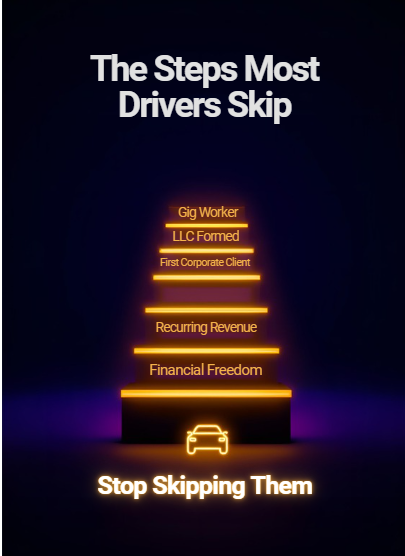
You Already Own a Business. You Just Have Not Claimed It Yet.
Every morning you check your schedule. You decide when to work and when to stop. You manage your own vehicle. You cover your own expenses. You file your own taxes. You are responsible for your own income when the platform is slow, when your car needs repair, and when life gets complicated.
That is not a gig. That is a business.
The only difference between you and a small business owner right now is paperwork and mindset. And the drivers who make that shift — who stop thinking of themselves as platform workers and start operating like the business owners they already are — do not just feel different. They earn differently. They protect themselves differently. They build something that compounds over time instead of resetting every Monday morning.
Here are the steps most drivers skip. And exactly why skipping them is costing real money.
Why This Matters More in 2026 Than Ever Before
The rideshare industry is not getting more generous. Platform cuts have increased. Surge windows have shortened. Deactivation policies have tightened. Drivers who built their entire income on a single platform relationship have watched that relationship change terms without warning and without recourse.
The drivers thriving in 2026 are the ones who treated the platform as one revenue channel among several — not as an employer, not as a partner, and definitely not as a safety net.
Formalizing your driving as a small business is not about complexity. It is about protection, legitimacy, and access to opportunities that are invisible to drivers who stay in gig worker mode.
Step One — Decide Who You Are Professionally
This sounds soft. It is not.
Every business decision you make flows from how you define what you do. A driver who sees themselves as someone who gives people rides will make different decisions than a driver who sees themselves as a professional transportation provider serving their local market.
The second identity opens doors the first one cannot reach. Corporate accounts. Hotel relationships. Event contracts. Direct bookings. Premium pricing. None of those conversations start with "I drive for Uber."
Take five minutes and write down your professional identity in one sentence. What do you provide, for whom, and what makes you the right choice. That sentence becomes the foundation of every business decision you make going forward.
Step Two — Form an LLC. This Week.
This is the step most drivers know they should take and keep postponing. Stop postponing it.
Forming a Limited Liability Company separates your personal finances from your business finances legally. That separation matters enormously for three reasons.
Personal asset protection. If something goes wrong on a ride — an accident, a dispute, a liability claim — an LLC creates a legal barrier between that event and your personal savings, your home, and your personal credit. Operating as an individual with no business entity means your personal assets are directly exposed.
Tax advantages. An LLC taxed as an S-Corporation allows you to pay yourself a reasonable salary and take the remainder of your business income as distributions — which are not subject to self-employment tax. For a driver netting $60,000 per year this structure can save $3,000 to $6,000 annually in taxes alone. That is money sitting on the table right now.
Credibility. When you approach a corporate client, a hotel, or an event company, handing them a business card that says your LLC name changes the conversation. You are not a gig worker looking for side income. You are a professional transportation business seeking a commercial relationship.
Forming an LLC costs between $50 and $500 depending on your state. LegalZoom, ZenBusiness, and your state's Secretary of State website all make the process straightforward. Most drivers can complete it in under an hour.
Step Three — Open a Dedicated Business Bank Account
This is the simplest step on this list and one of the most skipped.
When your business income and personal income flow through the same account, three bad things happen. Your bookkeeping becomes a nightmare. Your tax preparation becomes expensive and error-prone. And if you are ever audited, the IRS looks at commingled accounts as evidence that you are not operating a legitimate business — which can cost you every deduction you claimed.
Open a free business checking account the same week you form your LLC. Every ride payment goes in. Every business expense comes out. Your personal account never touches it.
This one change makes tax season dramatically simpler and keeps your business finances clean enough that a bookkeeper or CPA can work with them efficiently — saving you more than the account costs in professional fees alone.
Step Four — Get Your Tax Strategy Right From the Start
Most drivers discover their tax situation the hard way — a bill in April they were not prepared for and penalties for underpayment they did not know were coming.
Here is the framework that prevents both:
Set aside 25 to 30 percent of every deposit immediately. Move it to your tax account the day it hits your business account. Treat it as spent. It is not your money — it is the government's money that you are holding temporarily.
Make quarterly estimated tax payments. The IRS expects self-employed individuals to pay taxes four times per year — in April, June, September, and January. Missing these payments triggers underpayment penalties on top of the tax bill. Your state likely has the same requirement. Set calendar reminders now.
Track every deductible expense from day one. Mileage, gas, maintenance, insurance, phone, car washes, supplies, professional subscriptions, business meals with clients — every legitimate business expense reduces your taxable income dollar for dollar. Drivers who track obsessively pay dramatically less tax than drivers who reconstruct their expenses from memory in March.
Work with a CPA who understands self-employment. The cost of one annual session with a qualified tax professional is almost always recovered in deductions they identify that you would have missed. Ask specifically about S-Corp election, home office deduction if applicable, and vehicle depreciation options beyond the standard mileage rate.
Step Five — Build Your Professional Identity Online
A small business without a professional presence is invisible to the clients who would pay the most for its services.
This does not mean building a complex website or running paid advertising. It means having a verified, findable professional profile that communicates your credentials, your services, and your reliability to anyone who looks you up.
Think about the corporate client decision-making process. An office manager is considering hiring a driver for their executive team's airport transfers. They search your name. What do they find?
If the answer is nothing — or just an app profile — the conversation is over before it starts.
If they find a verified professional profile with your photo, your vehicle details, your service offerings, your ratings, and a clear way to contact and book you directly — that is a business they can trust with their executives.
This is exactly what RSG at rideshareguides.com provides free to every driver who joins the platform. Your RSG profile is your professional business identity online — a verified driver profile, a Personal Driver ID that signals legitimacy, and a digital business card that makes direct booking effortless. For drivers making the transition from gig worker to small business owner it is the fastest way to establish the professional presence that corporate clients and direct booking passengers expect.
Step Six — Create a Simple Service Menu and Pricing Structure
Businesses have prices. Gig workers accept whatever the platform offers.
Sit down and define what you offer and what you charge for each service. Airport transfers. Executive hourly travel. Event transportation. Corporate account rates. Long distance runs. Each service should have a clear rate that reflects your costs, your market, and the value you deliver.
Having defined pricing does three things. It forces you to understand your own economics — you cannot set a profitable rate without knowing your true cost per mile. It makes client conversations clean and professional instead of awkward negotiations. And it signals to prospective clients that you are running a real operation with real standards.
Your pricing does not need to be the cheapest in the market. It needs to be fair for the value you deliver consistently.
Step Seven — Build Recurring Revenue Streams
A small business that depends entirely on one-time transactions is fragile. A small business with recurring revenue is stable.
For a transportation provider recurring revenue looks like this:
Monthly retainer clients who pay a flat fee for a guaranteed number of rides per month. Predictable for them. Predictable for you.
Standing weekly bookings with corporate clients who need the same airport transfer every Monday morning and Friday afternoon. Same time. Same route. Confirmed in advance.
Preferred vendor relationships with hotels, event companies, and medical facilities that generate consistent referral volume without requiring you to market actively.
Direct booking clients who have saved your contact and rebook you personally instead of opening the app. Every direct booking client you earn reduces your dependence on platform income and improves your margin on every ride.
Each of these revenue streams takes time to build. None of them happen without deliberately pursuing them. But each one you add makes your business more resilient and your income more predictable than any surge window the platform will ever offer you.
Step Eight — Track Your Business Like a Business
Gut feel is not a financial strategy.
Every week you should know your gross revenue, your expenses by category, your net income, your cost per mile, your revenue per hour including dead time, and your progress toward your monthly income target.
This is not complicated. A simple spreadsheet updated weekly takes 15 minutes. Apps like Wave, FreshBooks, or QuickBooks Self-Employed make it even easier by connecting directly to your bank account and categorizing expenses automatically.
Drivers who track these numbers make better decisions. They know which days are profitable and which are not. They know when to drive and when staying home costs them nothing because the math does not work. They know exactly how much one new corporate account would move their monthly net.
Knowledge is leverage. And in a business where your margins are determined by dozens of small decisions every day, the drivers who know their numbers have a permanent advantage over the ones who do not.
The Shift That Changes Everything
Here is what nobody tells you about making this transition.
The paperwork is not the hard part. The LLC filing is one afternoon. The bank account is one morning. The tax setup is one conversation with a CPA.
The hard part is the mindset. Stopping the habit of thinking like someone waiting to be assigned work and starting the habit of thinking like someone who owns a business and is responsible for building it.
That shift changes how you present yourself to passengers. It changes how you approach corporate clients. It changes how you think about every hour you spend behind the wheel — not as time rented to a platform but as time invested in a business you are building.
The drivers who made that shift in 2024 and 2025 are the ones with corporate accounts, direct client bases, and income that does not reset when the platform changes its algorithm.
The drivers who make it in 2026 will be saying the same thing in two years.
Your Action Plan Starting This Week
Today: Write your professional identity statement. One sentence. Who you serve, what you provide, and why you are the right choice.
This week: Research LLC formation in your state. Most drivers can complete the filing in under an hour for under $200.
Next week: Open a dedicated business bank account. Move all ride income into it from this point forward.
This month: Set up your quarterly tax payment schedule. Download a mileage and expense tracking app. Book one session with a CPA who works with self-employed clients.
This quarter: Build your professional online profile. Define your service menu and pricing. Identify your first three corporate account targets and make contact.
This year: Add one recurring revenue stream per quarter. By December you will have a business that looks, operates, and earns like one.
The gig economy gave you flexibility. The small business mindset gives you freedom. They are not the same thing — and only one of them compounds.
Stop renting your labor. Start owning your business. 🚗
Comments
Sign in to join the conversation
Sign In