How to Build a Transportation Business That Runs Without You — Scaling Beyond Solo Driving
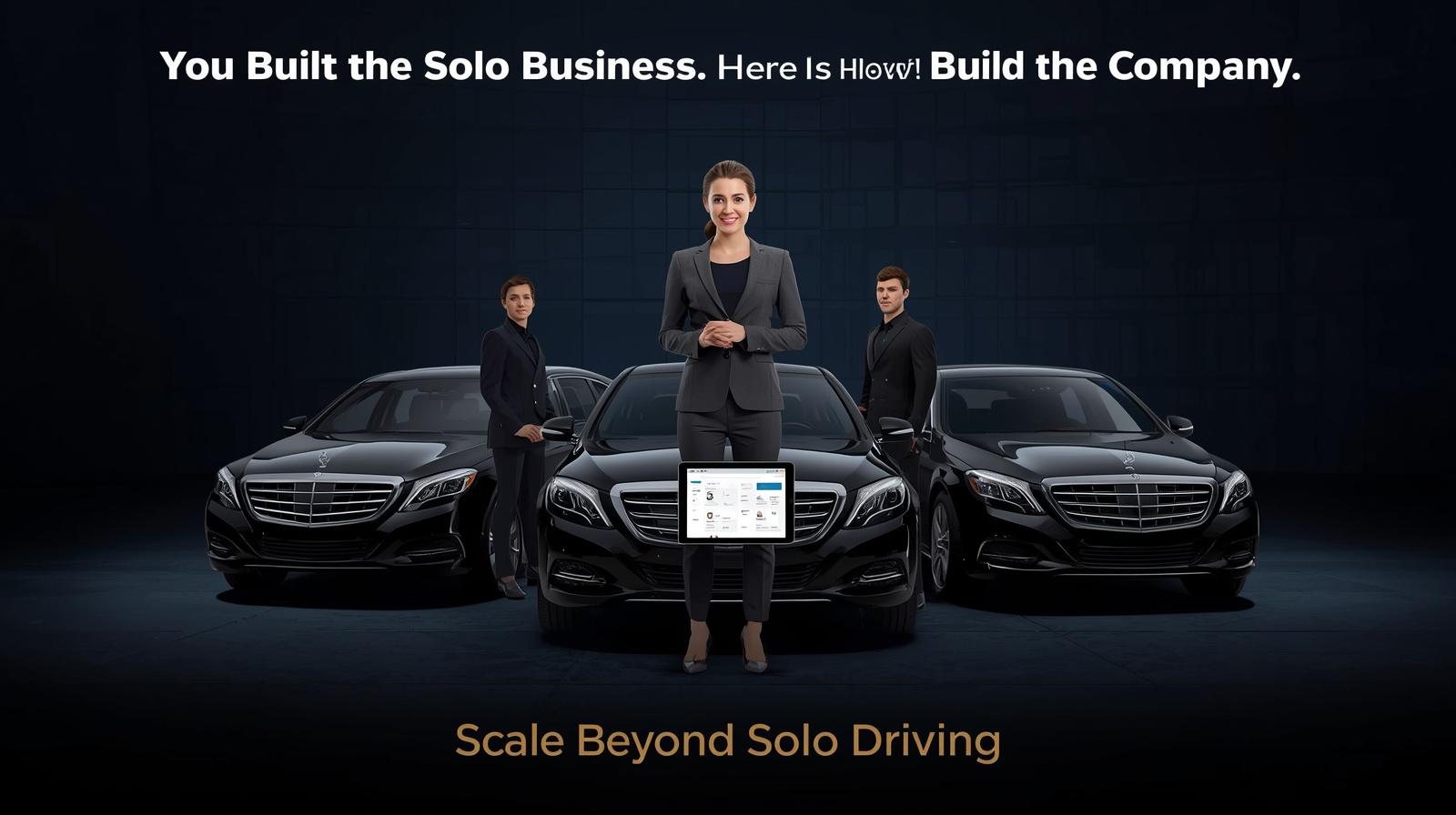
The Ceiling Every Solo Driver Eventually Hits — And What Exists on the Other Side
There is a moment that comes for every rideshare driver who has done everything right.
You built the direct booking clients. You landed the corporate accounts. You developed the medical transport relationships. You have the luxury tier vehicle and the five-star rating and the referral system generating new clients every month. You are working the right shifts at the right times in the right zones.
And then you hit the wall.
Not a financial wall. Not a motivation wall. Not a skill wall.
A physical wall.
There are only 24 hours in a day. You can drive for eight of them — maybe ten on a strong week. The income ceiling of a solo transportation operator is determined entirely by the number of hours one person can professionally drive a vehicle — and that number is fixed. No strategy, no technology, no professional development changes the fundamental arithmetic of one driver, one vehicle, one shift at a time.
The drivers who break through that ceiling are the ones who make a specific decision — the decision to stop thinking about their business as a driving job and start thinking about it as a transportation company that happens to currently employ one driver.
That decision changes everything.
The business that runs without you is not a fantasy for transportation operators with deep pockets and industry connections. It is the deliberate result of specific structural decisions — legal, operational, financial, and human — that transform a solo driving practice into a scalable transportation business that generates income whether you are behind the wheel or not.
This article is those decisions. Every one of them. In the sequence that makes each step possible and each subsequent step inevitable.
The Mindset Shift That Makes Scaling Possible
Before any structural decision can be made effectively the mindset that underlies those decisions needs to change — specifically and completely.
The solo driver mindset evaluates every decision through a single lens: does this make my driving more profitable? The transportation business owner mindset evaluates decisions through a different lens: does this make the business more valuable, more scalable, and more capable of operating without my direct personal involvement?
These two lenses produce different answers to the same questions.
The solo driver who is considering a second vehicle asks: can I afford the second vehicle payment? The transportation business owner asks: is there sufficient demand in my market to justify a second vehicle and can I identify, qualify, and manage a driver who can deliver the service standard my clients expect?
The solo driver who is considering corporate accounts asks: how much more can I earn per ride? The transportation business owner asks: what account structures, rate agreements, and service guarantees allow me to sell transportation capacity at the company level rather than ride-by-ride?
The solo driver who is considering technology asks: which app makes my driving more efficient? The transportation business owner asks: what technology infrastructure allows me to manage a multi-vehicle, multi-driver operation professionally from a central system?
The mindset shift is not about abandoning the skills and standards that made the solo operation successful. It is about applying those skills and standards to the design of a system that replicates and exceeds them without requiring your personal presence in every vehicle on every shift.
The Legal and Structural Foundation for a Scalable Transportation Business
Upgrading From Single-Member LLC to Multi-Member Business Structure
The single-member LLC that is appropriate for a solo driver may need to be restructured as the business scales. The specific structure that works best depends on the scale of the operation, the number of drivers, and the tax optimization goals — and requires guidance from both a business attorney and a CPA who understands transportation business structures.
The S-Corporation election — available to LLCs that meet eligibility requirements — becomes increasingly valuable as the business generates income beyond what one driver's labor produces. The S-Corp structure allows the business owner to take a reasonable salary and receive the remainder of the business income as distributions not subject to self-employment tax — a tax efficiency that produces material savings at the income levels a multi-vehicle transportation operation generates.
Partnership structures for businesses with co-founders or equity partners require specific operating agreements that define ownership percentages, decision-making authority, profit distribution, and the terms under which a partner can exit or be bought out. A business partnership without a formal operating agreement is a source of future conflict that the initial excitement of building something together tends to obscure.
The holding company structure — where a parent holding company owns the operating transportation business — provides liability separation between the business's assets and operations that becomes increasingly important as the business grows. A single vehicle accident that generates a liability claim larger than the insurance coverage should not threaten the entire business's assets — and a properly structured holding company provides the legal separation that prevents that outcome.
Consult a business attorney before making any structural changes as the business scales. The cost of one attorney consultation is infinitesimal compared to the cost of a structural error that becomes apparent during a tax audit, a liability claim, or a partnership dispute.
Commercial Insurance — The Non-Negotiable Upgrade
A solo driver with a rideshare endorsement on a personal policy is insured for solo operation. A business that employs drivers in multiple vehicles requires commercial fleet insurance — a fundamentally different product category that covers the business's liability, the vehicles' value, the drivers' activity, and the passengers' safety across an entire fleet operation.
Commercial fleet insurance costs significantly more than personal insurance with rideshare endorsements — typically $3,000 to $8,000 per vehicle per year depending on the vehicle type, the market, the drivers' records, and the coverage levels selected. This cost is a legitimate business expense, is fully tax-deductible, and is non-negotiable from both a legal and an ethical standpoint.
A transportation business that employs drivers in client-facing vehicles without proper commercial fleet coverage is operating with a liability exposure that no amount of income justifies. The first significant accident that occurs in an under-insured vehicle can end the business financially — and potentially personally if the liability exceeds the business's coverage and pierces the corporate veil to reach the owner's personal assets.
Get commercial fleet coverage before the second vehicle is on the road. Not after. Before.
Business Licenses and Transportation Permits
Local transportation regulations vary significantly by market and by service type. What is legally required for a solo driver operating under platform licenses may be insufficient for a multi-vehicle transportation company providing direct client services.
Research your specific market's requirements for:
For-hire vehicle licenses — many municipalities require separate licensing for vehicles used in commercial transportation beyond the platform's operating authority.
Transportation network company operating authority — some markets require independent transportation companies to obtain specific operating authority beyond what individual drivers carry.
Commercial vehicle registration — vehicles used primarily for commercial transportation may require commercial rather than personal registration, which affects both the registration cost and the insurance requirements.
ADA compliance — transportation companies serving the public in most commercial contexts are subject to Americans with Disabilities Act requirements that affect fleet composition, accessibility features, and service delivery standards.
The regulatory compliance cost of scaling a transportation business is real and variable by market. Research it completely before committing to a scaling timeline — discovering a regulatory requirement after the second vehicle is already in service is significantly more expensive than discovering it before.
The Driver Development System — Finding, Qualifying, and Retaining Professional Drivers
This is the operational challenge that determines whether a transportation business scales successfully or fails in the attempt. The quality of the drivers in your fleet is the quality of your business — because your clients are experiencing your brand through those drivers' conduct in every vehicle on every shift.
The Driver Profile — What You Are Actually Looking For
The instinct when hiring first drivers is to look for drivers who are similar to yourself — the professional standards, the service philosophy, the work ethic, the client focus. That instinct is correct but it requires translation into specific, measurable, observable qualities that can be assessed through a hiring process rather than assumed from a good first impression.
Verifiable professionalism. A driver who has their own RSG profile at rideshareguides.com — who has invested in building a verified professional identity independently — is a driver who thinks about transportation as a profession rather than a gig. This self-initiated professional investment is one of the most reliable indicators of the professional standard your business requires.
Clean driving record. A motor vehicle record check — available through your state DMV or through a background check service — reveals the specific driving history that determines both the driver's safety profile and their insurability under your commercial fleet policy. Drivers with serious violations — DUI, reckless driving, multiple at-fault accidents — are either uninsurable or prohibitively expensive to insure. Know this before making any hiring commitment.
Professional references from transportation contexts. A driver who has been a platform driver for two or more years with a 4.8 or above rating has a verifiable professional track record. A driver who has direct booking clients who will provide a reference has an even more compelling one. The references that matter are not character references from friends — they are professional references from transportation contexts that demonstrate the service standard your clients will experience.
Financial stability and personal responsibility signals. A driver who manages their own vehicle, their own insurance, their own taxes, and their own professional development without being managed is a driver who can operate professionally within your system. A driver who needs constant oversight and correction is a driver whose management cost exceeds their value.
The Independent Contractor vs Employee Decision
This is the most consequential legal and financial decision in building a transportation business that employs drivers — and it is the one that most scaling operators get wrong because the wrong answer is the cheaper-looking one.
The independent contractor model — engaging drivers as 1099 contractors rather than W-2 employees — is less expensive in the short term because it avoids employer payroll taxes, workers compensation insurance, and employee benefit obligations. It is also legally precarious in transportation contexts because the IRS and many state labor agencies apply specific tests to determine whether a worker is genuinely an independent contractor or a misclassified employee.
A driver who operates exclusively for your transportation business, drives vehicles you own or control, follows your service standards and client protocols, works the schedules you assign, and is subject to your operational oversight is almost certainly an employee under most applicable legal tests regardless of what the contract says.
Misclassifying employees as independent contractors produces back-payroll-tax liability, penalties, and in some cases damages that can be financially catastrophic for the business. The regulatory enforcement environment for worker classification in transportation contexts has intensified significantly in recent years.
The employee model — engaging drivers as W-2 employees — is more expensive in the short term and administratively more complex. It is also legally defensible, creates a clearer management relationship, and produces a workforce whose professional standards you can enforce rather than merely request.
For a transportation business that owns vehicles, sets service standards, and controls client relationships the employee model is almost certainly the legally appropriate choice regardless of how many independent contractor models in similar businesses have avoided enforcement to date.
Consult an employment attorney before engaging your first driver. The employment law landscape in your specific state matters — some states have particularly strict worker classification standards that make the independent contractor model even more precarious than the federal standard suggests.
The Driver Training System
The service standard your clients expect is the standard you have personally delivered to earn their trust. Replicating that standard in other drivers requires a training system — a documented, repeatable process for communicating what excellence looks like and developing the skills and habits that produce it.
A driver training system for a professional transportation business includes:
Service standard documentation. Written standards for every element of the client experience — vehicle condition, professional appearance, greeting protocol, communication during the ride, luggage handling, professional close, client follow-up. Standards that live only in your head cannot be taught, assessed, or enforced.
Vehicle operation training. The specific techniques — smooth driving, defensive awareness, weather operation, route planning — that your professional standard requires. Some of these techniques are teachable in a brief formal session. Others develop through supervised driving with feedback.
Client communication training. The specific language, tone, and communication protocols that your corporate and direct booking clients expect. A driver who communicates informally with a client whose account was built on formal professional communication produces the client relationship damage that formal communication is specifically designed to prevent.
Technology and operations training. The specific tools — booking systems, scheduling apps, invoicing software — that your operation uses. A driver who cannot operate the technology that runs the business is a driver whose operational errors create client-facing problems.
Supervised period with feedback. The most effective training protocol includes a supervised driving period — where the new driver operates under observation and receives specific, constructive feedback before taking client assignments independently. This period is an investment that prevents the client relationship damage from an untrained driver's first independent mistakes.
Driver Retention — The Most Underrated Operational Priority
Every driver you lose is a training cost, a service disruption cost, and a client relationship risk you absorb simultaneously. The best transportation businesses maintain high driver retention rates not through contractual obligation but through the quality of the working relationship they provide.
Competitive compensation. Drivers who earn significantly below what they could earn through platform driving or competing transportation companies will leave — not immediately but eventually. Pay rates that reflect the professionalism you require and the clients you serve retain the drivers who produce the standard those clients expect.
Clear performance standards and feedback. Drivers who know exactly what is expected of them and who receive regular, specific, constructive feedback perform better and stay longer than drivers who operate in ambiguity and receive feedback only when something goes wrong.
Professional development investment. A driver who sees investment in their professional development — training certifications, advanced driving courses, first aid qualification — sees a business that values them as a professional rather than as an interchangeable labor unit. That valuation produces the loyalty that low turnover requires.
Transparent operations and communication. Drivers who understand the business — its clients, its standards, its financial model, its growth direction — are engaged employees rather than disengaged labor. Transparency about where the business is going and how their role contributes to getting there produces the engagement that distinguishes professional transportation operators from gig economy enterprises.
The Client Infrastructure for a Multi-Driver Business
The client relationships you built as a solo driver need structural upgrading when the business scales beyond your personal operation. A corporate client who built a relationship with you personally needs to understand how that relationship translates when a different driver in your fleet shows up for their Monday morning pickup.
The Brand Promise That Transcends the Individual Driver
The transition from a personal transportation relationship — where the client is booking you specifically — to a business relationship — where the client is booking your company's service with confidence in the standard regardless of which driver delivers it — requires a brand promise that is credible and specific.
The brand promise is not a marketing slogan. It is a service guarantee — the specific, measurable, enforceable standard that your clients can rely on from every driver in your fleet on every ride. A written service agreement that specifies vehicle standards, driver presentation standards, on-time performance standards, and client communication protocols translates your personal service standard into a contractual company standard that survives beyond your personal involvement in every ride.
The Service Level Agreement for Corporate Accounts
Corporate accounts that were established on the basis of your personal service need to be re-contracted on the basis of your company's service level agreement as the business scales. A service level agreement — SLA — for corporate transportation typically specifies:
Minimum vehicle standards — make, model year, condition requirements. Driver qualification standards — background check, driving record, training certification. On-time performance guarantee — specific percentage of pickups within a defined time window. Cancellation and substitution policy — how the company handles driver unavailability and how clients are notified. Rate structure and payment terms — specific rates by service type, invoicing schedule, and payment method. Escalation and complaint resolution process — specific contact and response time for service issues.
A corporate client who receives and approves a professional SLA from your transportation company has made a business-to-business commitment rather than a personal-relationship booking. That distinction is the structural foundation of the scalable corporate account relationship.
The Technology Infrastructure for Multi-Vehicle Operations
Managing a solo operation from a single phone is adequate. Managing a multi-vehicle, multi-driver, multi-client transportation operation from a single phone is not.
The technology stack for a scalable transportation business requires specific tools that the solo driver tech stack does not include.
Fleet Management Software
Ground Alliance and TripMaster are fleet management platforms specifically designed for ground transportation businesses. They manage driver scheduling, vehicle dispatch, client booking, invoicing, and GPS tracking in a single system — replacing the manual coordination that becomes unmanageable as the fleet grows beyond two or three vehicles.
Samsara provides GPS fleet tracking, driver behavior monitoring, and maintenance scheduling in a commercial fleet context. The driver behavior data — hard braking events, speed violations, idle time — provides the specific, objective performance data that professional driver management requires.
Booking and Dispatch Systems
Ground Alliance Dispatch and iCabbi are dispatch systems designed for professional transportation companies that manage client bookings, driver assignments, and real-time tracking in a coordinated system. These platforms replace the manual booking management that works for a handful of direct clients and fails at twenty or fifty.
A white-label booking app — a client-facing mobile application that presents your transportation company's brand rather than a generic booking interface — is the technology investment that transforms your company's perceived professionalism from independent driver to professional transportation operator in the client's experience.
Accounting and Payroll Systems
QuickBooks Payroll for driver compensation management — the payroll processing that W-2 employment requires — integrated with QuickBooks accounting for the complete financial management of a multi-revenue, multi-expense transportation operation.
Stripe or Square for Business — payment processing systems that handle corporate invoicing, direct client payment collection, and the financial reporting that multi-account business management requires.
The Revenue Architecture of a Scalable Transportation Business
The revenue model of a multi-vehicle transportation business is fundamentally different from the revenue model of a solo operation — and understanding that difference is what allows the business to be structured around sustainable unit economics rather than the gross revenue that solo drivers tend to optimize.
Unit Economics — The Number That Determines Scalability
The unit economics of a transportation business are calculated per vehicle per month — the gross revenue a single vehicle generates minus the direct costs of operating that vehicle including the driver's compensation, the vehicle's operating costs, and a proportional share of the business's overhead.
A vehicle that generates $8,000 per month in gross revenue with $5,500 in direct costs — driver compensation of $3,500, vehicle operating costs of $1,200, proportional overhead of $800 — produces $2,500 in contribution margin per month. That contribution margin is what the business retains after covering the direct costs of that vehicle's operation.
A business with four vehicles each generating $2,500 in contribution margin produces $10,000 per month in total contribution margin — from which the fixed overhead costs of the business are covered and the owner's compensation is drawn.
Understanding and calculating unit economics before adding each vehicle is the financial discipline that prevents the common scaling mistake of adding capacity before the unit economics support profitable operation at scale.
Service Mix Optimization
A scalable transportation business is not a rideshare operation at scale. It is a multi-service transportation company whose revenue is distributed across service types that together produce better unit economics than any single service type alone.
The service mix that produces the strongest unit economics in most markets combines:
Corporate account standing rides — the highest-margin, most predictable revenue category. Airport transfer direct bookings — consistent volume with predictable route economics. Medical transport contracts — reliable but lower-margin revenue that fills scheduling gaps. Event transportation — high-margin concentrated revenue that requires specific scheduling management. Platform rides for drivers whose schedules have unfilled capacity — the lowest-margin category that fills gaps rather than anchors the business.
The specific mix that maximizes unit economics in your market requires your specific market data — the rates achievable in each category, the volume available in each category, and the operating costs specific to your vehicles and your market.
The Transition Plan — From Solo Driver to Business Owner
The transition from solo driver to transportation business owner is not a single moment. It is a deliberate multi-phase process that manages the financial risk of the transition while building the infrastructure that eventually supports the fully scaled operation.
Phase One — Foundation Building (Months One Through Six)
During this phase the solo operation continues generating income while the business infrastructure is built alongside it. The specific actions of Phase One:
Complete the legal and structural upgrades — LLC review, S-Corp election assessment, operating agreement for any partnership structure. Research and obtain commercial fleet insurance quotes. Establish the driver qualification standards and training system documentation. Build the SLA templates for corporate account re-contracting. Research fleet management technology options. Calculate the unit economics of a second vehicle in your specific market and service mix.
Phase One costs time rather than capital — the infrastructure building happens alongside the solo operation rather than requiring the transition to start first.
Phase Two — First Driver Addition (Months Seven Through Twelve)
The second vehicle and first driver are the most consequential scaling decision — the proof of concept for the business model. Every subsequent scaling decision is easier when the first driver addition succeeds and more cautious when it reveals problems.
Hire deliberately and train extensively. The investment in the first driver's training is the highest-return training investment the business makes — because the lessons learned from the first driver's onboarding inform every subsequent hiring process.
Begin the process of transitioning corporate clients from personal relationships to business relationships — introducing the service level agreement, the new booking protocol, and the assurance that the service standard they built their relationship around is guaranteed by the business rather than dependent on your personal availability.
Track unit economics from the first week of the second vehicle's operation. The data from the first full month of two-vehicle operation is the most valuable financial information the business has produced — it tells you whether the unit economics support continued scaling or whether adjustments are needed before the third vehicle is added.
Phase Three — Systematic Scaling (Year Two and Beyond)
Once the first driver addition succeeds and the unit economics confirm scalability the third, fourth, and fifth vehicles can be added at a pace the business's financial performance supports.
The operational systems that were adequate for two vehicles need review at each scaling milestone. The technology infrastructure that managed three vehicles may need upgrading at six. The management approach that worked when you knew every driver personally needs evolution when the fleet grows beyond your personal oversight capacity.
The business owner who scales successfully is the one who consistently asks not just whether the unit economics support adding another vehicle but whether the operational infrastructure supports managing that vehicle to the standard the business's clients expect.
The Owner's Role in the Scaled Business
Here is the question most solo drivers never ask when they imagine building a transportation business that runs without them — what do I actually do when I am not driving?
The answer is everything the business needs that is not driving.
Client relationship management. Driver development and performance management. Financial oversight and cash flow management. Business development — new corporate accounts, new service categories, new market opportunities. Strategic planning — which markets to expand into, which service types to add, which technology investments to make.
These are not driving skills. They are business owner skills — and developing them while the solo operation still generates income is the preparation that makes the transition from driver to owner achievable rather than aspirational.
RSG at rideshareguides.com supports this transition directly. The verified professional identity that started as a solo driver's direct booking tool becomes the foundation of the transportation company's professional presence. The direct booking clients that built the solo income become the corporate account anchors of the scaled business. The referral network that generated individual client introductions becomes the business development infrastructure that produces fleet-level account relationships.
The business that runs without you was built from the same foundation as the driving business that you ran yourself. The difference is not where you started. It is the decision you made about where you were going.
Your Scaling Action Plan
Today: Calculate the unit economics of a potential second vehicle in your market. Use your current direct booking rate structure, your current operating costs, and a realistic driver compensation estimate for your market. Determine whether the contribution margin supports a second vehicle before any other scaling decision is made.
This week: Schedule a consultation with a business attorney to review your current legal structure and discuss the structural requirements of a multi-driver operation. The legal foundation needs to precede every operational decision.
This week: Contact three commercial fleet insurance providers for quotes on a two-vehicle operation. Know the insurance cost before you know whether the unit economics support it.
This month: Document your service standards completely. Write down every element of the client experience your direct booking clients have come to expect. This documentation is your training system foundation — and building it now, while your own execution is current and clear, produces a better training system than reconstructing it later from memory.
This month: Begin identifying your first driver prospect. Look for drivers with RSG profiles, strong platform ratings, and the professional references that indicate genuine service standard alignment. The right first driver is more important than the timing of the first driver — wait for the right person.
This quarter: Complete Phase One of the transition plan. Have the legal structure, the commercial insurance, the service standards documentation, and the first driver candidate identified before any vehicle is added.
This year: Execute Phase Two. Add the first driver, track the unit economics, transition corporate clients to the SLA-based relationship, and build the operational data that determines the Phase Three scaling pace.
The ceiling you hit as a solo driver is not the ceiling of your market.
It is the ceiling of one person operating one vehicle.
The market ceiling is significantly higher — and the business that accesses it is the one you build when you stop asking how to drive better and start asking how to build better.
Build better.
Scale deliberately. Build systematically. Own the business that outlasts the driver. 🚗🏢💰
Comments
Sign in to join the conversation
Sign In