How Professional Rideshare Drivers Build Referral Networks That Generate Income Around the Clock in 2026
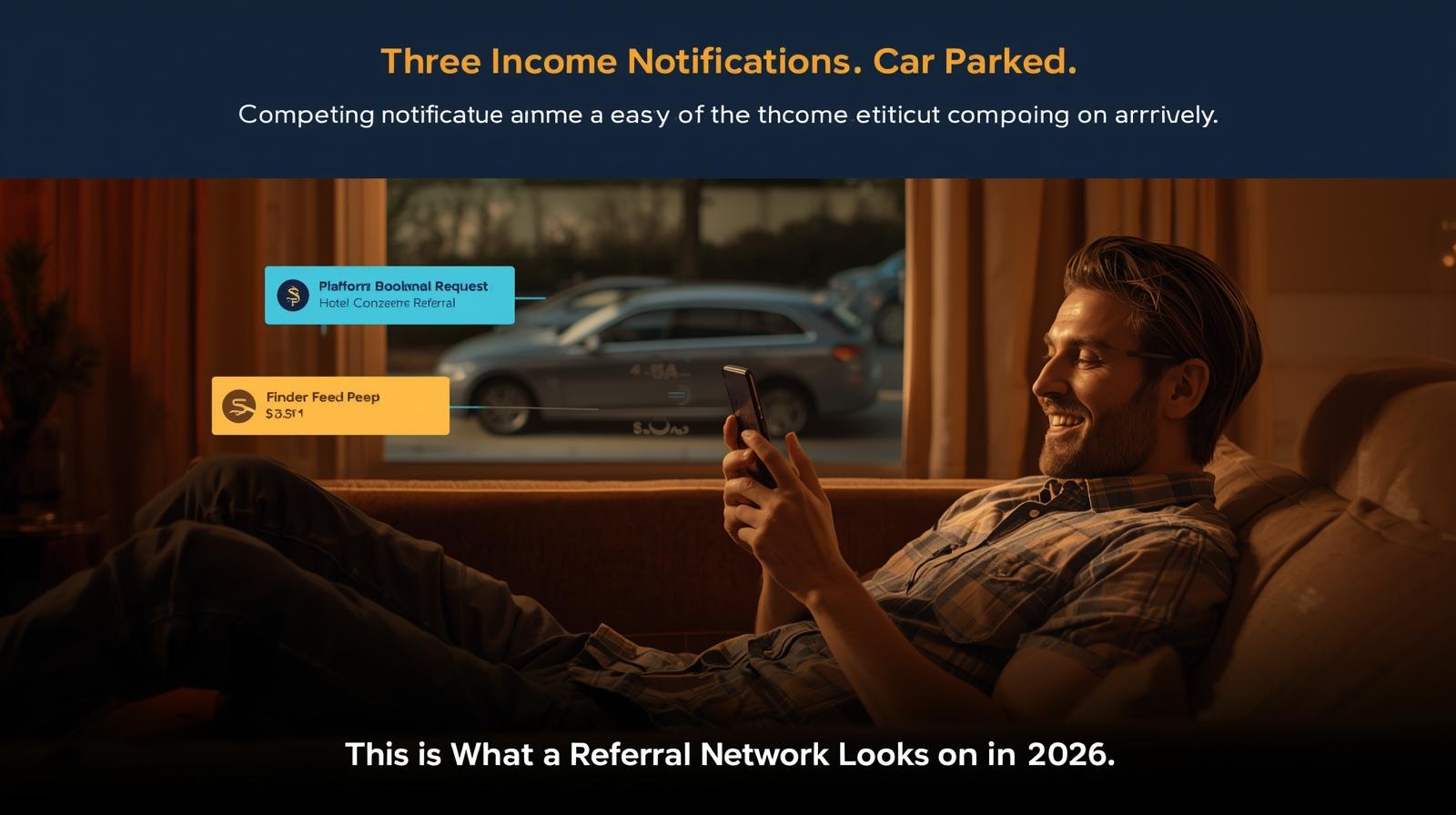
The Income That Arrives Without Turning the Key
There is a category of rideshare income that most drivers do not know exists.
Not surge income. Not bonus income. Not the extra tip from the passenger who appreciated the water bottle.
Income that arrives in your account while you are eating dinner. While you are watching a game. While you are sleeping. Income generated not by miles driven but by relationships built — by the deliberate construction of a referral network that sends clients to you, sends other drivers to platforms through your code, and creates value chains that compound month after month without a single additional mile on your odometer.
The drivers building this income are not working harder than you. They are not driving more hours or covering more ground or chasing better surge windows.
They built something most drivers never think to build — a referral architecture that generates income from their knowledge, their relationships, and their professional reputation rather than exclusively from their time behind the wheel.
This is exactly how they did it. And exactly how you can build the same architecture starting this week.
What Referral Income Actually Means for Independent Drivers
Before getting into specific strategies it helps to understand the full landscape of referral-based income available to rideshare and independent drivers — because it is significantly broader than most drivers realize.
Platform driver referrals — the most familiar category. Both Uber and Lyft pay bonuses when an existing driver refers a new driver who completes a qualifying number of trips. The referral code system is built into both platforms and accessible to every driver.
Passenger referrals to direct booking clients — when a satisfied passenger refers a friend, colleague, or family member to your direct booking service you have received a referral that generates ongoing income without any marketing cost.
Professional referral partnerships — formal or informal arrangements with businesses, concierges, social workers, event planners, and other professionals who regularly refer clients needing transportation to drivers they trust.
Driver community referrals — arrangements between drivers in the same market where overflow bookings, out-of-area requests, and specialty service needs are referred between trusted professional connections rather than lost entirely.
Service provider referral networks — relationships with complementary service providers — moving companies, wedding planners, corporate travel managers — who refer transportation needs to trusted drivers as part of their own service delivery.
Each of these referral categories has different mechanics, different income potential, and different relationship requirements. Understanding all of them is what allows top drivers to build referral architectures that generate income across multiple channels simultaneously.
Platform Driver Referrals — The Foundation Most Drivers Underuse
Platform driver referral programs are the most accessible referral income available to any rideshare driver and among the most consistently underutilized.
The mechanics are straightforward. You share your unique referral code with someone who signs up to drive. When they complete the qualifying number of trips within the specified time window you receive a bonus payment. The new driver often receives a bonus as well — making the referral genuinely valuable to both parties.
What most drivers never realize is how significant these bonuses can be — and how strategically they can be deployed.
The Referral Bonus Timing Strategy
Referral bonus amounts are not fixed. They fluctuate based on the platform's current driver supply needs in specific markets. When the platform is experiencing driver shortages — during peak demand periods, following policy changes that reduced driver supply, or during new market expansion — referral bonuses spike to levels that can reach $500 to $1,500 per qualified referral in high-demand markets.
Drivers who monitor referral bonus amounts in their market over time develop a sense of when bonus levels are at their peak — and deploy their referral relationships during high-bonus windows rather than distributing codes randomly throughout the year.
The monitoring approach is simple. Check the referral section of your driver app every Sunday when you are building your weekly event calendar. Note the current bonus amount. When you see the amount jump significantly above its recent baseline that is the window to actively share your referral code with the people in your network who have expressed interest in driving.
Who to Refer — Building a Targeted Referral Pipeline
Most drivers share referral codes randomly — posting on social media, mentioning it to passengers occasionally, distributing it without strategy. The drivers who generate the most referral income are strategic about who they target.
The best referral candidates are people who have already expressed interest in rideshare driving — people who asked you about your experience, mentioned they were considering driving for extra income, or showed genuine curiosity about the gig economy lifestyle.
These warm referrals convert at dramatically higher rates than cold referrals because the interest already exists. Your referral code is not introducing the concept — it is removing the friction between existing interest and taking the first step.
Maintain a mental or written list of people who have expressed interest in rideshare driving — passengers who asked about your experience during rides, friends and family members who mentioned extra income interest, social connections who liked or commented on content you shared about driving. When the referral bonus window peaks this list becomes your outreach target.
The Referral Conversation That Converts
The referral conversation that produces the highest conversion rate is not a pitch. It is a genuine offer of help.
When you share your referral code with someone who has expressed interest in driving frame it as giving them access to your experience rather than asking them to do you a favor.
Something as simple as this works consistently: "I know you mentioned thinking about driving for extra income — I have been doing it for a while and I am happy to share what I know. If you decide to try it use my code and I can walk you through getting started. The bonus helps both of us and I can tell you everything I wish I had known when I started."
This framing does three things simultaneously. It positions you as a resource rather than a salesperson. It offers genuine value — your experience and guidance. And it makes using your code feel like a natural part of accepting your help rather than a transaction that benefits you at their expense.
Drivers who frame referrals this way report conversion rates three to four times higher than drivers who share codes without context.
Passenger Referral Networks — Your Most Valuable and Most Overlooked Asset
Every satisfied passenger you serve is a potential referral source. Not every passenger will refer anyone. But the passengers who had a genuinely exceptional experience and who have social connections with transportation needs are referral sources of extraordinary value — because their referral comes pre-loaded with the trust their relationship with the recipient carries.
A corporate executive who refers you to three colleagues in the same firm has not just sent you three new clients. He has sent you three clients who already trust you before they ever meet you — because someone whose professional judgment they respect specifically recommended you.
That trust is worth more than any marketing spend, any platform promotion, or any surge window the algorithm will ever produce.
Building the Conditions for Passenger Referrals
Passenger referrals do not happen automatically from good service. They happen from exceptional service combined with a deliberate referral mechanism that makes the act of referring easy and natural.
The exceptional service part — the water bottle, the smooth driving, the professional close, the genuine care for the passenger's experience — is covered throughout this guide. It is the foundation that makes everything else possible.
The deliberate referral mechanism is what most drivers never build. It has three components.
A direct booking presence that passengers can share. When a passenger wants to refer you to a colleague or friend they need something to share — a profile link, a contact, a digital card that their connection can use to find and book you directly. A passenger who wants to refer you but has only a vague memory of your name and a platform rating that lives inside an app they may not share cannot complete the referral regardless of how motivated they are.
Your RSG profile at rideshareguides.com is exactly this referral mechanism. A verified professional profile with your photo, your services, your credentials, and a direct booking link is something a satisfied passenger can share via text message in thirty seconds. That shareability is what converts referral intention into referral action.
The referral ask — simple and genuine. Most drivers never ask for referrals because it feels awkward. The professional version of the referral ask is not awkward — it is a natural extension of a positive relationship.
At the end of a ride where the passenger has expressed genuine satisfaction a simple statement works consistently: "I really appreciate your kind words — if you know anyone who needs reliable transportation I would genuinely welcome the introduction."
That is the entire ask. No pressure. No discount offer. No complex explanation. Just a genuine expression of welcome for introductions. Passengers who have had a great experience and who have relevant connections in their network will act on that ask at meaningful rates.
The follow-up that keeps you top of mind. Direct booking clients who have your contact information are potential referral sources every time a transportation need arises in their network — but only if they remember you when that need comes up.
A simple periodic check-in message — not a marketing email, just a brief professional touch — keeps you present in the mental rolodex of direct booking clients who could refer you. Something as simple as "hope you had a great trip last week — I am available for your next visit whenever you need" sent through your booking channel takes thirty seconds and maintains the relationship that makes you the first name they think of when a colleague asks if they know a reliable driver.
Professional Referral Partnerships — The Most Scalable Referral Income Available
Beyond individual passenger referrals lie professional referral partnerships — formal or informal arrangements with businesses and professionals whose regular activities generate transportation needs that they currently route through platforms or handle inconsistently.
A single professional referral partnership can generate more monthly income than dozens of individual passenger referrals — because the partner has ongoing access to a client base with regular transportation needs rather than a single connection with an occasional need.
Hotel Concierge Partnerships
Hotel concierges are the most valuable professional referral partners available in most markets. Their job involves fielding guest requests for transportation — airport transfers, restaurant reservations, local touring, business meeting transportation — multiple times per day.
A concierge who trusts a specific driver refers that driver consistently because doing so makes the concierge look excellent to their guests. Every referral the concierge makes is a reflection of their professional judgment — which means they refer drivers they are personally confident in rather than whoever the app happens to assign.
Building a hotel concierge relationship requires one approach and one demonstration. One professional visit to introduce yourself — not to pitch, but to offer. "I specialize in professional transportation for hotel guests — airport transfers, business meeting transportation, touring. If you ever have a guest who needs reliable personalized service I would welcome the opportunity to help."
One exceptional experience with a referred guest seals the relationship. When the concierge refers a guest and that guest returns to the hotel raving about their driver the concierge becomes a committed referral partner rather than an occasional one.
A single five-star hotel concierge relationship in a major market can generate five to fifteen referrals per month at direct booking rates — producing $500 to $2,000 per month in additional income from a single professional relationship that requires no additional marketing, no platform algorithm, and no surge conditions to sustain.
Event Planner Partnerships
Event planners coordinate transportation for weddings, corporate events, galas, conferences, and private celebrations — and they consistently need reliable driver relationships for transportation components that exceed what a single call to a rideshare app can reliably deliver.
An event planner who trusts a specific driver refers that driver to every event that has a transportation component within the driver's capacity. A wedding with twenty guests needing airport pickup coordination. A corporate gala with VIP transportation requirements. A conference with executive attendee airport transfers.
The event planner referral relationship produces concentrated high-value income rather than consistent weekly income — fewer but larger bookings that require the same professional standard in every interaction because the event planner's professional reputation is directly tied to every vendor they recommend.
Approach event planners through the local events industry — the bridal associations, the meeting professionals organizations, and the corporate event planning networks that exist in every market. A driver who becomes known within the local event planning community as the reliable professional transportation contact receives referrals from multiple planners simultaneously — compounding the income without compounding the effort.
Medical and Social Work Referral Networks
Social workers, discharge planners, and patient care coordinators at hospitals, rehabilitation centers, and medical practices are constantly looking for reliable transportation for patients who need rides to follow-up appointments.
A driver who has established a direct relationship with even two or three social workers at medical facilities in their market receives referrals every time a patient needs transportation that the standard NEMT broker network cannot cover efficiently or reliably enough for the social worker's comfort level.
Medical referral partnerships produce some of the most consistent and loyal referral income available because the referral sources — social workers and care coordinators — are specifically tasked with solving their patients' transportation problems and they remember and return to the solutions that worked.
Corporate Travel Manager Partnerships
Large companies with significant employee travel needs employ corporate travel managers whose responsibility includes coordinating ground transportation for employees, executives, and visiting clients.
A corporate travel manager who has a trusted driver relationship for local ground transportation refers that driver every time a transportation need arises that fits the driver's capacity. Executive airport transfers. VIP client pickups. Team transportation to off-site meetings.
The corporate travel manager referral is among the highest-value professional referral partnerships available because corporate transportation budgets are real, expense account tipping is generous, and the volume of referrals from a single large company can sustain a significant portion of a driver's weekly income independently.
Driver Community Referral Networks — The Peer Income Stream Most Drivers Never Build
Here is a referral income category that almost no guide addresses and that top independent drivers in mature markets have been quietly leveraging for years.
Driver-to-driver referrals.
The rideshare driver community in every market contains dozens or hundreds of independent operators with different vehicle types, different service specialties, different geographic coverage areas, and different scheduling availability. When a driver cannot fulfill a request — because of vehicle capacity, scheduling conflict, geographic limitation, or service specialty mismatch — that request does not have to be lost. It can be referred to a trusted peer driver who can fulfill it.
The driver who refers the booking maintains the client relationship. The driver who fulfills the booking earns the fare. Both parties benefit from a professional peer network that neither could sustain alone.
Building Your Driver Peer Network
The foundation of a driver peer network is trust — specifically the trust that comes from knowing another driver's professional standards match your own. You cannot build a peer referral network with drivers you have never observed or interacted with professionally because a bad referral damages your reputation with the client regardless of which driver actually performed the service.
Build your driver peer network through the rideshare driver communities that exist in your market — local Facebook groups, rideshare-specific Discord servers, in-person driver meetups, and platform community events. Identify drivers whose professional standards you can assess through interaction and reputation — drivers who are known in the community for reliability, professionalism, and client satisfaction.
Approach two or three of these drivers with a simple professional proposal: "I occasionally have bookings I cannot fulfill due to scheduling or capacity — I would rather refer them to a driver I trust than lose the client relationship. Would you be interested in a mutual referral arrangement?"
Most professional drivers respond positively to this proposal because it offers them income from referrals without requiring any marketing effort on their part.
The Referral Agreement Structure
A driver peer referral arrangement does not require a formal contract but it does benefit from clear mutual expectations.
The referring driver maintains the client relationship and is the primary contact for the client going forward. The fulfilling driver provides the service at the agreed rate and reports back to the referring driver after the service is completed.
A finder's fee arrangement — where the fulfilling driver pays a small percentage of the fare to the referring driver — is common in professional referral networks and creates a financial incentive for active referral behavior. Ten to fifteen percent of the fare is the standard finder's fee range in most driver peer networks.
Alternatively some driver peer networks operate on pure reciprocity — no financial exchange but a mutual commitment to refer overflow to each other equally over time. Both structures work when trust and professional standards are aligned.
Service Provider Referral Networks — The Cross-Industry Income Stream
Beyond the transportation industry itself lie dozens of service provider categories whose businesses regularly intersect with transportation needs that they cannot efficiently fulfill through platforms.
Moving companies need transportation for clients whose move involves multiple trips and who need a reliable driver for personal logistics during the move process. Wedding vendors — photographers, caterers, florists — occasionally need transportation assistance for equipment and personnel beyond what their own vehicles can handle. Corporate hospitality companies need ground transportation components for executive entertainment packages. Luxury accommodation providers need guest transportation for properties without transportation infrastructure.
These cross-industry referral opportunities are entirely invisible to drivers who only look within the transportation ecosystem for referral income. They are accessible to drivers who think about every service industry whose client base might have transportation needs that a trusted professional driver could fulfill.
The approach for cross-industry referral relationships is identical to professional referral partnerships — one genuine introduction, one exceptional performance with the first referred client, and a sustained relationship that deepens with every successful referral.
Building Your Referral Architecture — The System That Compounds
The most important insight about referral income is not any individual referral strategy. It is the compound effect of building multiple referral channels simultaneously.
A driver with one hotel concierge partnership generates additional income from that single relationship. A driver with one hotel concierge partnership, one event planner relationship, two medical facility social worker connections, three driver peer network arrangements, and an active platform referral strategy generates income from six simultaneous referral channels — each producing independently, each compounding as the relationship deepens, and each providing partial protection against the loss of any single channel.
This is what referral architecture means — not one referral strategy but a deliberate system of multiple referral channels built and maintained simultaneously that collectively generate income without additional miles.
The construction of this architecture takes time. Each channel requires an initial relationship investment before it begins generating referrals. But the investment is front-loaded — the relationship maintenance required to sustain a productive referral channel is minimal compared to the ongoing income it generates.
A driver who builds one new referral channel per month for six months has six independent income streams at the end of that period. A driver who builds two per month has twelve. The compounding is not theoretical — it is the mathematical reality of income diversification applied to referral relationships.
Your Referral Network Action Plan Starting This Week
Today: Check your platform referral bonus amount in your driver app. Note it. Check it again next Sunday and the Sunday after. Begin building awareness of when your market's bonus peaks.
This week: Identify three people in your personal or professional network who have expressed interest in rideshare driving. Do not share your code yet — simply note them as warm referral candidates for the next bonus peak window.
This week: Visit your RSG profile at rideshareguides.com and confirm it is complete and shareable. This is your passenger referral mechanism — the link a satisfied passenger can share with their network to refer you directly.
Next week: Identify one hotel in your market where you have completed multiple pickups. Visit the concierge desk professionally. Introduce yourself. Make the offer. Plant the seed that may take two to four visits to flower into a productive referral relationship.
This month: Identify one event planner in your market through local wedding industry associations or corporate events networks. Make a professional introduction. Offer to serve one event as a demonstration of your standard.
This month: Identify one medical facility social worker in your regular driving area. Make a professional introduction using the approach described in the medical transport section. Offer a trial arrangement.
This quarter: Identify two or three drivers in your local driver community whose professional standards match your own. Propose a mutual referral arrangement. Build the peer network that allows overflow bookings to generate income rather than disappear.
Ongoing: After every exceptional ride ask genuinely for introductions. Share your RSG profile link with every direct booking client. Treat every satisfied passenger as a potential referral source rather than a completed transaction.
The drivers building referral income are not working more miles.
They are working more relationships.
And relationships — unlike miles — compound over time without wearing out the vehicle, without burning the gas, and without adding a single hour to the shift.
Build the relationships. Build the architecture. Build the income that arrives while you are doing something other than driving.
Drive less. Refer more. Build the income that compounds. 🚗🤝💰
Comments
Sign in to join the conversation
Sign In