Executive Protection Transportation Guide — What It Actually Takes to Serve High Net Worth Clients as an Independent Driver in 2026
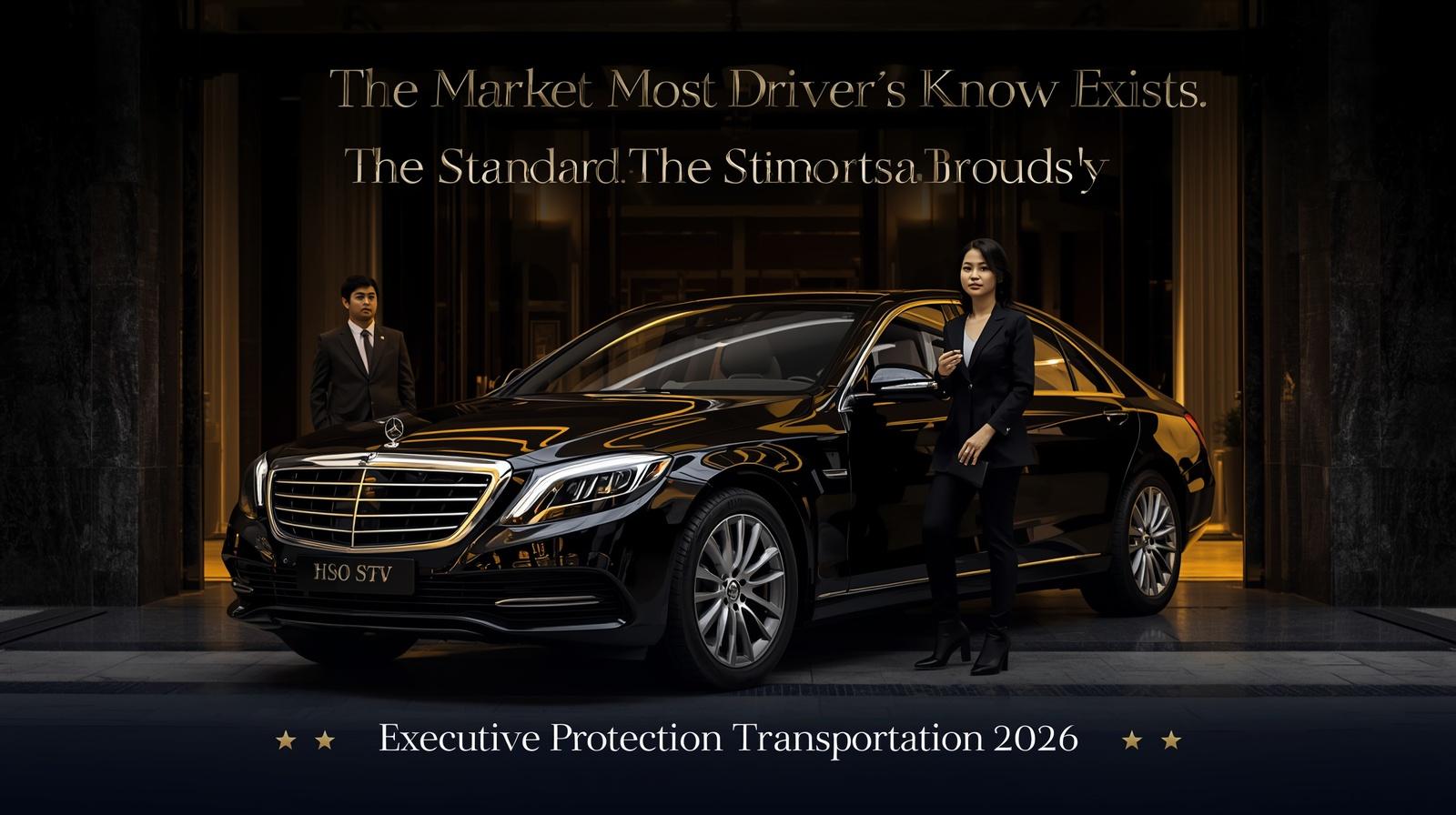
The Market Most Drivers Never Know Exists — And the Standard It Demands
There is a tier of transportation service that operates entirely outside the rideshare ecosystem.
No platform. No algorithm. No surge pricing. No anonymous passenger assigned by an app.
Just a private client, a trusted driver, and a professional relationship built on a level of discretion, competence, and personal security awareness that the standard rideshare market never requires and almost never develops.
This is executive protection transportation — the provision of secure, professional ground transportation to high net worth individuals, corporate executives, celebrities, dignitaries, and others whose security, privacy, and professional reputation demand a standard of service that no platform-based solution can reliably provide.
The market is real. The demand is consistent. The income is among the highest available to any independent transportation professional. And the barrier to entry is not the vehicle, the license, or the connections.
It is the standard.
A standard that requires specific knowledge, specific training, specific personal qualities, and a specific professional identity that most drivers have never been asked to develop — not because they are incapable of it but because nobody has ever told them it exists or explained what it actually requires.
This is that explanation.
What Executive Protection Transportation Actually Means
The term executive protection covers a spectrum of service levels that range from sophisticated professional driving to full security detail coordination. Understanding where independent transportation professionals can realistically operate within that spectrum — and where licensed security professionals are required — is the foundation of a legitimate entry into this market.
Secure Transportation — The Independent Driver's Entry Point
At the entry level of executive protection transportation the service is fundamentally professional driving with a heightened security awareness and a significantly elevated personal and professional standard.
The corporate executive who needs reliable, discreet airport transfers while visiting a city. The high net worth individual who wants a trusted driver for private events and personal travel. The celebrity who needs transportation that prioritizes privacy and professional conduct over everything else. The visiting dignitary whose schedule requires precise, coordinated ground transportation without the unpredictability of platform-based services.
These clients do not always require an armed security professional or a full protective detail. They require a driver who understands their security needs, who exercises genuine discretion about their movements and communications, who is alert to their environment in ways that standard drivers are not, and who can be trusted completely with the access to their personal and professional life that a private transportation relationship provides.
This level of service is entirely accessible to independent transportation professionals who invest in the knowledge, training, and professional development that it requires.
Full Executive Protection Detail — Where Licensing Requirements Apply
At the higher end of the spectrum — protective details for principals facing genuine physical security threats, transportation in high-risk environments, armed security driving — the requirements extend well beyond transportation skills into licensed security professional territory.
Most states require a private security license or armed guard certification for professionals who provide protective services beyond pure transportation. Drivers who want to operate at this level need to research their specific state's licensing requirements and complete the required training and certification before offering these services.
This article focuses primarily on the secure transportation entry level — where independent drivers with the right training and professional standard can legitimately and lucratively operate. For drivers who want to advance into the full executive protection tier the professional pathway is clear and the career development resources are extensive — but they start with the foundation described here.
The Clients Who Use Executive Protection Transportation
Understanding who uses this service — and why they use it — is what allows a driver to position themselves correctly and communicate their value proposition convincingly to the right prospects.
Corporate Executives and C-Suite Travelers
Senior corporate executives — CEOs, CFOs, board members, and senior partners at major professional services firms — travel extensively and often carry schedules and communications that make platform-based transportation genuinely problematic from a business security perspective.
A conversation taken in the back of an Uber about a pending merger, an acquisition target, or a boardroom conflict is a conversation that was overheard by an anonymous stranger. Most executives accept this risk because they have no better option available or because they have not thought carefully about the alternative.
The driver who presents themselves as a professional with specific expertise in executive transportation discretion — who can articulate what confidentiality means in practice, what it means for a driver to be trusted with sensitive communications they will overhear — offers something the platform cannot.
Corporate executives who find and trust a private transportation professional typically become among the most loyal and highest-value clients available. Their travel is consistent, their schedules are predictable, their expense accounts are real, and their professional network is full of other executives with identical transportation needs.
High Net Worth Individuals and Family Offices
High net worth individuals — those with investable assets typically in the $10 million or above range — often have professional family office relationships that manage their personal affairs including transportation arrangements. These family offices actively seek trusted transportation providers for their principals and are willing to pay premium rates for drivers who meet the standard their clients require.
The family office contact is among the most valuable professional relationships an executive transportation driver can build — because a single family office manages the transportation needs of a principal whose schedule may generate dozens of rides per month and whose referral within their professional network can produce multiple additional high-value clients.
Celebrities and Entertainment Industry Principals
Entertainment industry clients — recording artists, actors, producers, and other high-profile individuals — have transportation needs that prioritize privacy and discretion above almost every other consideration.
The paparazzi problem is real for many entertainment industry clients — a driver who inadvertently or deliberately reveals a client's location, schedule, or movements has committed a professional breach that ends the relationship immediately and permanently. A driver who maintains absolute discretion about their clients — who can be trusted never to discuss, post about, or reveal any detail of a client's transportation — becomes invaluable to entertainment industry clients who have been burned by less discreet service providers.
Political and Diplomatic Figures
Local, state, and national political figures — elected officials, senior government staff, foreign diplomats visiting the market — have transportation needs that combine security awareness, schedule discretion, and professional conduct in the specific context of political and diplomatic activity.
This client category typically involves more formal vetting and relationship development than corporate or entertainment clients — often requiring established relationships with security personnel, advance teams, or professional networks in the political and diplomatic community. The barrier to entry is higher but the relationships, once established, are among the most stable available.
Legal and Medical Professionals
Senior partners at major law firms and prominent medical professionals have transportation needs that specifically require confidentiality around client and patient information that may be discussed during transit. A driver trusted with the conversations that happen in the back of a car between a lawyer and their client — or a physician and a colleague — has established a professional standard that generates referrals within the legal and medical communities at significant rates.
The Non-Negotiable Standard — What High Net Worth Clients Actually Require
Here is the honest truth about executive protection transportation that most guides avoid stating directly.
The majority of drivers who express interest in serving high net worth clients are not ready to serve them. Not because of their vehicle or their license or their location. Because the personal and professional standard that these clients require is genuinely different from the standard that produces five-star ratings on the platform — and most drivers have never been asked to develop it.
Understanding this standard completely — and honestly assessing your readiness to meet it — is the prerequisite for every other element of breaking into this market.
Discretion as a Professional Discipline
Platform rideshare drivers are occasionally discreet. Executive protection transportation drivers are always and completely discreet by professional discipline — not as a courtesy but as a non-negotiable operational standard.
Complete discretion means never discussing a client's identity, location, destination, schedule, or any overheard communication with any person under any circumstances. Never posting on social media about clients or rides even without using names. Never acknowledging to anyone that you work for a specific client. Never confirming or denying a client relationship even to people the client knows.
This level of discretion is not natural for most people. It is a professional discipline that requires conscious development and consistent practice. Drivers who have not explicitly trained themselves in this discipline will breach it eventually — not maliciously but through the casual social sharing that feels harmless and is not.
Situational Awareness Beyond Normal Driving
Executive protection transportation drivers maintain active environmental awareness that goes significantly beyond normal safe driving practices.
This means noting vehicles that follow the client's route for multiple turns. Identifying unusual activity near pickup and dropoff locations before the client exits the vehicle. Being aware of the exits and alternative routes from every location the client visits regularly. Recognizing the difference between ambient crowd behavior and behavior that is specifically oriented toward the client.
This situational awareness is not paranoia. It is a professional skill that can be developed through specific training — and that makes a meaningful difference to clients who have genuine security concerns regardless of whether those concerns ever materialize into actual incidents.
Absolute Schedule Reliability
For platform rideshare drivers being five minutes late is an inconvenience. For executive protection transportation clients being five minutes late can have consequences — missed flights, missed meetings, damaged professional relationships, or genuine security exposure from unplanned location changes.
The reliability standard in executive protection transportation is not on time. It is consistently early — present and ready before the client needs to move, with enough time to assess the pickup environment and ensure everything is in order before the client exits their building.
Drivers who are not completely reliable at this standard should not represent themselves as executive protection transportation providers. One late pickup at the wrong moment ends a high-value client relationship permanently.
Professional Appearance Without Exception
The professional appearance standard for executive protection transportation is strict, consistent, and non-negotiable.
Professional dark clothing — a dark suit, blazer, or at minimum a dark professional jacket — for every client interaction without exception. No casual clothing regardless of the time of day, the nature of the trip, or the weather. The appearance that communicates professional competence and respect for the client's status every single time.
This standard extends to grooming, to the condition of the vehicle, and to every physical element of the professional presentation. High net worth clients notice every detail — and a detail that communicates casual effort rather than professional excellence signals a mismatch with the standard they expect.
Communication Precision
Executive protection transportation drivers communicate with precision — specific, confirmed, professional. Not "I'm nearby," but "I am at the north entrance of the building on Fifth Avenue, positioned beside the second column from the left, available to move immediately."
This precision is what allows clients and their security teams to coordinate movements efficiently and confidently. Vague communication creates uncertainty that experienced security-conscious clients find uncomfortable and eventually unacceptable.
The Vehicle Standard for Executive Protection Transportation
The vehicle requirements for executive protection transportation are strict and completely non-negotiable for any driver who wants to be taken seriously in this market.
Minimum Vehicle Requirements
A late model — typically within the past five years — luxury sedan or full-size SUV in black or dark navy. The most commonly used vehicles in executive protection transportation are the Mercedes-Benz S-Class, the BMW 7 Series, the Cadillac Escalade ESV, the Suburban in black car configuration, the Lincoln Navigator, and the Genesis G90.
The vehicle must be in pristine mechanical and cosmetic condition — zero visible damage, zero interior wear, zero odors, zero anything that communicates the vehicle's previous passengers or use.
Tinted windows — within legal limits for your specific state — are standard in executive protection transportation for the obvious privacy benefit they provide to clients who do not want their presence in the vehicle to be visible from outside.
Vehicle Equipment Beyond Standard
Partition or privacy screen: Not universally required but valued by many executive clients who conduct sensitive communications during transit and prefer a physical privacy barrier between the passenger compartment and the driver.
Redundant navigation: A primary navigation system plus a backup option. Navigation failure during a time-sensitive executive transfer is a professional failure that cannot be excused.
Communication equipment: A hands-free communication system that allows the driver to communicate with clients, security teams, and advance personnel without taking attention from the driving environment.
Emergency equipment: A professional medical kit, emergency contact information for the client, and documented knowledge of the nearest emergency medical facilities along every regular client route.
Privacy protection for the vehicle: Window treatments or portable privacy options for situations where the vehicle must be parked in exposed locations for extended periods with the client inside.
The Training and Certification Pathway
Professional credibility in executive protection transportation is built on specific training that demonstrates competence in the specific skills this market requires. This training is not optional for drivers who want to be taken seriously by high net worth clients and their professional teams.
Defensive and Evasive Driving Training
Advanced driving courses that teach defensive and evasive driving techniques — the skills required to respond to unexpected security situations while maintaining passenger safety — are the most directly relevant training investment for executive transportation drivers.
Courses worth pursuing:
The Bob Bondurant School of High Performance Driving offers executive protection driving programs that are recognized by professional security teams and corporate security directors. The Skip Barber Racing School offers similar programs with executive transportation applications. Regional driving academies in many major cities offer one and two day executive driving programs at price points of $500 to $2,000 that are accessible to independent drivers serious about this market.
Security Awareness Training
Understanding the fundamentals of personal security — threat assessment, surveillance detection, route planning, venue assessment, and emergency response coordination — without crossing into the licensed security professional territory that requires specific state certification.
Resources:
The ASIS International — the American Society for Industrial Security — offers training programs specifically designed for professionals who work adjacent to the security industry. The Certified Protection Officer program provides a recognized credential that demonstrates security awareness competency without requiring a full private security license.
Online courses through platforms like Udemy and Coursera offer security awareness fundamentals at accessible price points for drivers who want to demonstrate a baseline of professional security knowledge to prospective clients.
First Aid and Emergency Response
CPR and first aid certification is standard for executive protection transportation drivers — and the more advanced Wilderness First Aid or Emergency Medical Responder certification demonstrates a level of emergency preparedness that genuinely differentiates serious professionals from casual entrants.
A client who experiences a medical emergency in the vehicle with a driver who is trained and equipped to respond appropriately has experienced a level of professional care that generates loyalty and referral that no amount of marketing can produce.
EVOC — Emergency Vehicle Operations Course
Originally designed for law enforcement and emergency services, EVOC training is increasingly pursued by executive protection transportation professionals as a credential that demonstrates advanced vehicle control capability. Several private driving schools offer civilian versions of EVOC training that produce a recognized completion certificate without requiring law enforcement affiliation.
Building Your Executive Transportation Business — The Professional Pathway
Establishing Your Professional Identity
Executive transportation clients and their teams will investigate a driver before establishing any relationship. Your professional identity needs to withstand that investigation and communicate the specific standard these clients require.
Your RSG profile at rideshareguides.com is the professional foundation — a verified driver identity with your credentials, your training, your vehicle details, and your service standards clearly presented. For executive transportation clients update your RSG profile to specifically highlight your security awareness training, your defensive driving certification, your first aid credentials, and your specific service philosophy around discretion and client privacy.
A LinkedIn profile that presents your executive transportation services professionally — with specific mention of your training credentials, your service standard, and the client categories you serve — reaches the corporate and professional networks where executive transportation referrals originate.
The Entry Point — Luxury Platform Tiers
The most accessible entry point into executive transportation for drivers who are building toward private client relationships is the luxury tier on standard platforms — Uber Black and Lyft Lux Black — where the client profile is significantly closer to the executive market than standard platform tiers.
Luxury platform rides produce direct client conversion opportunities because the passenger profile — corporate travelers, high net worth individuals traveling for personal reasons, entertainment industry principals — matches the private executive transportation client profile. A driver who delivers executive-standard service on a luxury platform ride and makes themselves available for direct booking is in the same position as any other direct booking conversion opportunity — except the value of the conversion is dramatically higher because the client type is dramatically more valuable.
Corporate Security Director Relationships
The most direct route to consistent executive transportation work is a professional relationship with corporate security directors at major companies in your market. Corporate security directors are responsible for the safety of their organization's senior leadership during travel — and they maintain vendor relationships with transportation providers they trust.
A professional introduction to a corporate security director — through a mutual professional contact, through a referral from another security industry professional, or through direct outreach with a complete professional profile and training credentials — is the highest-value business development activity available to an executive transportation driver.
Personal Security Firms and Executive Protection Agencies
Personal security firms that provide full protective detail services to high net worth individuals regularly need vetted, trusted transportation professionals who meet their clients' standard but who do not hold security licenses — allowing them to fill transportation roles that do not require armed security personnel at lower cost while maintaining the professional standard.
A professional relationship with one or two established personal security firms in your market can provide consistent executive transportation work without requiring the independent business development effort that building private client relationships demands.
Hotel Concierge and High-End Hospitality Relationships
Five-star and luxury boutique hotel concierges maintain relationships with transportation providers who meet the standard their most important guests require. A hotel concierge whose VIP guest needs transportation that goes beyond standard black car service — that requires specific security awareness, specific discretion, and specific vehicle standards — thinks of the trusted professional they know can deliver that standard.
Building these relationships through the same professional introduction approach described throughout this guide — and specifically communicating your executive transportation training and standard rather than presenting yourself as a standard black car driver — positions you correctly for the specific referral these relationships generate.
The Income Reality of Executive Transportation
Executive transportation income looks different from platform rideshare income — and understanding the difference is important for drivers evaluating whether the investment in training and professional development is financially justified.
Per-ride rates: Executive transportation rates for direct private clients typically range from $150 to $500 per transfer for standard airport and event runs — compared to $30 to $90 for luxury platform rides. The premium reflects the specific standard of service, the security awareness, the client relationship, and the complete discretion that platform-based alternatives cannot provide.
Retainer arrangements: Many executive transportation clients prefer monthly retainer arrangements — a fixed monthly fee for a guaranteed level of service availability. Retainers for senior corporate executive accounts typically range from $2,000 to $8,000 per month depending on the frequency of transportation needs and the level of service required.
Hourly engagement rates: For clients who need a driver for extended periods — a full business day, a multi-day visit, an event requiring all-day availability — hourly rates of $75 to $200 per hour are standard in the executive transportation market.
The income trajectory: An independent driver who builds three to five executive transportation client relationships — two corporate accounts, one high net worth individual, one entertainment industry client — can realistically generate $8,000 to $15,000 per month in direct executive transportation income. This income does not depend on surge pricing, platform algorithms, or bonus structures. It depends entirely on the quality of the professional relationships and the consistency of the service standard.
The Mindset That This Market Requires
Here is the perspective that separates drivers who successfully enter the executive transportation market from those who approach it as an income opportunity rather than a professional calling.
High net worth clients are not buying a transportation service. They are buying a trusted professional relationship. The distinction is everything.
A transportation service can be replaced by any other transportation service that provides equivalent mechanical function — getting from point A to point B in a clean vehicle. A trusted professional relationship cannot be replaced by anything — because the trust was built through specific shared experiences, demonstrated reliability, and proven discretion that took time and excellence to establish.
Drivers who approach executive transportation as a premium income tier within the rideshare business framework are approaching it from the wrong direction. Drivers who approach it as the development of a specific professional identity — a transportation professional whose personal standard, security knowledge, and commitment to client service creates relationships that cannot be algorithmically replicated — are approaching it correctly.
The income follows the relationship. The relationship follows the standard. The standard follows the mindset.
Your Executive Transportation Action Plan
This week: Research defensive driving courses available in your market. Identify one course — a one or two-day executive driving program — that produces a recognized completion certificate. Schedule it for the next 30 to 60 days.
This week: Complete a CPR and first aid recertification if your current certification has lapsed. Research Emergency Medical Responder courses in your area as a next-level credential worth pursuing.
This week: Update your RSG profile at rideshareguides.com and your LinkedIn profile to specifically present your executive transportation service standard — your training credentials, your discretion philosophy, your vehicle standard, and the client categories you serve.
This month: Identify the luxury hotel concierges, corporate security directors, and personal security firms in your market. Research one professional introduction opportunity for each category.
This month: If your current vehicle does not meet the executive transportation standard research the specific upgrade that would qualify your vehicle for this market. Apply the total cost of ownership framework from the vehicle guide to evaluate the financial case for the upgrade specifically in the context of executive transportation income potential.
This quarter: Complete one advanced driving course and one security awareness training program. Add both credentials to your professional profile. Begin the professional outreach to the corporate security director and luxury hotel concierge contacts identified above.
This year: Build one executive transportation client relationship — one corporate account, one high net worth individual, or one entertainment industry principal — that generates consistent monthly income at executive transportation rates. Let that relationship demonstrate the income potential of the market and the case for investing further in the training and professional development that it requires.
The market most drivers never know exists is waiting for the professional most clients never find.
Be that professional.
Serve at the highest standard. Build the relationships that last. Earn what excellence commands. 🚗🛡️⭐
Comments
Sign in to join the conversation
Sign In