California Drivers Can Now Unionize — What the New 2026 Law Actually Means for You
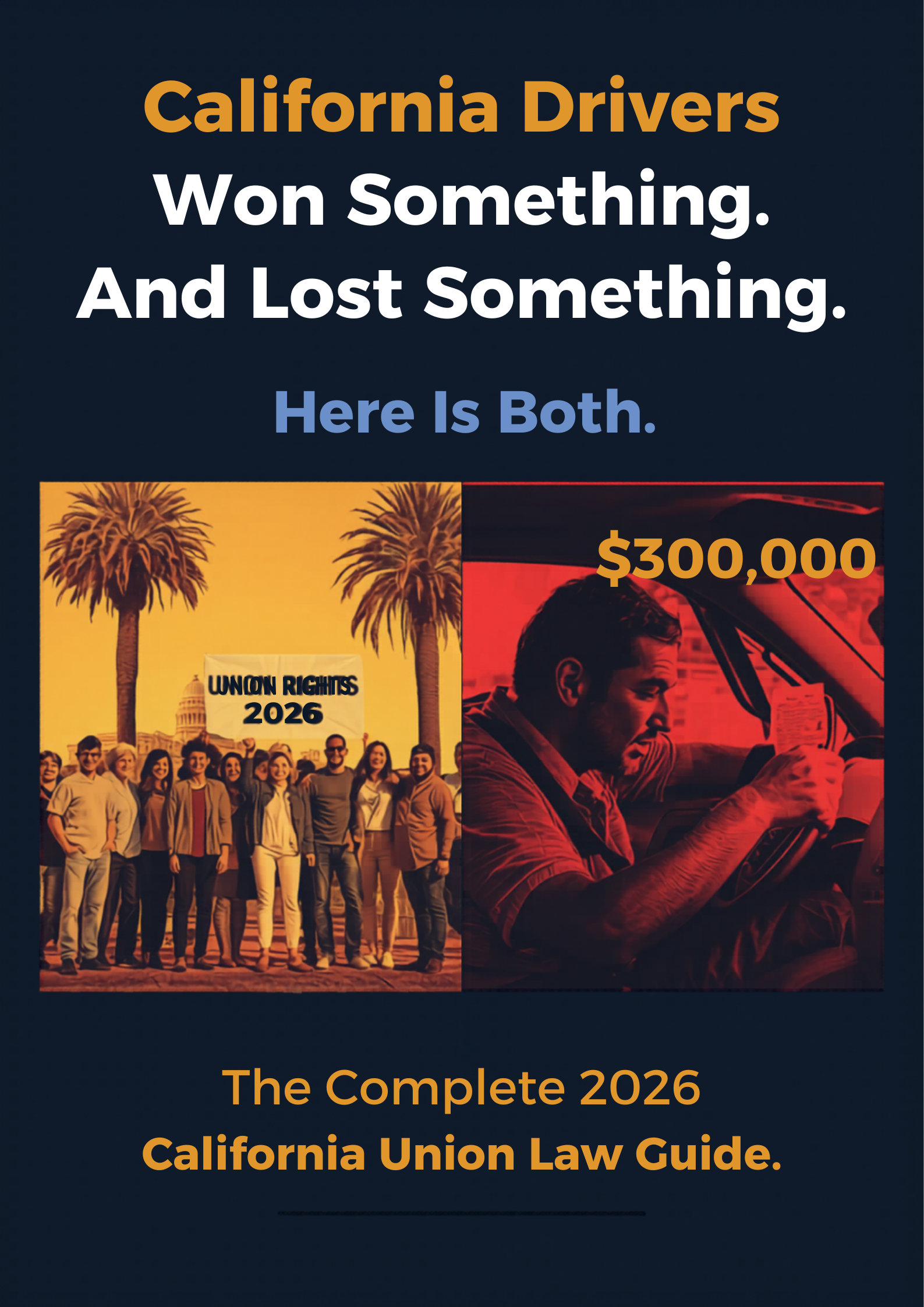
California Drivers Can Now Unionize — What the New 2026 Law Actually Means for You
The Most Significant Legal Change for Rideshare Drivers in Years Came With a Hidden Cost Most Drivers Never Saw Coming
On January 1, 2026 something happened that labor advocates spent years fighting for and that rideshare platforms spent hundreds of millions of dollars trying to prevent.
California's 800,000 rideshare drivers gained the right to unionize. NPR
For drivers who have watched their earnings decline, their deactivation appeals go nowhere, and their safety concerns be dismissed with form letters — this felt like a victory. A genuine, historic, long-overdue recognition that the people who make rideshare work deserve a collective voice in how it operates.
And in many ways it is a victory. The right to organize, to bargain collectively, to have a formal mechanism for addressing the compensation and working condition issues that individual drivers cannot address alone — these are real and meaningful rights that did not exist for California drivers on December 31, 2025.
But here is what most of the coverage of this law never adequately explained.
The victory came with a price.
Not a metaphorical price. A specific, calculable, financially consequential price that was buried in the deal-making and that most California drivers have still never fully understood — a price that may cost some drivers far more than the union rights will ever return.
Uber and Lyft initially opposed legislation expanding union rights to their drivers. But they changed course after striking a deal with labor and lawmakers in August, in which lawmakers agreed to pass another bill aimed at reducing the companies' insurance costs. Senate Bill 371 drastically cuts the amount of insurance companies like Uber and Lyft are required to carry for underinsured drivers. The new law reduces their insurance requirements from $1 million to $300,000 per incident. CapRadio
Read that again.
The platforms agreed to give drivers the right to unionize. In exchange, the platforms received a 70 percent reduction in their mandatory insurance coverage for underinsured drivers — from $1 million per incident to $300,000.
This is the trade that California drivers never got to vote on. This is the tradeoff that the headlines celebrating union rights almost universally failed to explain. And this is the information that every California driver needs to fully understand before they celebrate, before they organize, and before they decide what this law actually means for their specific situation.
This article explains all of it. The union rights — what they actually are, how they actually work, and what it realistically takes to use them. And the insurance reduction — what it actually costs, who it actually affects, and what California drivers need to do right now to protect themselves from the gap it created.
Part One — The Union Rights — What You Actually Gained
What the New Law Actually Provides
Democratic Governor Gavin Newsom brokered the deal between organized labor and major rideshare companies including Uber and Lyft. After Massachusetts voters decided to do so in 2024, California became the second state to extend collective bargaining rights to rideshare drivers. NPR
The law creates a specific legal framework for rideshare driver unionization in California. Understanding exactly what that framework includes — and what it does not include — is essential before any driver or driver community decides how to engage with it.
What the law gives you:
The right to form or join a union without retaliation from the platform. A defined process for union certification — how a majority of drivers in a covered group can formally establish a union that the platform is required to recognize and bargain with. The right to engage in collective bargaining over specific subjects — compensation, certain working conditions, and safety standards. Protection against platform interference with organizing activity.
What the law does not give you:
Employee status. Gig driver companies succeeded in getting an exemption from Assembly Bill 5 after voters passed Proposition 22 in 2020, classifying app-based drivers as independent contractors. CapRadio The new union law does not change that classification. You remain an independent contractor with all the limitations that classification carries — no workers compensation, no unemployment insurance, no employer-sponsored benefits — while gaining the specific collective bargaining right that the new law creates.
The right to strike in the traditional sense. The collective bargaining framework created by this law has specific parameters that differ from traditional union collective bargaining. The agreement reached through bargaining must be approved by drivers through a vote and reviewed by a state agency before taking effect. These procedural requirements add significant time and complexity to the bargaining process.
Guaranteed outcomes from bargaining. The law requires the platform to bargain in good faith — to engage seriously and constructively in the bargaining process. It does not require the platform to agree to any specific terms. A platform that engages in good faith bargaining but ultimately reaches no agreement with the union has technically complied with the law even if no improvement in driver compensation or conditions results.
How the Union Certification Process Actually Works
Understanding the certification process — the specific steps required to establish a recognized union under the new law — is essential because the process is significantly more complex than most coverage of the law has suggested.
Step One — Organizing the Driver Community
A union can be formed among drivers who work in a defined geographic or operational unit — a specific market area, a specific service category, or another defined group. Organizing requires communicating with fellow drivers, building support for the specific union and the specific bargaining agenda, and gathering the authorization cards or votes that demonstrate majority support.
For rideshare drivers whose entire work life is conducted in isolated individual vehicles without a shared physical workplace the organizing process faces specific logistical challenges that traditional union organizing does not encounter. The driver community platforms — local Facebook groups, driver forums, in-person meetups — are the organizing infrastructure that makes rideshare union organizing possible.
Step Two — Demonstrating Majority Support
The certification process requires demonstrating that a majority of drivers in the covered unit support the union. The specific threshold and verification process established by the new law requires current legal guidance — the implementing regulations are being developed and the specific procedural details have continued to evolve since the law's effective date.
Step Three — Platform Recognition or Election
Once majority support is demonstrated the platform either voluntarily recognizes the union — unlikely given the platforms' historical posture toward unionization despite their nominal support for this specific law — or a formal certification election is held. The election process involves the state agency established by the law to administer the collective bargaining framework.
Step Four — Bargaining
After certification the union and the platform enter formal collective bargaining. As noted above this process requires good faith participation but does not guarantee specific outcomes. The timeline from certification to a ratified agreement is measured in months to years in most collective bargaining contexts.
The Existing Driver Organizations You Should Know About
Labor advocates in California have long fought to expand union rights to workers in the state's gig economy. That includes Lorena Gonzalez, president of the California Federation of Labor Unions, who authored Assembly Bill 5 as an Assemblymember in 2019 to reclassify gig workers as employees rather than independent contractors. CapRadio
Several driver advocacy and organizing organizations have been working on rideshare driver rights in California for years and are positioned to help drivers navigate the new law.
The California Gig Workers Union and affiliated organizations connected to major labor federations — SEIU, the Teamsters, and others — have been preparing for this law's implementation and have the organizing infrastructure, legal resources, and bargaining experience that newly organizing driver groups will need.
If you are interested in participating in the union organizing process in California the most productive first step is connecting with the established organizations that have been working on this issue rather than attempting to navigate the complex new legal framework independently.
Part Two — The Insurance Reduction — What You Actually Lost
This is the section that most coverage of the new California union law either skipped entirely or mentioned so briefly that its significance did not register.
It needs to be understood completely.
What the Insurance Reduction Actually Means
Before the new law California required rideshare platforms to carry $1 million in underinsured motorist coverage per incident — insurance that protects drivers and passengers when an at-fault driver in an accident does not have sufficient coverage to pay for the resulting damages.
Senate Bill 371 drastically cuts the amount of insurance companies like Uber and Lyft are required to carry for underinsured drivers. The new law reduces their insurance requirements from $1 million to $300,000 per incident. CapRadio
The reduction is from $1 million to $300,000 — a 70 percent decrease in the platform's required coverage.
To understand why this matters you need to understand what underinsured motorist coverage actually does in a rideshare accident scenario.
When a rideshare vehicle is involved in an accident caused by another driver — a driver who ran a red light, a driver who was drunk, a driver who was texting — the at-fault driver's insurance is the primary source of compensation for the resulting medical bills, lost income, and pain and suffering. When that at-fault driver's coverage is insufficient to cover all the damages — which is common because minimum insurance requirements in most states are far below what serious accidents actually cost — the underinsured motorist coverage kicks in to make up the difference.
In California before January 1, 2026 the platform's $1 million in underinsured motorist coverage was available to bridge that gap. A driver seriously injured by an underinsured at-fault driver could recover up to $1 million from the platform's coverage after exhausting the at-fault driver's policy limits.
After January 1, 2026 that same driver — in the same accident, with the same injuries — has access to only $300,000 in platform underinsured motorist coverage.
When $300,000 Is Not Enough
Consider the specific scenarios where the $700,000 reduction in available coverage produces real financial harm to real drivers.
A rideshare driver is seriously injured in an accident caused by an underinsured driver. The injuries require hospitalization, surgery, and six months of rehabilitation. Medical bills total $180,000. Lost income during recovery totals $35,000. Pain and suffering damages are assessed at $400,000. Total damages: $615,000.
The at-fault driver's minimum liability coverage pays $25,000 — California's minimum liability requirement.
Under the old law the platform's $1 million underinsured coverage bridges the remaining $590,000 gap — the driver receives full compensation.
Under the new law the platform's $300,000 coverage bridges $300,000 of the $590,000 gap — the driver receives $325,000 of a $615,000 claim. They absorb $290,000 in uncompensated damages.
This is not a hypothetical. Rideshare drivers are injured in serious accidents caused by underinsured drivers in California every week. The $700,000 reduction in available coverage is a financial exposure that materializes every time that scenario plays out — and it plays out with genuine regularity in a state where minimum liability coverage is $25,000 and serious accident costs routinely reach six figures.
Who Is Most at Risk From the Insurance Reduction
The drivers most exposed to the practical consequences of the insurance reduction are the ones whose personal insurance coverage does not bridge the gap — which is most drivers.
A driver without supplemental underinsured motorist coverage on their personal policy has no independent coverage layer between the at-fault driver's policy and the platform's now-reduced coverage. If those two sources are insufficient to cover their actual damages the remaining gap becomes an uncompensated personal financial loss.
The drivers least exposed are the ones who carry meaningful personal underinsured motorist coverage on their own policy — coverage that exists independently of what the platform carries and that supplements both the at-fault driver's coverage and the platform's coverage.
Part Three — Protecting Yourself From the Insurance Gap Right Now
This is the most immediately actionable section of this article — the specific steps California drivers need to take now to protect themselves from the financial exposure the insurance reduction created.
Step One — Review Your Current Personal Insurance Coverage
Call your insurance provider this week. Ask specifically for a review of your current underinsured motorist coverage — both the bodily injury and property damage components.
Find out the specific coverage limits you currently carry. Find out whether your policy's underinsured motorist coverage applies when you are driving for a rideshare platform — some personal policies have exclusions that prevent personal coverage from applying during commercial operation periods.
If your personal underinsured motorist coverage is limited or excludes rideshare operation you have an insurance gap that existed before the new law and has become more consequential because of it.
Step Two — Increase Your Personal Underinsured Motorist Coverage
If your current underinsured motorist coverage is below $700,000 — the amount of platform coverage that was eliminated — consider increasing it to bridge the gap.
Underinsured motorist coverage is one of the least expensive coverage components relative to the financial protection it provides. Increasing your underinsured motorist coverage from $100,000 to $500,000 typically adds $10 to $30 per month to a standard auto insurance premium — a cost that is entirely deductible as a business expense for a rideshare driver operating as a self-employed independent contractor.
For a driver who earns $40,000 per year in rideshare income and is in the 22 percent federal tax bracket the after-tax cost of a $25 per month underinsured motorist coverage increase is approximately $18.50 per month. The protection that $18.50 buys in the specific accident scenario described above is $400,000 in coverage that is no longer available from the platform.
Step Three — Confirm Your Rideshare Endorsement Covers All Periods
As covered in the insurance article earlier in this series California has specific rideshare insurance regulations that differ from most other states. The rideshare endorsement or commercial policy that provides coverage during Period One — app on, no ride accepted — needs to specifically address the new insurance landscape and the reduced platform coverage during Periods Two and Three.
Have your insurance agent confirm specifically that your personal coverage — including any supplemental underinsured motorist coverage you add — applies during all rideshare operating periods and coordinates correctly with the platform's now-reduced coverage.
Step Four — Document This Coverage Change for Direct Booking Clients
For California drivers who have established direct booking corporate accounts and professional transportation relationships the insurance reduction is information that clients have a legitimate interest in knowing about.
A corporate travel manager who built a vendor relationship with you partly on the basis of your professional insurance coverage needs to know that the platform's underinsured coverage has changed — because their risk assessment of the vendor relationship included that coverage as a component.
Proactively communicating this change — along with the specific steps you have taken to maintain your coverage adequacy through personal supplemental coverage — demonstrates the professional transparency that builds rather than erodes corporate client trust.
Part Four — The Realistic Assessment — What This Law Actually Changes for California Drivers
Here is the honest, balanced assessment that most coverage of this law has not provided.
What Is Realistically Likely to Change
The new union rights create a legal mechanism for collective action that did not previously exist. That mechanism is genuinely valuable — in the long term.
The specific outcomes that are realistically achievable through collective bargaining under this law — over a multi-year horizon — include modest improvements in minimum pay standards, more transparent deactivation appeal processes, stronger safety reporting requirements, and potentially expanded benefits contributions from the platforms.
These outcomes are not guaranteed. They require successful organizing, successful certification, and successful bargaining — each of which is a significant undertaking with uncertain results. But the legal pathway for achieving them now exists in California in a way it did not before.
What Is Realistically Unlikely to Change
Employee classification. The law explicitly preserves independent contractor status. Any improvement in driver conditions achieved through collective bargaining under this law occurs within the independent contractor framework — not through reclassification as employees.
Rapid improvement in earnings. The bargaining process — organizing, certification, negotiation, ratification, state agency review — takes years to produce a ratified agreement. Drivers who have watched earnings decline significantly — David Crane, a Chicago-area rideshare driver, said he now earns about half of what he made when he started driving in 2018 despite spending far more time on the road — need income improvement faster than the collective bargaining timeline realistically produces. Block Club Chicago
This is not an argument against organizing. It is a realistic timeline assessment that should inform how California drivers balance their engagement with the new union rights against the immediate income strategies that can produce results now rather than in two to three years.
The Direct Booking Business As the Parallel Strategy
Here is the perspective that connects the new union rights to the direct booking business development that runs through every article in this series.
The union rights create a collective mechanism for addressing the platform relationship. The direct booking business creates an individual mechanism for reducing dependence on the platform relationship. Both are legitimate and complementary responses to the same underlying structural problem — the platform's current ability to set rates, deactivate accounts, and change terms without meaningful constraint.
A California driver who builds a direct booking client base through RSG at rideshareguides.com while simultaneously participating in union organizing is pursuing both paths simultaneously — improving the platform relationship through collective action while reducing dependence on the platform through individual client development.
The union bargaining timeline is measured in years. The direct booking income timeline is measured in months. Both matter. Neither alone is sufficient.
The Broader Context — What California's Law Means for the Rest of the Country
California's new union law does not apply to drivers outside California. But California's legislative decisions on rideshare driver rights have historically influenced — sometimes directly and sometimes through the competitive pressure they create — what happens in other states.
After Massachusetts voters decided to do so in 2024, California became the second state to extend collective bargaining rights to rideshare drivers. NPR
Illinois drivers are pushing for state legislation creating a pathway for unionization and collective bargaining statewide. The bill would create a state-level legal framework allowing rideshare drivers to unionize and bargain with app-based companies over pay, benefits, and working conditions. Block Club Chicago
The legislative momentum toward some form of rideshare driver collective bargaining rights is real and growing. The specific terms — what the union rights include, what they exclude, what the platforms receive in exchange — will vary by state and will reflect the specific political dynamics and platform negotiating positions in each market.
For drivers outside California the relevant lesson from California's experience is not just what the law provides but how the deal was made — specifically that the platforms will negotiate union rights more readily than they have historically suggested when the exchange involves something they specifically value. In California what they valued was the insurance reduction. In other states the exchange terms will be different.
Understanding what the platforms are likely to offer and what they are likely to request in exchange for union rights is the intelligence that state-level organizing efforts need — and California's experience provides the clearest real-world example available.
Your Action Plan — California Drivers
This week: Review your personal auto insurance policy specifically for underinsured motorist coverage limits and rideshare exclusions. This is the most immediately important action created by the insurance reduction — and the one with the most direct financial consequence if the coverage gap is not addressed before an accident occurs.
This week: Call your insurance agent and ask specifically about increasing your underinsured motorist coverage to compensate for the platform's reduced $300,000 limit. Get a specific quote for increasing to $500,000 or $700,000 in personal underinsured motorist coverage. The monthly cost is almost certainly lower than you expect and is fully tax-deductible as a business expense.
This month: Research the driver organizing organizations currently active in your California market. Understand what organizing activity is underway, what the specific bargaining agenda is, and what participation in the process involves. Make an informed decision about whether and how to engage rather than either reflexively joining or reflexively dismissing the opportunity.
This month: Assess your current income distribution — what percentage comes from platform rides versus direct bookings versus other transportation services. The union rights improve the platform relationship over a multi-year horizon. The direct booking business improves your income immediately. The most financially resilient California driver in 2026 is building both simultaneously.
Ongoing: Stay informed about the specific regulatory developments implementing the new law. The state agency responsible for administering the collective bargaining framework is developing the specific procedures, timelines, and requirements that govern how the law actually operates in practice. These details matter and they are still being determined.
The new law is simultaneously a genuine victory and a complicated tradeoff. Treating it as only one or the other — pure victory or pure betrayal — misses the complexity of what California drivers actually gained and actually lost on January 1, 2026.
Understanding the complexity is what allows you to make the decisions that serve your actual interests — as an individual driver, as a business owner, and as a member of a professional community that is navigating one of the most consequential periods in rideshare history.
Know the law. Understand the tradeoff. Protect yourself completely. 🚗⚖️🌴
Sonnet 4.6
Comments
Sign in to join the conversation
Sign In