Best Cars for Rideshare Driving in 2026 — The Honest Financial Comparison Every Driver Needs
Every Car Review for Rideshare Drivers Gets This Wrong. Here Is the One That Gets It Right.
Search for the best rideshare car online and you will find the same article written a hundred different ways.
Fuel efficient. Comfortable back seat. Good reliability ratings. Approved for Uber and Lyft. Maybe a hybrid option for the environmentally conscious driver. A list of five to ten vehicles with star ratings and a vague recommendation to consider your budget.
What you will not find is the honest math.
Not the sticker price. Not the monthly payment. The actual total cost of operating that specific vehicle as a rideshare car for 40,000 to 60,000 miles per year over three to five years — including depreciation, fuel, maintenance, insurance, tires, and the specific ways that rideshare use accelerates every single one of those costs beyond what the manufacturer's reliability ratings suggest.
That math is what actually determines whether a vehicle choice makes you money or costs you money over the life of your driving career. And it is almost never the same math that the monthly payment or the fuel economy sticker suggests.
This is the honest version.
The Framework: Why Total Cost of Ownership Is the Only Number That Matters
Most drivers make vehicle decisions based on three numbers — the purchase price, the monthly payment, and the miles per gallon. These three numbers tell you almost nothing useful about whether a vehicle is a good rideshare investment.
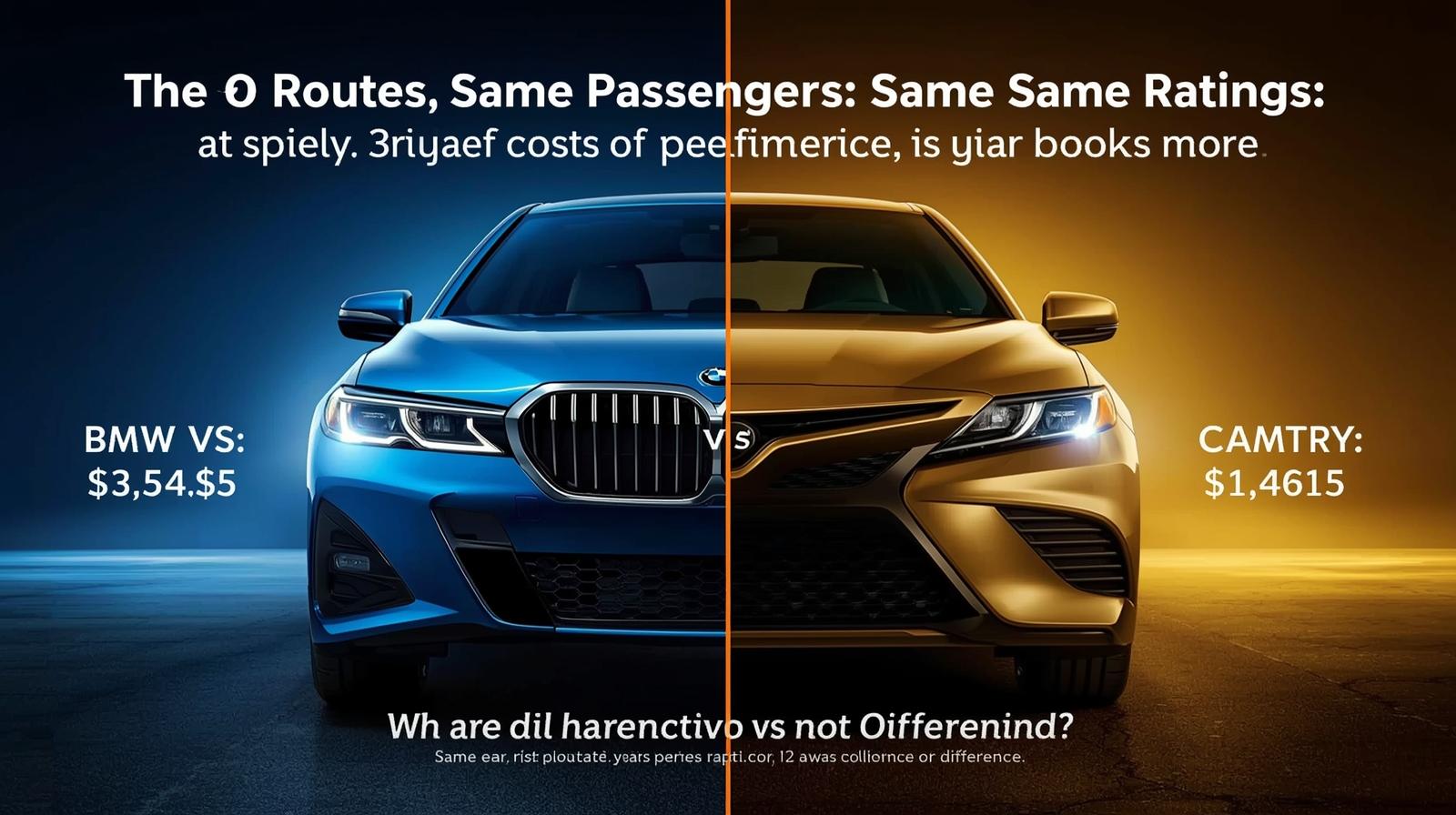
A $45,000 BMW 5 Series with a $750 monthly payment and 28 miles per gallon looks premium and aspirational. A $28,000 Toyota Camry with a $450 monthly payment and 32 miles per gallon looks sensible and boring.
But over three years of full-time rideshare driving the Camry will almost certainly produce $15,000 to $25,000 more in net income than the BMW — not because it earns more per ride but because it costs dramatically less to operate, maintain, and insure while delivering a passenger experience that produces identical ratings.
Total Cost of Ownership — TCO — is the only framework that captures this reality. TCO adds up every dollar spent operating a vehicle over a specified period and divides it by the miles driven to produce a true cost per mile that can be compared honestly across vehicle options.
For rideshare drivers the TCO calculation needs to include seven components.
Depreciation — the loss in vehicle value over the ownership period. For rideshare vehicles this is accelerated significantly by the high annual mileage — a vehicle accumulating 50,000 rideshare miles per year depreciates faster than the manufacturer's standard depreciation curves suggest.
Fuel cost — based on your actual local fuel price and the vehicle's real-world fuel economy in the stop-and-go urban driving that rideshare produces rather than the highway-optimized EPA rating.
Maintenance cost — oil changes, tire rotations, brake service, fluid changes, and the routine maintenance items that rideshare use accelerates beyond normal schedules.
Tire cost — rideshare driving produces tire wear at roughly twice the rate of normal driving due to urban stop-and-go patterns, frequent turns, and the higher total mileage. This is a significant ongoing cost that most vehicle comparisons ignore entirely.
Insurance cost — the rideshare endorsement or commercial policy premium that your specific vehicle and your specific market produces. Luxury and sports vehicles cost significantly more to insure than economy and mainstream vehicles.
Repair cost — beyond routine maintenance, the unexpected repairs that rideshare use generates. This is where vehicle reliability becomes directly financial rather than just quality-of-life relevant.
Financing cost — the total interest paid on a vehicle loan over the ownership period, which for a five-year loan on a $35,000 vehicle at current rates adds $4,000 to $7,000 to the true vehicle cost that never appears in the sticker price conversation.
With this framework established let us run the honest numbers on the vehicles that matter most for rideshare drivers in 2026.
The Vehicles: Honest TCO Comparisons
Toyota Camry — The Benchmark Every Other Vehicle Should Be Measured Against
The Toyota Camry is not the most exciting vehicle on this list. It is the most financially rational one — and in a business where every dollar of operating cost comes directly out of your net income, financial rationality is exactly the quality that matters most.
Purchase price: $27,000 to $32,000 new. $18,000 to $24,000 certified pre-owned 2021 to 2023.
Fuel economy: 28 to 32 mpg in real-world rideshare driving — meaningfully better than most vehicles in its size class.
Reliability: The Camry consistently ranks among the top three most reliable mainstream sedans in independent reliability surveys. For rideshare drivers reliability is not a comfort feature — it is an income protection feature. Every day a vehicle is in the shop is a day of zero income.
Maintenance cost: Toyota's maintenance costs are among the lowest in the industry. An oil change on a Camry costs $40 to $60. Brake service costs $150 to $250 per axle. Major service intervals are longer than European alternatives. A full-time rideshare driver in a Camry should budget $150 to $250 per month for routine maintenance.
Depreciation: Camrys hold their value better than most mainstream vehicles. A 2021 Camry purchased for $26,000 retains approximately $14,000 to $17,000 of value after three years of rideshare use — a depreciation of roughly $9,000 to $12,000 over the period.
Insurance cost: Mainstream and affordable. A rideshare endorsement on a Camry adds $10 to $20 per month to a standard personal policy in most markets.
Passenger experience: Comfortable, quiet, and spacious enough for most passengers. The back seat accommodates average passengers comfortably. The ride quality is smooth enough for a professional service experience. Not luxury — but genuinely comfortable and professional.
Three year TCO estimate for full-time rideshare: $28,000 to $36,000 including all operating costs on a certified pre-owned vehicle. Approximately $0.28 to $0.34 per mile at 40,000 miles per year.
Verdict: The Camry is the financial baseline against which every other vehicle should be evaluated. If a more expensive or more specialized vehicle cannot justify its premium over the Camry's TCO through meaningfully higher earnings the Camry is the right choice.
Honda Accord — The Camry's Equal in a Different Flavor
The Honda Accord competes directly with the Camry across every relevant metric and the honest answer is that neither vehicle is clearly superior for rideshare — they are different expressions of the same financially rational philosophy.
Purchase price: $28,000 to $33,000 new. $19,000 to $25,000 certified pre-owned.
Fuel economy: 29 to 33 mpg in real-world rideshare driving — marginally better than the Camry in some conditions.
Reliability: Comparable to the Camry — consistently near the top of mainstream sedan reliability rankings. Honda's maintenance costs are slightly higher than Toyota's but not significantly.
Passenger experience: The Accord's back seat is marginally more spacious than the Camry's — a meaningful advantage for taller passengers and a talking point in favor of the Accord for drivers who frequently serve business travelers.
Three year TCO estimate: $29,000 to $37,000 — essentially identical to the Camry within the margin of individual market variation.
Verdict: If you prefer the Accord's driving dynamics or passenger space choose it over the Camry without financial guilt. The TCO difference is negligible and either vehicle represents the financially rational mainstream sedan choice for rideshare.
Toyota Prius — The Fuel Economy Champion With a Complicated TCO Story
The Prius is the vehicle most frequently recommended for rideshare driving by people who focus exclusively on fuel economy. The fuel economy advantage is real. The full TCO story is more complicated.
Purchase price: $28,000 to $32,000 new. $18,000 to $23,000 certified pre-owned.
Fuel economy: 52 to 57 mpg in real-world rideshare driving — the best fuel economy of any non-plug-in hybrid in this comparison by a significant margin.
The fuel savings calculation: A driver covering 40,000 miles per year at $3.50 per gallon saves approximately $2,000 to $2,500 per year in fuel costs compared to a Camry. Over three years that is $6,000 to $7,500 in genuine fuel savings.
The complications:
Hybrid battery replacement. The Prius hybrid battery has a lifespan that varies significantly based on usage patterns. High-mileage rideshare use — particularly in hot climates like Florida, Texas, and Arizona — accelerates hybrid battery degradation. A replacement hybrid battery costs $2,000 to $4,000 depending on whether OEM or aftermarket parts are used. Drivers in hot climates should factor at least one battery replacement into their three-to-five year TCO calculation.
Passenger perception. The Prius is not universally appreciated by rideshare passengers — particularly business travelers and premium market clients who may perceive the vehicle as economy class transportation regardless of how clean or well-maintained it is. This perception does not affect standard platform ratings significantly but it does affect the driver's ability to transition into premium direct booking markets.
Ride quality. The Prius ride quality is competent but not premium — a meaningful consideration for drivers who want to build a reputation for comfortable professional transportation.
Three year TCO estimate: $26,000 to $33,000 — genuinely lower than the Camry primarily because of fuel savings, partially offset by higher hybrid component risk in high-mileage use.
Verdict: The Prius is financially superior to the Camry for high-mileage drivers in moderate climates who are not targeting premium markets. For drivers in hot climates or drivers building toward premium direct booking clients the Camry is likely the better long-term choice despite the higher fuel cost.
Toyota RAV4 — The SUV Option That Actually Makes Financial Sense
Most SUVs are financially difficult to justify for rideshare driving because their higher purchase price, lower fuel economy, and higher maintenance costs rarely produce proportionally higher earnings. The RAV4 is the exception.
Purchase price: $29,000 to $36,000 new. $22,000 to $28,000 certified pre-owned.
Fuel economy: 27 to 30 mpg in real-world rideshare driving — acceptable for an SUV.
The earnings premium: The RAV4 qualifies for UberXL and Lyft XL — the larger vehicle tiers that pay meaningfully more per trip than standard sedan tiers. The XL premium varies by market but typically adds 40 to 60 percent to the base fare for the same route. For drivers in markets with consistent demand for larger vehicles — families, groups, airport runs with significant luggage — the XL earnings premium can justify the higher operating cost.
The XL demand question: Before purchasing an SUV specifically for XL rides research your specific market's XL demand. In markets with consistent group travel demand — major tourist destinations, cities with active convention business, markets near major airports — XL demand is sufficient to justify the SUV premium. In markets where XL demand is inconsistent or thin the SUV costs more to operate without producing the earnings premium that justifies it.
Reliability and maintenance: The RAV4 shares Toyota's exceptional reliability reputation and relatively low maintenance costs. It is the only SUV in this comparison where the reliability profile approaches the Camry standard.
Passenger experience: Significantly better than any sedan for passengers with large luggage, families with children, or groups of three or four. The cargo space and the elevated seating position are genuinely appreciated by the passenger categories that book XL rides.
Three year TCO estimate: $35,000 to $44,000 — higher than any sedan option but potentially offset by XL earnings premium in the right markets.
Verdict: The RAV4 is the right choice for drivers in XL-demand markets who want SUV earnings without European reliability risk. In markets where XL demand is insufficient to support the premium it is a more expensive Camry.
Chrysler Pacifica or Toyota Sienna — The Minivan Option Most Drivers Never Consider
The minivan is the most underrated vehicle category in rideshare and the one that produces the most surprised reactions when drivers discover how well the financial case supports it.
Purchase price: Chrysler Pacifica $35,000 to $42,000 new, $22,000 to $30,000 certified pre-owned. Toyota Sienna $38,000 to $48,000 new, $28,000 to $36,000 certified pre-owned.
Earnings premium: Minivans qualify for UberXL, Lyft XL, and in many markets for specific large group or accessibility categories that produce additional earnings premiums. The combination of maximum passenger capacity — seven to eight passengers — and accessibility-friendly features makes minivans uniquely versatile earning platforms.
The accessibility advantage: Minivans — particularly the Chrysler Pacifica Hybrid which is available in wheelchair accessible configuration — open the wheelchair accessible vehicle market which produces some of the highest per-trip rates in the entire NEMT and rideshare ecosystem. A driver with a WAV-configured Pacifica can access platform WAV categories, NEMT broker networks for wheelchair transport, and direct medical facility relationships simultaneously — income diversification that no sedan or standard SUV can match.
Reliability: The Toyota Sienna is the reliability leader in this category — Toyota quality in a minivan platform. The Chrysler Pacifica has a more mixed reliability record but its hybrid version has performed better than the standard version in independent reliability tracking.
Passenger experience: Exceptional for groups and families. The sliding door entry, the flexible seating configuration, and the generous cargo space produce a passenger experience that generates consistent five star ratings from the group and family travel market.
Three year TCO estimate: $40,000 to $55,000 for the Sienna, $32,000 to $45,000 for the Pacifica — justified only for drivers who can consistently access XL rates and ideally who can develop WAV or NEMT income streams that use the vehicle's unique capabilities.
Verdict: The minivan is a niche choice that makes extraordinary financial sense for a specific driver profile — those willing to pursue XL, WAV, and NEMT income simultaneously. For drivers focused purely on standard platform rides it is an expensive way to carry more people than most rides require.
Tesla Model 3 — The EV That Changes Everything Except the Things That Matter Most
The Tesla Model 3 has become the most discussed vehicle in rideshare communities over the past three years and the honest TCO analysis produces results that surprise drivers on both sides of the EV debate.
Purchase price: $40,000 to $50,000 new. $28,000 to $38,000 certified pre-owned 2021 to 2023.
Fuel cost: The Model 3's electricity cost for rideshare driving varies significantly based on whether the driver charges primarily at home on a standard or Level 2 charger versus at public fast chargers. Home charging produces a fuel cost equivalent of approximately $0.03 to $0.05 per mile — dramatically lower than any gasoline vehicle. Public fast charging costs significantly more — in some markets approaching parity with gasoline vehicles at current electricity rates. The EV fuel savings case depends entirely on having reliable and affordable home charging.
The charging time reality: Public fast charging at Tesla Superchargers adds time to a rideshare shift that has no gasoline equivalent. A 20-minute Supercharger stop that adds 150 miles of range is efficient by EV standards and genuinely disruptive to rideshare productivity by driving standards. Drivers who cannot charge primarily at home will find that charging logistics reduce their effective earning hours in ways that partially or fully offset the fuel savings.
Maintenance cost advantage: Electric vehicles have significantly lower routine maintenance costs than gasoline vehicles — no oil changes, no transmission service, no spark plugs. Tesla maintenance costs for rideshare drivers run approximately $50 to $100 per month — meaningfully lower than any gasoline alternative.
The depreciation reality: Tesla vehicles have experienced significant value volatility over the past three years as the company has repeatedly reduced new vehicle prices. A certified pre-owned Tesla purchased today carries residual value uncertainty that no other vehicle on this list matches. Drivers who are financing a Tesla and planning to sell or trade after three years of rideshare use should factor this uncertainty into their financial planning.
Passenger experience: Excellent — the Model 3's interior is premium, quiet, and technologically impressive. Passengers consistently react positively to Tesla pickups and the vehicle produces above-average tip rates in most markets due to the perceived premium experience.
Range anxiety in rideshare: Rideshare driving is range-intensive — constant short trips, frequent stops, climate control running continuously. Real-world rideshare range for the Model 3 standard range is 200 to 220 miles per charge — sufficient for a full shift with careful management and home charging available.
Three year TCO estimate with home charging: $35,000 to $45,000 — competitive with the Camry when home charging is available and fuel savings are fully realized. Without home charging the TCO increases to $40,000 to $52,000 — significantly less competitive.
Verdict: The Tesla Model 3 is financially compelling for drivers with reliable home charging, who drive in markets with good Supercharger coverage, and who are not financing at high interest rates. For drivers without home charging or in markets with expensive electricity the TCO advantage largely disappears.
Honda Civic — The Overlooked Value Leader
The Honda Civic is consistently underrated in rideshare vehicle discussions because its compact size is perceived as a limitation. In most urban rideshare markets that perception does not match the reality of what passengers actually need.
Purchase price: $23,000 to $27,000 new. $16,000 to $21,000 certified pre-owned.
Fuel economy: 32 to 36 mpg in real-world rideshare driving — better than the Camry or Accord.
Reliability: Honda Civic reliability is among the best in any vehicle category — consistently near the top of compact car reliability rankings with maintenance costs that rival or beat the Camry.
The size question: The Civic's back seat accommodates two passengers comfortably and three passengers adequately for most urban trip distances. For solo and dual passenger rides — which represent the majority of standard platform rides in most markets — the size limitation is irrelevant. For airport runs with significant luggage the Civic's smaller trunk is a genuine limitation.
Passenger experience: Modern Civic interiors are significantly more premium than the vehicle's economy positioning suggests. The ride quality is comfortable, the interior materials are respectable, and the overall experience is entirely appropriate for standard platform service.
Three year TCO estimate: $22,000 to $28,000 — the lowest TCO of any gasoline vehicle on this list for drivers who primarily serve solo and dual passenger urban trips.
Verdict: The Civic is the best financial choice for drivers in dense urban markets with limited parking, high fuel costs, and primarily solo or dual passenger traffic. Its limitations matter only for drivers who regularly serve groups or airport runs with heavy luggage.
Lexus ES — The Smart Luxury Entry Point
For drivers building toward premium direct booking markets and luxury platform tiers the Lexus ES represents the most financially rational luxury entry point available in 2026.
Purchase price: $42,000 to $50,000 new. $28,000 to $38,000 certified pre-owned 2020 to 2022.
Fuel economy: 25 to 29 mpg in real-world rideshare driving — acceptable for a luxury vehicle.
The luxury earnings premium: The Lexus ES qualifies for Uber Black and Lyft Lux in most markets — accessing fare rates that are typically 2 to 3 times the standard platform rate for the same route. A driver generating even 50 percent of their rides at luxury rates on a route that normally pays $30 standard receives $60 to $90 instead — a difference that compounds significantly over a full week of driving.
Reliability: The Lexus ES is built on Toyota's mainstream platform with luxury refinements — which means it combines Toyota-level reliability with luxury-level passenger experience. This combination is unique in the luxury category. No European luxury vehicle approaches the Lexus ES reliability record for high-mileage use.
Maintenance cost: Significantly lower than European luxury alternatives. A Lexus ES oil change costs $60 to $90. Brake service costs $200 to $350 per axle. These costs are higher than the Camry but dramatically lower than BMW, Mercedes, or Audi equivalents — which is the entire financial case for the Lexus as a luxury rideshare vehicle.
Passenger experience: Genuinely premium — quiet cabin, smooth ride, high-quality interior materials, and the Lexus brand perception that produces corporate client credibility. Not flashy luxury but refined professional luxury that business travelers and premium direct booking clients find entirely appropriate.
Insurance cost: Higher than mainstream vehicles but lower than European luxury alternatives. Budget an additional $100 to $150 per month over a Camry equivalent for a rideshare-endorsed Lexus policy.
Three year TCO estimate: $45,000 to $58,000 — significantly higher than any mainstream vehicle but potentially offset by luxury earnings premiums for drivers who can consistently access luxury platform tiers and direct booking premium clients.
Verdict: The Lexus ES is the right luxury vehicle choice for drivers who have run the break-even calculation, confirmed their market supports luxury demand, and want the most financially rational path to premium earnings. It is the only luxury vehicle where the reliability profile makes the TCO case work over a full rideshare career.
The Vehicles to Avoid — And Why
European Luxury Vehicles for High-Mileage Rideshare
BMW, Mercedes-Benz, and Audi vehicles are aspirational and they produce genuine luxury earnings premiums. They are also genuinely expensive to maintain at rideshare mileage levels in ways that the luxury earnings premium frequently cannot fully cover.
A BMW 5 Series oil change costs $150 to $200. Brake service costs $600 to $900 per axle. Suspension components, electronic systems, and the general complexity of German engineering all produce repair costs at rideshare mileage levels that shock drivers who made the vehicle choice based on fare premiums without running the full maintenance cost calculation.
The Lexus ES delivers a passenger experience that premium clients find entirely comparable to a BMW or Mercedes at roughly 40 percent of the maintenance cost. For drivers who prioritize financial rationality the European luxury vehicles are hard to justify against the Lexus alternative.
Exception: Drivers who specifically serve clients who request or expect German luxury brands — some corporate accounts have brand preferences — may find that the client relationship value justifies the higher maintenance cost. Run the specific math for your specific client base before dismissing the European options entirely.
High-Mileage Used Vehicles Without Certified Pre-Owned Warranty
The temptation to purchase a used vehicle with high existing mileage at a low price point is understandable and financially dangerous for rideshare use specifically.
A vehicle with 80,000 miles that costs $12,000 looks like a bargain until you factor in that rideshare use will add another 50,000 miles within the first year — pushing the vehicle past the 130,000-mile threshold where many components reach the end of their expected service life simultaneously.
The cost of replacing a transmission, a cooling system, and a suspension component in the same six-month period on a high-mileage vehicle can easily exceed the original purchase price. Rideshare vehicles should have low enough existing mileage that the high annual rideshare mileage accumulation does not immediately push them into high-risk mechanical territory.
Sports Cars and Two-Door Vehicles
Sports cars and two-door vehicles are not approved for most rideshare platform tiers regardless of how comfortable or well-maintained they are. They also produce passenger experience limitations — difficult rear access, limited luggage space, lower ride height — that generate negative reviews from passengers who expected a conventional vehicle.
The Vehicle Decision Framework
Here is a simple framework for making the vehicle decision that is right for your specific situation rather than the generic situation described in most rideshare vehicle guides.
Step One — Define your target market. Standard platform rides only? UberXL and group travel? Luxury platform tiers and direct booking premium clients? NEMT and medical transport? Your target market determines which vehicle categories are even relevant for your evaluation.
Step Two — Run your specific TCO. Use the framework described above with your local fuel prices, your insurance quotes, and the specific vehicle prices in your market. The national averages in this article are starting points — your specific numbers are what matter.
Step Three — Calculate the earnings premium honestly. If a more expensive vehicle accesses higher-earning tiers calculate the actual earnings premium you can realistically expect in your market — not the theoretical premium but the practical premium based on your market's demand for that tier.
Step Four — Compare TCO to earnings premium. Does the additional earnings premium over three years exceed the additional TCO over the same period? If yes the upgrade may make sense. If no the financially rational choice is the lower-TCO vehicle regardless of how aspirational the upgrade feels.
Step Five — Factor in reliability risk. A vehicle that breaks down costs you not just the repair bill but every ride you could not complete during the time it was unavailable. For full-time drivers reliability is a financial variable not just a comfort variable. Weight it accordingly.
Building the Income That Justifies the Vehicle
Here is the dimension of the vehicle decision that most guides never connect to the financial analysis.
The vehicle you choose affects not just your operating costs but your income ceiling — and your income ceiling is not determined solely by which platform tiers you can access.
The drivers generating the highest income from their vehicles in 2026 are the ones who built direct client relationships that produce income the platform never touches. A Camry driver with five corporate direct booking clients who pay $55 per airport transfer is generating more net income than a BMW driver with no direct clients who generates $75 platform fares from which the platform extracts $20 to $25 before the driver sees a dollar.
The vehicle enables the service. The service builds the client relationship. The client relationship creates income independence. RSG at rideshareguides.com is where that client relationship infrastructure gets built — free professional profile, direct booking system, verified credentials that corporate clients and premium passengers expect before they commit to a direct relationship.
The best vehicle for rideshare in 2026 is not the most expensive one or the most fuel-efficient one or the most technologically impressive one.
It is the one that produces the best net income over its operating life in your specific market for your specific client base — with enough reliability to be there every shift and enough comfort to build the passenger experience that converts platform rides into direct booking relationships that belong entirely to you.
Your Vehicle Decision Action Plan
This week: Calculate your current true cost per mile. Add fuel, maintenance, insurance, and a depreciation estimate based on your vehicle's current value versus its likely value in three years at rideshare mileage. Write the number down. This is your benchmark for any vehicle comparison.
This week: Define your target market specifically. Are you building toward luxury tiers and premium direct clients? Are you maximizing volume on standard tiers? Are you pursuing NEMT or XL markets? The answer determines which vehicles are even worth evaluating.
This month: Get insurance quotes for the two or three vehicles you are considering. Use your actual rideshare endorsement or commercial policy requirements. The insurance difference between vehicle options is often larger than expected and always relevant to the TCO comparison.
This month: Research certified pre-owned availability and pricing for your top vehicle options in your specific market. National averages are starting points. Your local market prices are what matter for your specific decision.
This quarter: If the TCO analysis supports a vehicle change make it from a position of financial preparation — with a deductible fund established, a tax account funded, and enough direct booking income to reduce the financial pressure that makes rushed vehicle decisions happen.
The car review that tells you which vehicle is best without knowing your market your target clients your local fuel prices your insurance situation and your income goals is not a car review.
It is a list.
This was the honest version.
Choose the vehicle the math supports. Build the income the vehicle enables. Own the business that outlasts both. 🚗💰
Comments
Sign in to join the conversation
Sign In